
Every trading business eventually has a quiet month where the bills are due and there is a retirement account sitting there with real money in it. The temptation is obvious, and the question that follows is the right one to ask before acting rather than after. Is a sep ira withdrawal taxable has a short answer, yes, and a longer answer that matters far more, because the tax is only the first of two charges and the second one is the reason this decision wrecks more small operations than it rescues.
The short answer, and the account type that decides it
A SEP-IRA is not a separate species of account at withdrawal time. The IRS is explicit that a SEP-IRA "is a traditional IRA and follows the same investment, distribution, and rollover rules as traditional IRAs", which you can read in the agency's SEP plan FAQs.
That one sentence settles the question. Contributions went in before tax and were deducted by the business, the money grew without being taxed along the way, and so the entire withdrawal comes out as ordinary income in the year you take it. Not capital gains, which is the assumption traders most often bring to this and the most expensive one to get wrong. Ordinary income, taxed at your marginal rate, stacked on top of whatever else the business earned that year.
There is no basis to subtract and no favourable rate to apply, unless you made non-deductible contributions, which is unusual in a SEP. The money was never taxed. Now it is.
Is a sep ira withdrawal taxable before 59 and a half, or is there a second charge
There are two charges, and conflating them is where owners underestimate the damage.
The first is ordinary income tax, which applies at any age. The second is an additional tax of 10 per cent that applies specifically to early distributions. The IRS states that individuals "must pay an additional 10 per cent early withdrawal tax unless an exception applies" on amounts withdrawn before reaching age 59 and a half, and that the additional tax is reported on Form 5329. The rule and the exception list are on the agency's page covering exceptions to tax on early distributions.
So the federal cost of an early withdrawal is your marginal rate plus ten percentage points. At a 12 per cent marginal rate the federal bite is 22 per cent. At 22 per cent it is 32 per cent. At 24 per cent it is 34 per cent. At 32 per cent it is 42 per cent. State and local income tax, where it applies, sits on top of all of that.
What a withdrawal actually delivers, with the assumptions on the table
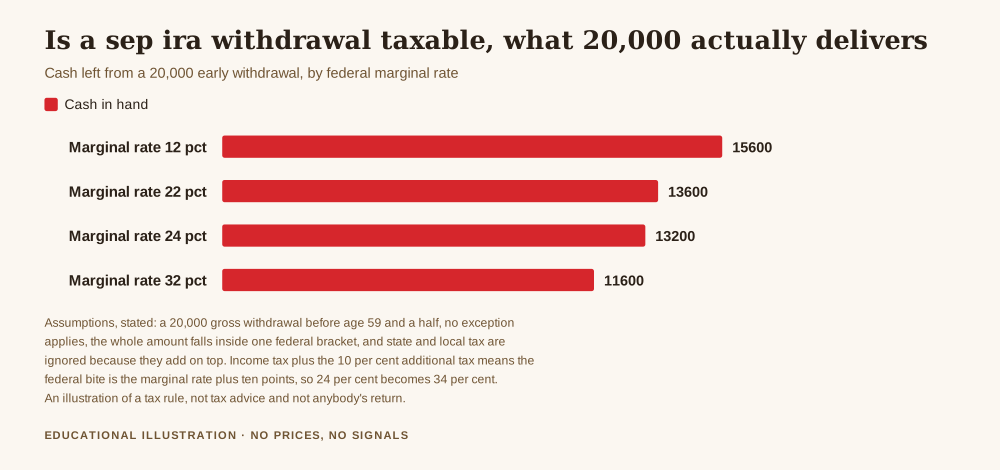
Owners plan around the gross figure and then get surprised by the net, so it is worth doing the arithmetic properly once. I am assuming a 20,000 dollar gross withdrawal taken before age 59 and a half, that no exception applies, that the whole amount falls inside a single federal bracket, and that state and local tax are excluded because they vary. Those assumptions flatter the result, so treat these as the best case.
At a 12 per cent marginal rate, income tax takes 2,400 and the additional tax takes 2,000, leaving 15,600, which is 78.0 per cent of the gross. At 22 per cent, 4,400 plus 2,000 leaves 13,600, or 68.0 per cent. At 24 per cent, 4,800 plus 2,000 leaves 13,200, or 66.0 per cent. At 32 per cent, 6,400 plus 2,000 leaves 11,600, or 58.0 per cent.
Read that as an operating fact rather than a tax fact. If the business needs 13,200 dollars to cover a shortfall and the owner is in the 24 per cent bracket, the business is not withdrawing 13,200. It is withdrawing 20,000 and destroying 6,800 of accumulated capital to deliver it. Any competent owner would at least compare that to the cost of the alternatives before signing.
There is also a timing trap worth naming. The default federal withholding on the distribution is a prepayment, not a settlement. If the withheld amount is less than the eventual liability, the balance is due at filing, which is typically months later and typically when the money is gone. Owners who treat the net cheque as the final answer discover the rest of the bill in April.
The exceptions remove the penalty, not the income tax
The IRS publishes a list of circumstances in which the 10 per cent additional tax does not apply, including reaching age 59 and a half, and a set of specific situations covering death, disability, certain medical costs, qualified higher education expenses, a first home purchase within limits, substantially equal periodic payments, and several others added or expanded over recent years. The current list sits on the same IRS page linked above.
Two things about exceptions are routinely misunderstood. The first is that an exception removes only the additional 10 per cent. The ordinary income tax still applies in full, because the money was never taxed. The second is that qualifying is a matter of meeting a defined condition, not of having a good reason. A genuine cash crisis in your trading business is not on the list. "I needed it" is not an exception.
A separate rule worth knowing if you also run a SIMPLE IRA: distributions taken within the first two years of participation in a SIMPLE plan carry a 25 per cent additional tax rather than 10 per cent.
The cost that does not appear on any tax form
The tax is the visible cost. The invisible one is usually larger, and a business owner should price it.
Take the same 20,000 dollars and assume it stays invested at a constant annual growth rate, with no further contributions and no fees. This is an illustration of compounding, not a projection of any market. At 4 per cent a year it becomes about 29,605 after ten years, 43,822 after twenty, and 64,868 after thirty. At 6 per cent a year it becomes about 35,817 after ten years, 64,143 after twenty, and 114,870 after thirty.
So the owner in the 24 per cent bracket who withdraws 20,000 to receive 13,200 is, on the 6 per cent path with twenty years to run, trading 13,200 now for roughly 64,143 later. Whether that is a bad trade depends entirely on what the 13,200 is for. Covering a genuine solvency gap in a viable business can be worth it. Funding a drawdown recovery is almost never worth it, because it converts a retirement asset into trading capital at a 34 per cent federal haircut and then exposes it to the same process that created the hole.
This is why a trading business needs a cash buffer that is not the retirement account, which is the entire argument in how to build a cash reserve for your trading business. The reserve exists precisely so that a bad quarter never forces a 34 per cent decision.
The ceiling on the way in, which sets the stakes
It helps to know what the account can absorb, because that is what you are giving up the capacity to rebuild. For 2026 the SEP contribution limit is the lesser of 25 per cent of the employee's compensation or 72,000 dollars, and the compensation that can be counted is capped at 360,000 dollars. Both figures are published by the IRS on its SEP contribution limits page.
Worked through, 25 per cent of 80,000 of compensation is a 20,000 ceiling, of 150,000 is 37,500, and of 288,000 is exactly 72,000, which is where the dollar cap starts binding. Above that, more compensation does not buy more room.
Two warnings for traders specifically. First, if you are self-employed the 25 per cent is not applied to your headline profit. IRS Publication 560 sets out a separate computation based on net earnings from self-employment after adjustments, and the usable ceiling is lower than the simple percentage suggests. Second, and more fundamental, these limits are expressed in terms of compensation and net earnings from self-employment. Gains from trading your own capital are generally not earned income of that kind, which means many individual traders do not have a contribution base at all without some other qualifying business activity. That is a question for a professional who can see your actual return, and it is worth asking before you build a plan around the account rather than after.
When the decision stops being yours
At the other end, withdrawals become compulsory. Required minimum distributions from traditional, SEP and SIMPLE IRAs and retirement plan accounts generally begin in the year the owner reaches age 73, with the first one allowed to be deferred to 1 April of the following year, per the IRS required minimum distributions FAQs.
Deferring that first distribution is not free, because it stacks two taxable distributions into one calendar year, which can push the total into a higher bracket. For a business owner that is a planning item with a known date attached, which makes it one of the easier ones to get right.
How a trading business should actually handle this
Treat the retirement account as what it is on the balance sheet: a long dated asset with a withdrawal penalty, not a line of credit. Three operating rules follow from the arithmetic above.
Write down, in advance, the circumstances under which you would touch it, and make a cash shortfall during a losing run explicitly not one of them. Decisions made during a drawdown are the worst decisions the business makes, which is why this belongs in the plan rather than in the moment. Keep the operating reserve separate and sized so that the account is never the first place you look. And when the question does arise, price the full cost: gross withdrawal, income tax, the 10 per cent where it applies, state tax, and the compounding given up, rather than looking only at the cash that lands.
If you are paying yourself from the business at all, the sequencing matters, and how to pay yourself from your trading business covers the order those decisions should be made in. For the records that make any of this defensible, keeping track of day trading for taxes and how long to keep tax records cover the filing side.
Get the free REX one page trading business plan, including the reserve and drawdown lines that decide whether a bad quarter ever forces a decision like this one. One email, no spam, unsubscribe anytime.
Get the free business plan →Frequently asked questions
Is a sep ira withdrawal taxable if I am over 59 and a half?
Yes, as ordinary income. Passing age 59 and a half removes the additional 10 per cent tax on early distributions, it does not make the withdrawal tax free. The contributions were deducted and the growth was untaxed, so the distribution is income in the year it is taken.
Is the withdrawal taxed as capital gains because it was invested?
No, and this is the most expensive misunderstanding in this area. Distributions from a SEP-IRA are ordinary income regardless of how the gains were generated inside the account. The tax treatment follows the wrapper, not the underlying activity.
How much of a 20,000 withdrawal would I actually keep?
On the assumptions set out above, a single bracket, an early withdrawal with no exception and no state tax, roughly 15,600 at a 12 per cent marginal rate, 13,600 at 22 per cent, 13,200 at 24 per cent and 11,600 at 32 per cent. State and local tax reduce each figure further.
Can I avoid the 10 per cent additional tax?
Only by meeting one of the defined exceptions, which cover circumstances such as age, death, disability, certain medical costs, qualified education expenses, a first home within limits and substantially equal periodic payments. Business cash flow is not among them. Any exception removes the 10 per cent only, never the income tax.
Can I fund a SEP-IRA from my trading profits?
Contributions are based on compensation, or on net earnings from self-employment for the self-employed, and gains from trading your own capital are generally not earned income of that kind. Many individual traders therefore have no contribution base without separate qualifying business activity. This is exactly the question to put to a tax professional who can see your return rather than to settle from an article.
When am I forced to take money out?
Required minimum distributions generally begin in the year you reach age 73, with the first able to be deferred to 1 April of the following year. Deferring stacks two distributions into one tax year, which can raise the rate applied to both.
Where this leaves you
The compact answer to is a sep ira withdrawal taxable is that it is ordinary income every time, plus an additional 10 per cent if you are under 59 and a half and no exception fits. That makes the federal cost your marginal rate plus ten points, so a 24 per cent bracket means 34 per cent before any state tax, and a 20,000 withdrawal delivers about 13,200 of usable cash.
The business lesson sits underneath the tax one. An account you can reach for under pressure, at a third off, is a liability dressed as an asset, because the moment you are most likely to reach for it is the moment you can least afford the haircut. Build the reserve that makes the question hypothetical, write the rule before the bad quarter arrives, and the arithmetic above stays a thing you know rather than a thing you paid for. Where that gets written down is the one page trading business plan.
The statement that a SEP-IRA is a traditional IRA following the same distribution rules is from the IRS SEP plan FAQs. The 10 per cent additional tax on distributions before age 59 and a half, the requirement to report it on Form 5329, the exception list and the 25 per cent additional tax within the first two years of a SIMPLE IRA are from the IRS page on exceptions to tax on early distributions. The 2026 SEP ceiling of the lesser of 25 per cent of compensation or 72,000 dollars is from the IRS SEP contribution limits page, the 360,000 dollar compensation cap for 2026 is from the IRS page on contribution limits for defined contribution plans, the separate computation for the self-employed is in Publication 560, and the age 73 starting point for required minimum distributions is from the IRS RMD FAQs. The figures of 2,400, 4,400, 4,800, 6,400 and 2,000 in tax, the net amounts of 15,600, 13,600, 13,200 and 11,600, the percentages of 78.0, 68.0, 66.0 and 58.0, the combined rates of 22, 32, 34 and 42 per cent, the ceilings of 20,000, 37,500 and 72,000, and the compounded values of 29,605, 43,822, 64,868, 35,817, 64,143 and 114,870 were all calculated here from those published rules and the assumptions stated in the text. This article describes United States federal rules only.
REX Trading Signal publishes the daily record with the quiet days and the losing days included, so you can judge a process rather than a highlight reel. The free business plan above is the one page version of the operating rules used here. Following along is free, the Kit is optional, and nothing here promises a profit.
About the author. Rex writes REX Trading Signal for people who want to run an account like a business rather than a hobby, because the operators who last are the ones who wrote the rules down before the market tested them. This is education and not financial, tax or legal advice, tax rules differ by country and change over time, your own circumstances decide what any of this means for you, and no entry, stop or target discussed should be treated as a signal.