

Anyone working out how to start compound trading has usually just seen the spreadsheet. Three percent a month, twelve months, and the final cell is a number that makes you sit back in your chair. I have built that spreadsheet. Most traders I know have built that spreadsheet. It is one of the more expensive pieces of arithmetic in this business, not because it is wrong, but because it is only half of the sum.
Compounding is a genuine force and I am not going to talk you out of it. What I want to do is what any owner does before committing to a growth plan: read the whole model, including the part that is not on the slide. Before anything else, the standing rule here: no entry, stop or target discussed should be treated as a signal.
What compounding actually is, in business terms
Every business faces the same decision at the end of a good period. The money is in the account. Do you take it out, or do you put it back into the operation so the next period runs at a larger scale?
A bakery that reinvests buys a second oven. A haulage firm buys a second lorry. Compounding a trading account is the same decision with a much shorter cycle and one important difference: the second oven cannot lose money. Reinvested trading capital can.
That is the whole subject in one sentence. In a normal business, reinvestment increases capacity. In this one, reinvestment increases both capacity and exposure, in exactly equal proportion, and you do not get to choose one.
The half of the arithmetic that ends up on the slide
Let us do the appealing part properly first, because it is real.
Take a purely illustrative figure of three percent a month. I want to be plain that this is an arbitrary number chosen to demonstrate arithmetic. It is not a target, not a forecast, and not something I am suggesting anyone will achieve.
Withdraw every month and you have collected 36.0 percent of your starting capital over the year. Leave it all in and the account is up 42.6 percent, because each month works on a slightly larger base than the one before. The gap is 6.6 percentage points, and it comes from nothing but leaving the money alone.
Over longer periods that gap widens sharply, which is the whole reason compounding gets talked about. If you want to run the numbers on your own assumptions rather than mine, the SEC's compound interest calculator on Investor.gov does it without selling you anything.
How to start compound trading means first pricing the downside
Here is the half that does not make it onto the slide.
Compounding is not a growth mechanism. It is a multiplication mechanism, and multiplication has no opinion about the sign of what it is multiplying. The same structure that makes a good run larger makes a bad one deeper, and the two are not symmetric.
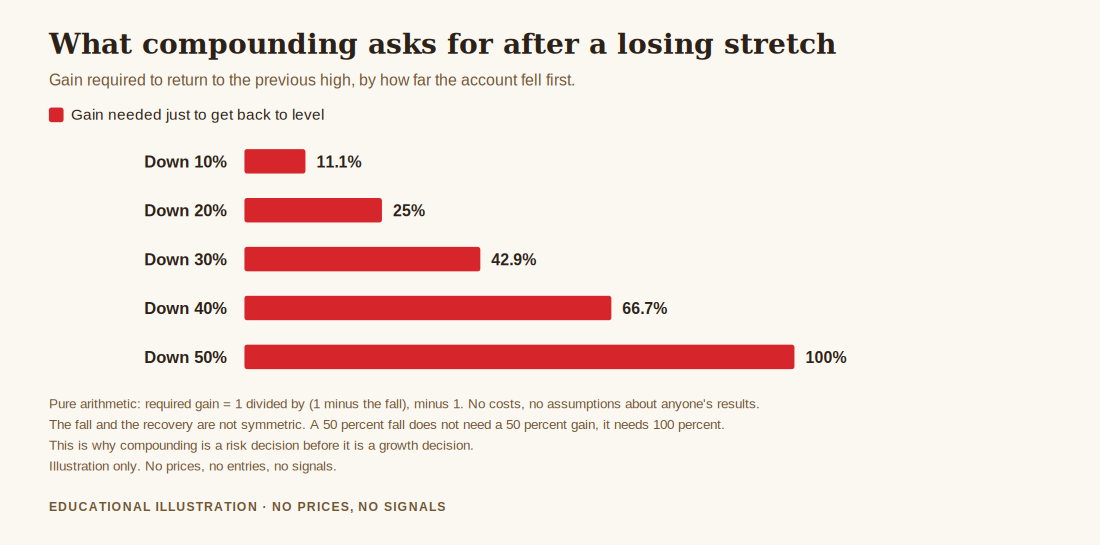
Lose ten percent and you need 11.1 percent to get back to level. That is close enough to fair. Lose twenty percent and you need 25 percent. Lose thirty and you need 42.9. Lose half and you need to double.
This is straight arithmetic with no assumptions in it at all: the gain you need is one divided by what is left, minus one. But run it against the compounding you were counting on and it becomes uncomfortable. At the illustrative three percent a month, a single month down twenty percent erases 7.5 months of progress. A month down thirty percent erases 12.1 months, which is more than the year you were compounding. A month down forty erases 17.3 months.
The sharpest version I know is this. Suppose eleven months go well at five percent each and one month goes badly at minus forty. Add those up the way people do in their heads and you get plus fifteen percent. Multiply them the way an account actually does and you get plus 2.6 percent for the year. Eleven good months, one bad one, and essentially a flat year.
The assumption underneath the spreadsheet
Every compounding plan rests on an assumption that is almost never stated: that whatever produced this month's result will keep producing it. Compounding is not just a bet on your edge. It is a bet on the persistence of your edge, month after month, while the size of that bet grows.
That assumption is worth testing against the evidence, and there is good evidence, because Taiwan's exchange made complete day trading records available to researchers. Barber, Lee, Liu and Odean examined day traders in Taiwan from 1992 to 2006, roughly 450,000 individuals in an average year.
In a typical year, about 20 percent of them earned a profit net of fees. That is already a minority, but it is not the striking number. The researchers then sorted traders by their results in one year and looked at how the same people did the next year. Fewer than one percent, around 4,000 out of 450,000, went on to earn reliably positive returns net of costs in the following year.
One in five had a good year. Fewer than one in a hundred could do it again in a way that was distinguishable from luck. Persistence, not profitability, is the rare thing, and persistence is precisely what a compounding plan assumes you have.
I am not putting that here to be discouraging. I am putting it here because it changes what the right first step is. If persistence is the scarce input, then the sensible sequence is to establish it before you lever it, rather than compounding your way into a larger position in something you have not yet shown to be repeatable.
How I would actually stage it
This is the operating version, written the way I would write it into a business plan.
Do not compound anything until you have a measured baseline. Six months of records at a constant position size, minimum. Not because six is magic, but because you cannot compound a number you have not measured, and a constant size is the only condition under which your results mean anything. Growing size while you are still learning makes your own data unreadable.
Compound the risk percentage, not the position. The correct mechanism is boring and it matters: keep risking the same fixed percentage of equity, and let the position size follow the account up and down on its own. This is compounding, done properly, and it self corrects. When the account falls, the size falls with it, which is exactly the behaviour that stops a drawdown becoming terminal. Increasing lots by hand after a good month is a different thing wearing the same name. The mechanics are in position sizing for gold trading.
Set a ceiling on the compounding, in advance. Decide now that risk per trade will not exceed some fixed figure no matter how well the account does. Without a ceiling, compounding is an instruction to increase exposure without limit, and no business plan should contain that sentence. When to scale up your trading business works through where that line belongs.
Pay yourself something. A business that reinvests one hundred percent of its earnings is not disciplined, it is illiquid, and it is the reason owners end up making decisions under personal financial pressure. A fixed split, some withdrawn and the rest compounded, costs you a few percentage points a year and buys you the ability to keep trading calmly. That trade is worth making. How to pay yourself from your trading business covers the mechanics.
Hold a reserve outside the account. Compounding pushes every available pound to the front line. A reserve is the thing that means a bad quarter is a bad quarter rather than the end of the business. See how to build a cash reserve for your trading business.
Review quarterly, not monthly. Monthly review of a compounding plan tempts you to raise the rate after a good month, which is the same behaviour as raising your size after a winning trade. A quarter is long enough to be data rather than mood.
Get the free REX one page business plan, the sheet where your risk ceiling, your withdrawal split and your compounding limit live on a single page. One email, no spam, unsubscribe anytime.
Get the free business plan →Frequently Asked Questions
Is compound trading a strategy?
No, and treating it as one is the common error. Compounding is a capital allocation policy that sits on top of whatever strategy you already have. It changes the size of your outcomes, both directions, and changes nothing about whether the underlying approach works. A compounding plan applied to a strategy without an edge simply loses money faster.
What rate should I compound at?
The question has the causation backwards. You do not choose a rate, you measure one and then decide what fraction of it to reinvest. Any figure chosen in advance is a target, and targets in this business tend to be met by taking more risk rather than by trading better. The three percent in this article is an illustration for the arithmetic and nothing more.
How long before compounding is noticeable?
At the illustrative figures above, compounding contributes about 6.6 percentage points over a year against withdrawing everything. That is real but it is not dramatic, and the drama people expect from compounding lives in years three through ten rather than year one. If your plan needs compounding to work quickly, it is not really a compounding plan.
Should I compound during a drawdown?
If you are compounding correctly, by risking a fixed percentage of current equity, this takes care of itself: your position size falls automatically as the account does. That is the mechanism working, not a failure of it. The mistake is overriding it by holding size constant in currency terms while the account shrinks, which quietly raises your percentage risk exactly when you can least afford it.
Does compounding work differently on a small account?
The percentages are identical at any size, but two practical things bite harder when the account is small. Minimum position sizes mean you cannot always risk the exact percentage you calculated, and fixed costs are a larger share of a small account. Both make the early stage slower than the spreadsheet suggests, which is worth knowing before you are disappointed by it.
What is the single biggest mistake here?
Compounding a result you have not yet shown to be repeatable. The Taiwan data is blunt about this: having a profitable year is not rare, having a repeatable one is. Compounding multiplies whatever is actually there, and if what is there is a good run rather than an edge, it multiplies that instead.
Where this leaves the business
Compounding deserves its reputation. It is the mechanism that turns an ordinary process into a serious outcome given enough time, and no business gets large without some version of it.
It also deserves a second sentence that almost never gets said with it. Compounding requires survival to work, because it operates by multiplication and multiplication runs through zero. The recovery table is what that means in practice: every deep drawdown does not just cost you money, it costs you the compounding that money would have done. That is why the growth question and the risk question are the same question, and why I would rather see a trader compound slowly with a ceiling and a reserve than quickly without them.
Decide the rate you keep, the ceiling you will not pass and the reserve you will not touch, and write all three on the same page as the rest of your operation. The one page trading business plan template exists for exactly that, and how to set realistic monthly targets deals with the number that goes at the top of it.
REX Trading Signal is a free Telegram channel with daily XAUUSD analysis, the reasoning stated before the trade, losing days included. There is nothing to buy to follow along, an optional Kit if you want more structure, and no profit claims, because there honestly cannot be any.
About the author. Rex writes the REX Trading Signal journal. He treats a trading account as a small business with a balance sheet, an operating tempo and a set of constraints, on the view that most accounts fail for ordinary business reasons rather than exotic market ones.
Disclaimer: This article is general educational content about how leveraged markets and account arithmetic work. It is not financial advice and it is not a recommendation to buy or sell anything. Trading gold, CFDs and leveraged products carries a high risk of losing money rapidly. No entry, stop or target discussed should be treated as a signal. The three percent monthly figure is an arbitrary illustration used to demonstrate arithmetic and is not a target, a forecast or a claim about results. Figures attributed to external sources are linked so you can check them.