
Somebody offers to trade your account for a share of the gains. It sounds like hiring a specialist, which is a normal business decision. Then you look for the rules and find that forex trading fund managers are not one thing at all: the phrase covers a registered firm with filings and fingerprints, a neighbour with a spreadsheet, and an anonymous account on a messaging app, and the law treats those three very differently. This article is about where the lines sit, what numbers define them, and what a one person trading business should do with that information.
What forex trading fund managers actually are
Strip the marketing away and there are only two jobs being described. Either somebody advises you about trades, or somebody pools money from several people and trades it as one account. Those are separate activities with separate rule books, and almost every confusing offer you will ever receive is one of them wearing the other's clothes.
The United States regulator calls the first job a commodity trading advisor. The National Futures Association describes it as an individual or organisation that, for compensation or profit, advises others directly or indirectly as to the value of or the advisability of trading futures contracts, options on futures, retail off exchange forex contracts or swaps. Read that definition slowly, because it is wider than most people expect. It does not require a fund, a licence plate on a door, or a minimum deposit. It requires compensation and advice. A person charging a monthly fee for trade instructions on retail forex is doing the thing the definition describes.
The second job, pooling other people's money, makes you a commodity pool operator. That is the activity most people picture when they hear the words fund manager: one account, several owners, the manager deciding what it does.
Neither label tells you whether the person is skilled. What they tell you is which rule book applies, and therefore which questions have a documented answer rather than a verbal one.
The two legal doors, and the numbers written on them
Here is where it stops being abstract. The rules set exemptions, and exemptions come with numbers. Numbers are checkable.
For the advisory job, Commission regulation 4.14(a)(10) exempts a person who, during the preceding twelve months, has not furnished commodity trading advice to more than 15 persons and does not hold itself out generally to the public as a commodity trading advisor. Two conditions, joined by an and. Fifteen people, and no public shingle.
For the pooling job, regulation 4.13(a)(2) exempts an operator where none of its pools has more than 15 participants at any time, and the total gross capital contributions it receives across all the pools it operates do not in the aggregate exceed 400,000 dollars.
Those two figures together describe the entire legal size of an unregistered pool in that regime. Divide one by the other and you get the average contribution at the ceiling: 400,000 divided by 15 is 26,666.67 dollars per participant. That is the arithmetic of the exemption, and it is worth sitting with for a moment, because it tells you something the marketing never does. An operation that is genuinely too small to register is genuinely small. Fifteen people. Four hundred thousand dollars in total, not each.
And it is a cliff, not a slope. A sixteenth participant, or one dollar over 400,000 in aggregate contributions, ends the exemption. There is no sliding scale, no grace band, no proportionate version of the rule for a slightly bigger pool.
So when somebody advertises account management publicly, to an audience of thousands, for a share of the gains, both exemptions are already gone by the terms of the exemptions themselves. Advertising to the public fails the second condition of 4.14(a)(10) on its own. An audience of thousands fails the headcount. That does not automatically mean the person is dishonest. It means the claim that no registration is needed does not survive reading the rule.
Registration, for the record, is not an exotic hurdle. The National Futures Association lists the route for an advisor: designate a security manager for access to the online registration system, complete Form 7-R, complete the membership application, pay a non refundable application fee of 200 dollars, complete the member questionnaire, and pay membership dues. Principals and associated persons file Form 8-R, get fingerprinted, and satisfy proficiency requirements. Two hundred dollars and a fingerprint card is the price of being checkable. Anyone who will not pay it is telling you something.
The profit split is not a fee, it is an option
Set the paperwork aside and look at the economics of the usual offer, because this is the part a business owner can work out alone with no legal knowledge at all.
The standard proposal is a share of the gains and no share of the losses. Fifty fifty is common. Seventy thirty appears constantly. Phrased as a fee it sounds modest. Phrased accurately it is a one sided claim on your capital: the manager is paid when the account rises and paid nothing when it falls, which is not a fee structure, it is a free option written on your money.
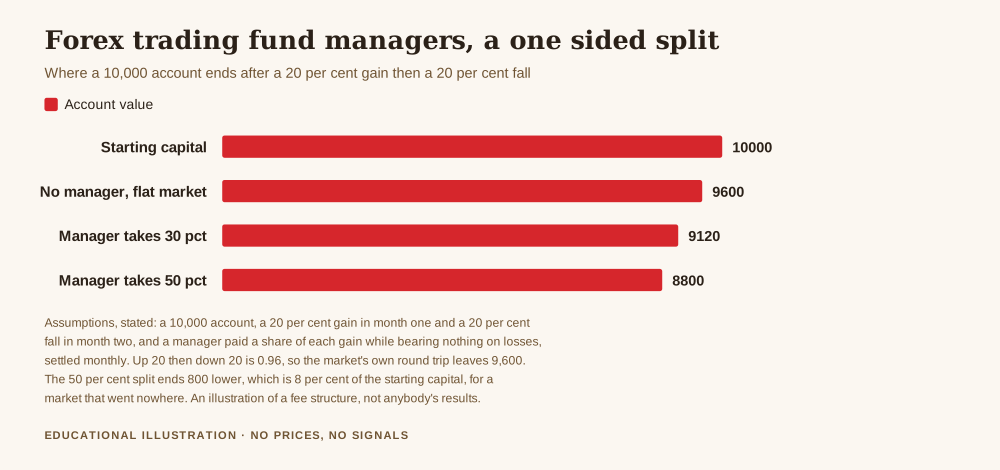
Assume a 10,000 dollar account. Assume the manager takes 50 per cent of each month's gain and bears nothing on a losing month, settled monthly, which is how these arrangements are usually described. Now assume the market does something completely ordinary: up 20 per cent one month, down 20 per cent the next.
Month one, the account gains 2,000 dollars. The manager takes 1,000. Your equity is 11,000. Month two, the account falls 20 per cent, and it falls on the larger balance: 11,000 becomes 8,800.
Now price the same round trip with nobody taking a share. Up 20 per cent then down 20 per cent is 1.20 multiplied by 0.80, which is 0.96. Ten thousand dollars becomes 9,600.
The split cost 800 dollars more than the market's own round trip, which is 8 per cent of the starting capital, and the market went precisely nowhere. Run the same exercise at a seventy thirty split, with the manager on 30 per cent, and the account ends at 9,120 against the unmanaged 9,600: 480 dollars, or 4.8 per cent of starting capital, for a flat market.
Those assumptions are written out so you can check them, and they are deliberately gentle. No fraud, no hidden leverage, no missed withdrawal. Just a plain asymmetry, settled monthly, on a market that ended where it began. The fee was paid out of capital that later evaporated, and no clause brings it back.
This is the structural reason to be careful, and it holds even when the manager is honest, registered and good: pay out of gains that are later reversed and you have funded somebody's good month with capital that had to survive your bad one.
What the inbox actually says
About 131 messages in my inbox mention account management. That is a keyword count across years of chats, not a survey, and the sample is simply people who wrote to me. But the pattern in the wording is consistent enough to be worth repeating, because almost nobody asks for account management because they admire somebody's process.
One reader wrote: "I don't have much time, you know, that's why I'm asking if there's account management or something else. I can only be at the PC for a few minutes at a time." Another: "If I deposit 2,000 on Monday can you manage my account, because most of the time now I have lectures."
Those are time problems, not skill problems, and handing capital to a stranger is an expensive way to solve a calendar.
The second pattern is worse. One reader wrote: "When I was a new trader, I used to give my account to managers. They used to manage my account and they gave me a lot of loss." Another: "I am new, tried a few account management options, but lost 25k. I am into business and I don't have the time to trade." A third, in the plainest terms available: "I have 110 dollars now. I had 4,000 and burned the whole account through a wrong account manager."
And the one that explains why this article is about rules rather than character judgement: "We got scammed a couple of times by fake mentors and decided to figure it out ourselves." They did not lack judgement about people. They lacked a document.
The four questions to ask before any deposit
These are the questions a business owner asks a supplier, and they work whether the answer is impressive or not. You are not trying to catch anyone. You are trying to establish whether a verifiable answer exists.
First: who are you, in a register? A legal name, a firm name and a registration number that you can look up yourself in a public database. The whole value of registration is that a third party holds the record, so the answer should not need to come from the person being asked.
Second: who holds the money, and who can move it? Advisory access and withdrawal access are different permissions. A trading authority that lets somebody place orders is not the same as a password that lets them withdraw. If those two are the same credential, the arrangement has no separation at all, and separation of duties is the oldest control in bookkeeping.
Third: what happens in a losing month, in writing? Not what they expect to happen. What the document says. If gains are shared and losses are not, say that out loud in the arithmetic above and see whether it still sounds like a partnership.
Fourth: what are you promising? A weekly or monthly return target is the single most informative answer on this list, because nobody who understands the distribution of trading outcomes will give you one. One reader asked, in good faith, "could you please tell me about account management, profit share, and what profit should I expect to make per week?" The honest answer to that question is that the question has no answer, and a manager willing to supply one has told you how they handle uncertainty.
If the first question has no public answer, the remaining three are a formality. This is the same test applied in choosing a broker like a business partner, and for the same reason: in a one person business, due diligence is a process you run, not an instinct you trust.
What a one person business does instead
The useful reframing is that you do not have a manager problem. You have a capacity problem, and it has cheaper solutions.
If the constraint is time, reduce the number of decisions rather than outsourcing them. Fewer instruments, longer holding periods, a fixed review slot. The arithmetic of a smaller, slower operation is dull and entirely yours.
If the constraint is confidence, the answer is a record, not a delegate. A written process, a risk ceiling and a month of honest bookkeeping will tell you more about whether this business suits you than any third party can, and that is exactly what the one page trading business plan is for.
And if you genuinely want professional management, that is a legitimate choice. Make it the way you would buy any other regulated service: through a registered entity, with the money held where somebody other than the manager controls withdrawals, with the fee structure written down, and with the loss side specified. Those conditions are not unreasonable demands. They are the conditions the rules already assume.
Get the free REX one page trading business plan, including the risk ceilings and the review cycle that make outsourcing the account unnecessary in the first place. One email, no spam, unsubscribe anytime.
Get the free business plan →Frequently asked questions
Are forex trading fund managers legal?
The activity is legal and regulated. In the United States, advising others on retail off exchange forex for compensation falls under the commodity trading advisor definition, and pooling other people's money falls under the commodity pool operator rules, each with narrow exemptions. The activity being legal is not the same as a particular person being authorised to do it, which is why the register matters more than the pitch.
Does a small manager need to register?
Not always, and that is the point of the exemptions. Regulation 4.14(a)(10) covers advice to not more than 15 persons in the preceding twelve months where the person does not hold itself out generally to the public, and 4.13(a)(2) covers a pool operator with no more than 15 participants per pool and not more than 400,000 dollars of aggregate contributions. Advertising publicly breaks the first exemption by itself.
Is a 50/50 profit split fair?
Fairness depends on what happens on the other side. A split of gains with no participation in losses is an asymmetric arrangement, and the worked example above shows an 8 per cent cost of starting capital across a flat up twenty then down twenty round trip at a 50 per cent split. That is arithmetic rather than an opinion, and it is the number to put next to the word fair.
What is the difference between a signal service and a fund manager?
Control of the account. A signal service tells you what it is doing and you decide. A manager acts on the account directly. Both can fall under the advisory definition if there is compensation, but only one of them removes your ability to decline a trade. If you are weighing up the first kind, see whether trading signals are worth it.
Can I let a friend trade my account informally?
People do, and it is worth being clear eyed about what it is. Informality removes the paperwork and every protection that came with it, and the exemption thresholds above exist precisely because regulators expect small arrangements to exist. If you do it anyway, separate trading access from withdrawal access, agree the loss side in writing, and set a ceiling at which the arrangement stops.
Do these rules apply outside the United States?
No. The 15 person and 400,000 dollar thresholds are United States Commission regulations. Other jurisdictions license discretionary management under different regimes with different thresholds and different registers. Use this article as a model for which questions have documented answers, not as a statement of your own country's law.
Where this leaves you
The honest summary of forex trading fund managers is that the interesting question is not whether somebody can trade. It is whether a third party holds a record of who they are, and whether the fee structure survives being written down. Both of those are checkable before any money moves, and neither requires you to judge character.
The definition of a commodity trading advisor and the registration route are from the National Futures Association, with the regulator's own overview at the CFTC intermediaries pages. The exemption thresholds are the text of 17 CFR 4.13 and 17 CFR 4.14 as published by the Government Publishing Office. The figures of 26,666.67 dollars per participant, 800 dollars and 8 per cent, and 480 dollars and 4.8 per cent were calculated here in Python from those published thresholds and from the assumptions stated in the text: a 10,000 dollar account, a 20 per cent gain followed by a 20 per cent fall, and a manager paid a share of each gain and nothing on losses. Those assumptions describe an illustration, not anybody's results.
REX Trading Signal is written for people who want to run the account like a business rather than like a hobby, with books, limits and a review cycle, and the free one page business plan above is where the controls in this article belong. Following along is free, the Kit is optional, and nothing here promises a profit. If the structure rather than the manager is what you are working on, start with opening a trading company.
About the author. Rex writes REX Trading Signal for traders who treat the account as a business with books, limits and a review cycle, because the operators who last are the ones who wrote the rules down before the market tested them. This is education and not financial, legal or tax advice, and no entry, stop or target discussed should be treated as a signal.