
The EA vs manual trading argument is almost always held as an argument about belief. One side says a machine has no emotions and never gets tired. The other says no algorithm can read context the way a person can. Both statements are true and neither one is a decision, which is why the argument never ends.
A business owner would not hold that conversation at all. A business owner would ask what the job is, what each option costs to run, what happens when it breaks, and what evidence exists that it works. Four questions, all answerable. Let me go through them in that order, because once you do, EA vs manual trading stops being a matter of taste and starts being a decision with a defensible answer, which may well be different for you than it is for me.
First, the Only Honest Way to Frame EA vs Manual Trading
An expert advisor is not a strategy. It is a delivery mechanism. It takes rules that already exist and executes them without you being present. That distinction matters more than anything else in this article, so I will put it plainly: automation does not create an edge, it deploys one.
If your rules make money when you follow them carefully by hand, automation can help you follow them more often and more consistently. If your rules do not make money, automating them makes you lose money faster and with less friction. A conveyor belt in a factory that assembles the product wrong does not fix anything. It produces defects at scale.
So the first question is never "should I automate". It is "do I have something worth automating, and how would I know". That second half is where nearly everyone gets hurt.
The Evidence Test, and Why Most Backtests Fail It
Here is the number that reframed this whole subject for me, and you can reproduce it in about twenty lines of code.
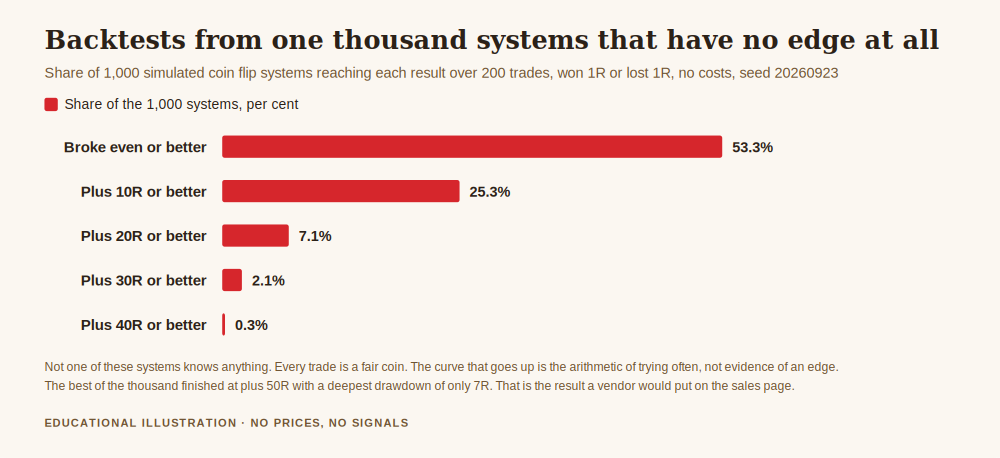
I simulated 1,000 trading systems that have no edge at all. Not weak systems. Systems with precisely zero skill: every trade is a fair coin flip, winning one unit of risk or losing one unit of risk, with no costs and no slippage. Each one runs 200 trades, roughly a year for someone taking a trade most days. The seed is fixed at 20260923 so anyone can run it and get the same output.
If a rising equity curve were evidence of an edge, none of these thousand systems should produce one. Here is what actually happened.
- 533 of the 1,000 finished at break even or better, which is 53.3 per cent.
- 253 of them, 25.3 per cent, finished at plus 10R or better.
- 71 of them, 7.1 per cent, finished at plus 20R or better.
- 21 of them, 2.1 per cent, finished at plus 30R or better.
- The best of the thousand finished at plus 50R, and its deepest drawdown along the way was only 7R.
Read that last line again. A system that knows absolutely nothing produced a year at plus 50R with a maximum drawdown of 7R. Put that curve on a sales page with a price next to it and it would sell. It would sell very well. And there is nothing behind it at all.
This is not an argument that backtests are worthless. It is an argument that a backtest result, on its own, carries almost no information unless you also know how many variations were tried before that one was shown to you. Test 1,000 parameter combinations and keep the best, and you have not found an edge, you have found the luckiest coin in a bag of coins. The vendor knows the denominator. You do not.
A business owner recognises this shape immediately, because it is the same reason you ask a supplier for their full client list rather than their three best references.
What the Streak Arithmetic Says About Both Options
The same maths that undermines the backtest also tells you what to expect operationally, and it applies whether a human or a machine is pressing the button.
Over 200 trades at a 50 per cent win rate, the chance of hitting a run of six consecutive losses somewhere in there is approximately 95 per cent. A run of eight consecutive losses turns up roughly 53 per cent of the time. Ten in a row, around 17 per cent. These are approximations from the independent window calculation rather than exact figures, but the order of magnitude is what matters: losing streaks that feel like a broken system are ordinary features of a working one.
Drop the win rate to 40 per cent, which many perfectly sound trend following systems run at because their winners are larger, and a run of eight losses becomes about 96 per cent likely across 200 trades. Near certain.
This cuts both ways in the EA vs manual trading decision, and that is exactly why it is useful.
Against manual trading: you will meet those streaks, and a human in the middle of one is under real pressure to change something. Widen a stop, skip the next signal, double the size to catch up. The machine will not do that. That is the strongest argument automation has, and it is a good one.
Against automation: you will meet those streaks, and you will have no way to distinguish an ordinary run of eight losses from a strategy that has genuinely stopped working, because the only instrument you have for telling the difference is judgement, and you deliberately removed yourself from the process. The machine keeps trading a broken edge with exactly the same discipline it applied to a working one. It has no opinion about which it is running.
So automation does not remove the need for judgement. It moves it, from inside the trade to outside it, and on to a different schedule. Which is a management problem, and management problems are solvable.
The Cost Side of the Ledger
Let me put rough numbers on the time, with the assumptions stated so you can substitute your own.
Assume a manual trader sits at the screen three hours per trading day, five days a week, 48 weeks a year. That is 720 hours annually. Assume instead a rules based system that takes 80 hours to specify, build and test properly, then 1.5 hours a week to review the journal and reconcile the fills. That is 152 hours in year one and 72 hours each year after.
The first year difference is 568 hours. That is real, and it is the honest case for automation. But those hours are not free, they are exchanged for a different set of liabilities, and a business owner prices both sides.
The liabilities you take on are operational: power cuts, dropped connections, a platform update that changes behaviour quietly, a broker amending contract specifications, and the most expensive one of all, which is that nobody is sitting there to notice. A manual trader whose internet fails knows within seconds. An automated system running on a machine you last logged into in March can be doing the wrong thing for a week. This is the same class of risk I wrote about in what happens if your broker platform goes down, except that here you have removed the person who would have raised the alarm.
There is a second cost that rarely gets counted. Automating a strategy stops you learning from it. Every manual trade teaches you something about how the market behaves around your rules. Hand that over on day one and you buy back 568 hours at the price of your own development, which is a trade a very experienced operator might happily make and a beginner almost certainly should not.
Where the Real Danger Sits
The EA vs manual trading question has a third option nobody puts on the list, and it is the one that actually harms people: buying someone else's system.
Building your own automation from rules you already trade is a legitimate business decision with knowable costs. Paying a stranger for a compiled file and an equity curve is a different activity entirely, and it sits in the most expensive category of internet crime there is.
The FBI's Internet Crime Complaint Center publishes an annual report of complaints and losses, and in its 2024 Internet Crime Report the investment category recorded 47,919 complaints and $6,570,639,864 in reported losses. That is the single largest loss category of any crime type IC3 tracked that year, well ahead of business email compromise at $2,770,151,146, out of $16.6 billion in total reported losses across 859,532 complaints.
Not all of that is trading robots, and I am not going to pretend otherwise. But the pitch structure is identical to the one my simulation explains: a curve, a price, and no denominator. When you know that one in four no edge systems produces a plus 10R year by chance alone, you know exactly how cheap that curve is to manufacture.
The business test is simple. If you cannot read the rules, you cannot maintain it, you cannot tell when it has stopped working, and you cannot fix it. No business buys a machine it is contractually forbidden from opening.
Get the free REX one page trading business plan, including a place to write down which parts of your process a machine could run and which parts must stay with you. One email, no spam, unsubscribe anytime.
Get the free business plan →Frequently Asked Questions
Which is better, EA vs manual trading?
Neither is better in general, because they answer different questions. Automation is a delivery mechanism for rules that already work, so the honest sequence is to trade a written process by hand until you have enough trades to believe in it, then consider automating the parts that are genuinely mechanical. Automating first is building a conveyor belt before you know what the product is.
Does a good backtest mean the EA works?
On its own, no. Out of 1,000 simulated systems with no edge at all, 25.3 per cent still finished a 200 trade run at plus 10R or better, and the best reached plus 50R with a 7R maximum drawdown. Without knowing how many variations were tested before that curve was selected, the curve tells you very little.
Do EAs remove emotion from trading?
They remove emotion from execution, which is real and valuable. They do not remove it from the decisions around the system: when to switch it off, when to change parameters, whether a run of eight losses is normal variance or a dead edge. At a 50 per cent win rate over 200 trades, a run of eight losses appears roughly 53 per cent of the time, so that decision will arrive.
How much time does automation actually save?
On the assumptions in this article, three hours a day manually against 80 hours of build plus 1.5 hours a week of review, the first year difference is 568 hours. Substitute your own numbers, and then subtract the operational risk you are taking on, because a system nobody is watching can misbehave for a long time before anyone notices.
Should I buy an EA rather than build one?
I would not, and the reason is operational rather than moral. If you cannot read the rules you cannot maintain, diagnose or retire the system, which means you cannot run it as a business. It is also worth knowing that investment fraud was the largest reported loss category in the FBI's 2024 Internet Crime Report, at $6.57 billion across 47,919 complaints.
Where REX Trading Fits
REX Trading Signal is free to follow. The daily record goes up with the reasoning stated before the outcome is known, losing days included, because a business keeps the whole ledger. There is a free one page business plan for anyone who wants to write their process down, and an optional Kit for people who want the full system. Nothing here promises a profit and nothing here is a signal service. If you are working through this decision, read can I automate my trading strategy for the feasibility question, then how to test an EA on MT5 for doing the testing properly, and keep the one page trading business plan template open while you decide.
Automation is a staffing decision, not a strategy. Hire the machine for the job it is actually good at, which is doing the same correct thing at three in the morning, and keep the judgement in house.
About the author. Rex writes REX Trading. He came to this from running an actual business with actual inventory, where the question was never whether a machine was clever but whether anyone would notice the day it stopped working. Nothing in this article is a recommendation to trade, and no entry, stop or target discussed should be treated as a signal.