
Can I automate my trading strategy is a question I get asked as though it were technical, and it is not. It is a capital expenditure question, the same shape as asking whether to buy a machine for a workshop. The machine does not decide whether the workshop is profitable. It decides how cheaply, how consistently and at what scale the workshop does whatever it was already doing, and if that was losing money, the machine will help you lose it faster and with fewer typing errors.
So before the software question, the business question: what is being automated, and do you have evidence it works? I ran a test to show why that second half is harder than it sounds.
What Automation Actually Buys You
Three things, and none of them is an edge.
Consistency of execution. The rule gets applied the same way at 3am on a Friday as at 9am on a Monday. If your losses come from skipping the rule when you are tired or doubling it when you are confident, this is a genuine repair, and it may be the single best reason to automate anything.
Capacity. One person can watch a handful of instruments. Code can watch a hundred. If your constraint is attention rather than ideas, automation lifts the ceiling.
Cost per decision. Your time has a value even when nobody invoices you for it. Anything that runs the same checklist every morning without you converts a recurring labour cost into a one off build cost plus maintenance.
What it does not buy is a positive expected result. Automation is a multiplier applied to whatever sits underneath it, and multiplying a negative number by a larger number does not improve the sign.
The Test I Ran Before Answering
Here is the thing that makes this question dangerous, and the reason I did not want to answer it with an opinion.
Nearly everyone who automates does so on the strength of a backtest. The backtest is the business case. It is the document that justifies the spend, and it is produced by the person who wants the answer to be yes, using data they have already looked at. In any other part of a business we would treat a projection built that way with open suspicion. In trading it gets treated as evidence.
So I built the situation deliberately, using the published LBMA gold benchmark over 2016 to 2025, which is 2,506 fixings. I split it in half: 2016 to 2020 as the years to optimise on, 2021 to 2025 as years the optimiser never saw.
Then I tested 1,683 variants of one ordinary rule family, a fast moving average crossing a slow one, long only, on the first half. I picked the single best performer, exactly as anyone building a system would. Then I ran that winner on the second half.
The assumptions, stated so you can argue with them: total return over each five year window, no leverage, no compounding of position size, and dealing costs excluded, which flatters every rule against simply holding.
Can I Automate My Trading Strategy Without Fooling Myself?
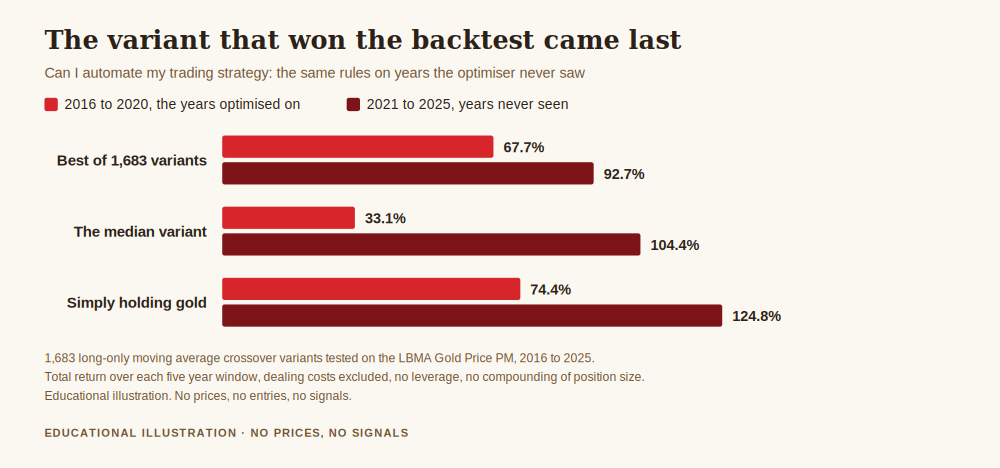
The best of the 1,683 variants returned 67.7% across the optimised period, taking 26 round trips. A clean looking result, and the sort of number a business case gets built on.
On the unseen years it returned 92.7%, which at first glance looks like a success. It is not, and this is where you need the two comparison lines.
Simply holding gold returned 74.4% over the optimised period and 124.8% over the unseen one. The winner lost to doing nothing in both halves. And the median variant of all 1,683, the completely unremarkable middle of the pack, returned 104.4% on the unseen years against the winner's 92.7%.
Ranked against the full field on the unseen data, the variant that won the backtest came 1,247th out of 1,683.
Nothing about that variant was defective. It was chosen because it happened to fit five particular years better than 1,682 alternatives, and that fit was the reason it looked good, not a property that travelled with it.
The Selection Gap, in Business Terms
There is a way to see the size of the illusion directly.
Across the optimised period, the median variant returned 33.1% and the best returned 67.7%. That gap of 34.6 percentage points is what searching produced. Not skill, not insight into gold, just the act of trying many things and keeping the one that scored highest.
Any process that tries enough variations will find one that looks impressive on the data it was tried against. That is not a flaw in your method, it is a property of searching, and it applies to indicator settings, session filters, stop distances and every parameter you were planning to tune. The more thoroughly you optimise, the larger the gap between what the backtest promises and what the rule can deliver.
The honest benchmark is not zero. Across the unseen years, only 198 of the 1,683 variants beat simply holding gold, which is 11.8%. If your automated system is going to consume build time, subscription costs and attention, the comparison it has to win is against the cheapest available alternative, not against a blank page.
The Running Costs Nobody Puts in the Plan
Suppose the rule is real. The business case still has to carry costs that do not appear in any backtest.
Dealing costs are the visible ones. The winning variant took 33 round trips across the unseen five years. At a fairly ordinary 0.05% per side, that is about 3.3 percentage points removed from the result, and this rule trades rarely. A system taking several trades a week is in a completely different position, and the arithmetic of that is in the trading business model.
Then the ones people forget entirely. Something has to run the code, which means a machine that stays on and a connection that stays up. Something has to tell you when it stops, because a system that silently stops is worse than no system, since you believe you have coverage you do not have. Something has to be maintained when your broker changes a symbol name or your platform updates. And someone has to decide what happens when the rule wants to trade during an event you would never have traded manually.
None of that is a reason to avoid automating. It is a reason to cost it honestly, the same way you would cost a machine that needs servicing, because a business case that omits maintenance is not a business case.
When Automating Is the Right Business Decision
Three conditions, and I would want all three.
The rule is already written down and already followed. If you have been trading it manually to a written specification, you have something to automate. If the rule lives in your head and changes with your mood, automation does not fix that, it freezes an unfinished thing in place.
The evidence is not purely from optimisation. A rule that survived a period you did not use to design it is worth something. A rule that only exists because it topped a search is worth roughly what the search cost you.
The constraint really is execution. Automate to solve a problem you can name: you miss entries during work hours, you cannot watch enough instruments, you override the rule when you are tired. Automating because manual work feels unprofessional is buying a machine to look like a factory.
Before You Buy Someone Else's
Most people asking this question end up considering a system built by someone else, and the answer there is mostly due diligence rather than code.
The CFTC's advisory on foreign currency fraud is a short and useful read here. Its practical instructions apply directly to buying automation: check the firm's registration status and disciplinary history with the CFTC, ask for all information in writing rather than relying on oral statements, ask how the seller is paid, and treat a false sense of urgency as a red flag rather than an offer. A vendor who will not put the rule, the costs and the assumptions in writing is not selling you a system, they are selling you a backtest.
And when they do show you a performance record, the test above is the question to ask about it: how many variants were tried before this one was chosen, and on what data was it selected. Most sellers will not have an answer, which is itself the answer.
Four Numbers to Have Before You Spend
Your rule's result on data you did not design it against. If you cannot produce that, you do not yet have a business case, you have a hypothesis.
How many variants you tried. Write it down honestly, including the ones you abandoned. This is the number that tells you how much of your result is selection, and nobody records it.
Your round trips per year and cost per side. Multiply them. That is the fixed toll the system pays before it is right about anything, and it belongs in the plan next to the build cost.
What the simplest alternative returned over the same period. Holding, or trading the rule manually as you do now. If the automated version does not clearly beat that after costs, the machine is not the constraint.
Get the free REX one page business plan, the sheet where your risk ceiling, your costs and your own expectancy live together, so a build decision is made against numbers instead of a backtest. One email, no spam, unsubscribe anytime.
Get the free business plan →Frequently Asked Questions
Can I automate my trading strategy if I cannot code?
Usually yes, through a platform's own strategy builder or by paying a developer, and the technical barrier is the smallest part of this decision. The question that decides the outcome is whether the rule is written down precisely enough that a developer could implement it without asking you what you meant. If it is not, the specification work is the real project and the code is the easy half.
Does the test prove automated systems do not work?
No, and it is not designed to. It tests one ordinary rule family on one instrument over one decade, and shows what happens when a winner is chosen by searching. Plenty of automated systems work. The finding is narrower and more useful: a backtest produced by optimisation overstates what the rule will do, and the more variants you tried, the more it overstates.
Where do the figures come from?
From the LBMA Gold Price PM over 2016 to 2025, 2,506 fixings, split into 1,255 fixings for optimising and 1,251 unseen. 1,683 long only moving average crossover variants were tested. The best in-sample variant returned 67.7% and then 92.7% out of sample, ranking 1,247th of 1,683 there. The median variant returned 33.1% then 104.4%, and holding returned 74.4% then 124.8%. Costs are excluded, which favours the rules over holding.
Would walk forward testing fix this?
It helps and it does not eliminate the problem. Walk forward re-optimises on a rolling window and tests ahead, which is a better discipline than one split. You are still choosing parameters by searching, so some selection advantage carries through, and the honest use of any such test is to reduce your expectation of the result rather than to certify it.
Should I automate a strategy that is working manually?
That is the strongest case there is, provided you automate the rule you are actually running rather than an improved version you have not tested. The common failure is treating the build as an opportunity to optimise, which quietly replaces a rule with evidence behind it with a rule that has only a backtest.
How much history do I need before automating?
Enough that the result is not explained by luck, which for most edges means hundreds of trades rather than dozens, and the count restarts every time you change the rule. Length of history matters less than whether any of it was untouched when you designed the rule.
What is the cheapest first step?
Automate the checklist, not the trading. Have something assemble your pre-market view, your position size and your risk ceiling every morning and put it in front of you. It removes real work, it cannot lose money on its own, and it tells you quickly whether your rule is specified well enough to be automated at all. That routine is in how to build a pre-market routine.
Where This Leaves You
Can I automate my trading strategy has a short answer, which is yes, and a useful one, which is that the automation was never the hard part. The hard part is having something worth automating, and the standard evidence for that, a backtest you produced yourself on data you had already seen, is precisely the evidence this test shows to be unreliable.
Treat it as you would any equipment purchase. Write the specification. Establish what the thing produces on data that did not shape it. Cost the running of it, including the parts that only appear when it breaks. Compare it against the cheapest alternative rather than against zero. Then decide, and the decision will be a business decision made with numbers, which is the only kind worth making.
The framework this sits in is the one page trading business plan template. The economics of a single trade are in the trading business model, and what to record so your own edge becomes measurable is in key metrics every trading business should track.
About the author. Rex writes REX Trading Signal. He treats an account as a small business with costs, capacity and a set of books, on the view that most trading problems turn out to be operational once someone bothers to write the numbers down.
Disclaimer: This article is general educational content about evaluating automation as a business decision. It is not financial advice, not legal advice, and not a recommendation for or against any software, platform, vendor or trading rule. No product is named and no vendor's data is used anywhere in it. Trading gold, CFDs and leveraged products carries a high risk of losing money rapidly. No entry, stop or target discussed should be treated as a signal. The moving average crossover variants tested here are a deliberately ordinary rule family used to demonstrate selection bias, they are not a strategy recommendation, and nobody should trade them. All return figures are computed from the published LBMA daily gold benchmark over 2016 to 2025 under the assumptions stated in the article, with dealing costs excluded, no leverage and no compounding of position size; they describe how that public benchmark moved in the past and are not a forecast, not a simulation of any account, and not a representation of any real trading result. A result on one instrument over one decade does not generalise. No price levels are quoted anywhere in this article.