
Most businesses decide their year-end close in a meeting, in advance, on a calendar. Trading accounts decide it on the 19th, in a bad mood, after a bad week. When to stop trading in december is a scheduling question with an arithmetic answer, and the answer is available in October, which is roughly when a business would sit down and work it out.
The folklore says December is quiet. Thin books, everyone away, nothing happening, so wind down and enjoy yourself. It is a comfortable story and it turns out to be the opposite of what the record shows, which matters, because the advice you build on a wrong premise tends to be wrong in the expensive direction.
So here is the measurement first, and the decision rule after it.
When to Stop Trading in December: Start With the Days You Actually Have
The London Bullion Market Association publishes the full history of the auction that sets the world benchmark price for gold, which makes it a clean public way to count the days the market genuinely traded. Count the years 2015 to 2025 month by month and December is the shortest month on the books, by a wide margin.
December averages 18.09 trading days. Every other month averages 21.14. That is 14.4 per cent fewer days than a normal month, and it makes December worth only about 7.2 per cent of the trading year rather than the 8.3 per cent a twelfth of a year would suggest.
Then there is the shape of those days. The longest market closure of the year is the Christmas and New Year week, and it has been five consecutive days in every year from 2015 to 2025 without a single exception. In 2025 it ran from 24 to 28 December. So the month is not merely short, it is short and then abruptly stops.
A business with a fixed cost base and 14 per cent fewer operating days in a month would plan around that. Trading accounts usually do not, because nobody ever put the number in front of them.
December Is Short, and It Is Not Quiet
Now the part that breaks the folklore.
Take every daily move in the benchmark from 2000 to 2026, which is 6,696 observations, and measure the average absolute move by month. December comes in at 0.7873 per cent against an all-year average of 0.7677 per cent. Slightly more, not less. It ranks seventh out of twelve, squarely in the middle of the pack. Whatever December is, it is not sleepy.
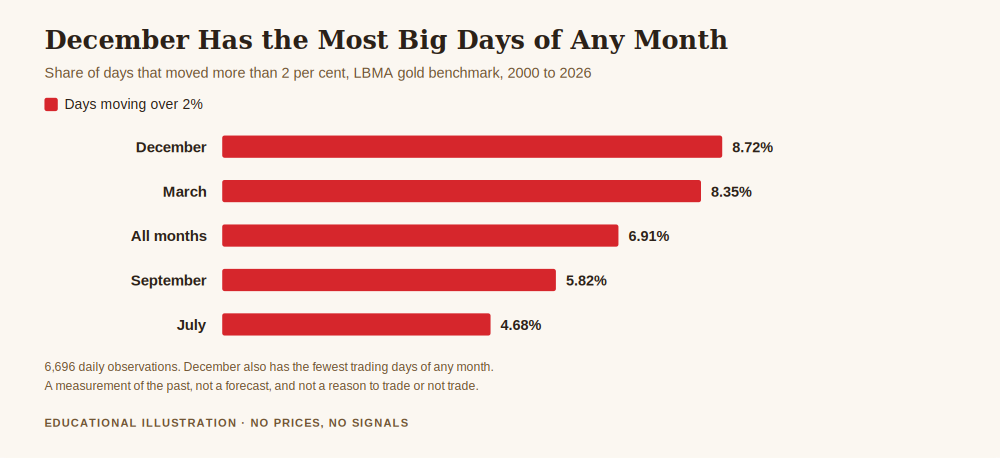
The tail is more striking. Count the share of days that moved more than 2 per cent, and December has the highest share of any month at 8.72 per cent, against an all-month average of 6.91 per cent and a quiet July at 4.68 per cent. Almost one day in eleven in December is a big day, and December is the month where you have the fewest days to work with.
And the last stretch is no calmer either. Take the final eight trading days of each year from 2000 to 2025 and the average absolute move is 0.8007 per cent, against 0.7482 per cent for every other day of the year. Seven per cent livelier, not quieter, right at the point where most people have mentally clocked off.
Put the two findings together and December has an awkward profile for a business: fewer operating days than any other month, the highest concentration of large moves, and a hard five-day stop at the end.
The Thing That Runs Out Is Repair Time
This is the actual reason to set a date, and it has nothing to do with market conditions.
A trading business repairs a bad month with subsequent trades. That repair takes days, and days are the resource December is short of. Run the arithmetic on what repair costs.
Down 5 per cent, you need 5.3 per cent to get back. Down 10 per cent, you need 11.1 per cent. Down 15 per cent, 17.6 per cent. Down 20 per cent, a full 25 per cent. The gap widens because you are earning the recovery on a smaller base than you lost it from.
Now convert that into days. Suppose you risk 1 per cent per trade and, generously, suppose every single trade from here is a 1R winner. Getting back from 10 per cent down would take about 10.6 consecutive winning trades. From 20 per cent down, about 22.4.
Against that, December offers around eighteen trading days, and if your stop date is the 23rd, about thirteen of them. The repair window is smaller than the repair job for anything worse than a modest drawdown, and that is with every trade assumed to win, which is not a thing that happens.
So the honest statement of the problem is this. In March, a bad week is a bad week and you have nine months to absorb it. In December, a bad week is a bad year, because there is no month after it. That is the whole argument, and it is a business argument rather than a market one.
Get the free REX one page trading business plan, the sheet where your risk limit, your review schedule and the year-end stop date described on this page live together instead of in your head. One email, no spam, unsubscribe anytime.
Get the free business plan →Three Ways to Set the Date, Pick One and Write It Down
None of these is better than the others in the abstract. What matters is that one of them is written down before December, so the decision is not made by whoever you happen to be feeling like on the 18th.
The fixed date. Pick a calendar day, close the book, and stop. The simplest version and the easiest to keep. The obvious candidate is the last trading day before the Christmas closure, because the market is going to stop for you anyway and a position carried into five closed days is a decision, not a default.
The remaining-days rule. Stop when the number of trading days left is smaller than the number of winning trades a repair would take. That turns your stop date into a function of how the year has actually gone, which is what a business would do. If you are 10 per cent down and there are eight days left, the arithmetic above says the month cannot fix it, so stop and let January be January.
The risk-budget rule. Set an annual risk budget in advance, and stop when December's share of it is spent. A month worth 7.2 per cent of the trading year does not get 20 per cent of the year's risk, and putting that in writing in October is much easier than arguing with yourself about it in December.
Whichever you choose, the date belongs in the plan alongside the risk limits rather than in your head. That is what the one page trading business plan template is for, and the year-end stop sits naturally next to the daily and monthly stops described in how to know when to stop trading.
Stopping Is Not the Same as Doing Nothing
Closing the trading book for the year frees up the part of the job that never gets done while positions are open, and a real business does this work in the same weeks it stops selling.
Close the books properly. Total the year: gross result, costs, what was actually paid out, what stayed in the account. The monthly profit and loss review scaled up to twelve months is the whole exercise.
Read the record rather than remembering it. Memory keeps the dramatic trades and loses the ordinary ones, which is precisely backwards, since the ordinary ones are the business.
Set next year's limits while this year's evidence is in front of you. Risk per trade, monthly ceiling, review schedule, and the stop date for next December, decided now while it costs nothing to decide.
Do the admin. Statements downloaded, records filed, costs tallied. It takes an afternoon in a closed market and considerably longer in a live one.
Rest on purpose. A closed market is the only time the screen is not asking anything of you. Taking the week is a business decision with a return, not a reward you have to earn.
What This Article Is Not Saying
It is not saying December is dangerous or that you should not trade it. It is saying December is short, has the highest share of large-move days on this record, and ends in a five-day stop, and that those three facts together make the repair window unusually tight.
It is not a forecast. Twenty-six years of measurement describes what happened. Next December is not obliged to resemble the average of the last twenty-six.
It is not a claim about your broker's hours. The auction record is used here because it is public and auditable, not because it matches any particular platform's schedule. Your own broker's December arrangements should be read from your own broker.
It is not an instruction about any position, entry or exit. It is about the date on which your business stops taking new risk for the year, which is a planning decision made in advance.
Frequently Asked Questions
When to stop trading in december, in one answer?
Set the date in advance rather than in the moment, and set it by the number of trading days you have left against the number of winning trades a repair would take. December averages 18.09 trading days against 21.14 for other months, so the runway is roughly 14 per cent shorter than you are used to.
Is December actually a quiet month for gold?
No. On 6,696 daily observations from 2000 to 2026, December's average absolute daily move is 0.7873 per cent against an all-year 0.7677 per cent, and December has the highest share of days moving more than 2 per cent of any month at 8.72 per cent. The quiet month, on this measure, is July.
How long is the market closed at Christmas?
Five consecutive days on the London benchmark record, and it has been five days in every year from 2015 to 2025. In 2025 the closure ran from 24 to 28 December.
Should I stop trading in December if I am already down for the year?
That is exactly the case the arithmetic addresses. Recovering a 10 per cent drawdown needs 11.1 per cent, which at 1 per cent risk per trade is about 10.6 consecutive winning trades. If fewer trading days remain than that, December cannot fix the year, and trading it as though it can is how a bad year becomes a worse one. The decision is yours, but make it with the number in front of you.
What should I do with the time instead?
Close the year's books, read the record rather than your memory of it, set next year's risk limits and review schedule while the evidence is in front of you, and take the week off deliberately.
Where did the figures in this article come from?
All of them are computed from the published LBMA gold auction history linked below, downloaded and checked before publication. Trading-day counts are the dates present in that record, averaged by month over 2015 to 2025. Move sizes are natural log changes between consecutive auction days from 2000 to 2026, 6,696 observations, with the mean of absolute values reported by month. Recovery percentages are one divided by one minus the loss, and the trade counts assume 1 per cent risk per trade with every trade a 1R winner, an assumption stated because it is deliberately optimistic. None of it is a price quote, a forecast or a performance claim.
Where REX Fits
REX is free to follow. Daily XAUUSD setups posted live on Telegram with a stop loss, a reason and a rule, wins and losses alike. There is a free one page business plan for anyone who wants the operating structure in one place, and an optional Kit for people who want the full method. Nothing here promises a profit and nothing here is a signal service.
The year-end stop date belongs in the plan next to the risk limits. The one page trading business plan template is the pillar this article sits under, how to know when to stop trading is the same decision at the scale of a day or a month, and your monthly profit and loss review is the work that fills the weeks after you stop. The day counts and move sizes come from the London Bullion Market Association price record. More about who writes this is on the about page.
About the author. Rex writes REX Trading Signal and looks at an account the way an owner looks at a set of books, which includes putting the year-end close in the diary rather than discovering it. He thinks most December damage is done by people trying to fix November. Nothing in this article is a recommendation to trade, and no entry, stop or target discussed should be treated as a signal.
Disclaimer: This article is general educational content about business scheduling, seasonality measurement and recovery arithmetic in retail trading. It is not financial advice, not investment advice and not a recommendation to trade, to stop trading, or to use any firm or product. Trading calendars and broker arrangements vary and change, and current schedules should be checked with your own broker. Trading leveraged products carries a substantial risk of loss and most retail accounts lose money. Figures are counts and calculations from the stated public data and stated assumptions, not predictions or performance claims.