
Ask what is chart of accounts vs general ledger and most answers will tell you one is a list and the other is a book, which is true and almost useless. The distinction that matters to a trading business is this: the chart of accounts is a decision you make once about what you want to be able to find out later, and the general ledger is the record that accumulates under it. Get the list wrong and no amount of diligent recording will answer the question you care about in March, because the information was never separated when it went in.
What is chart of accounts vs general ledger, in one pass
The chart of accounts is the index. It names every bucket your business is allowed to put a number into, and nothing else. It holds no amounts. A small trading business needs about fourteen of them, and here is a working set:
- Assets. 1000 bank, business current. 1010 broker account, trading capital. 1200 equipment, net.
- Liabilities. 2000 trade creditors. 2200 tax set aside.
- Equity. 3000 owner capital. 3100 owner drawings.
- Income. 4000 trading gains realised.
- Expenses. 5000 trading losses realised. 6000 commission and financing. 6100 data and platform fees. 6200 software and subscriptions. 6300 accounting and professional. 6400 depreciation.
The general ledger is the book those buckets fill up with. Every transaction lands in it twice, once as a debit and once as a credit, inside accounts that already exist on the list. The ledger is where the amounts live, where the dates live, and where the audit trail lives.
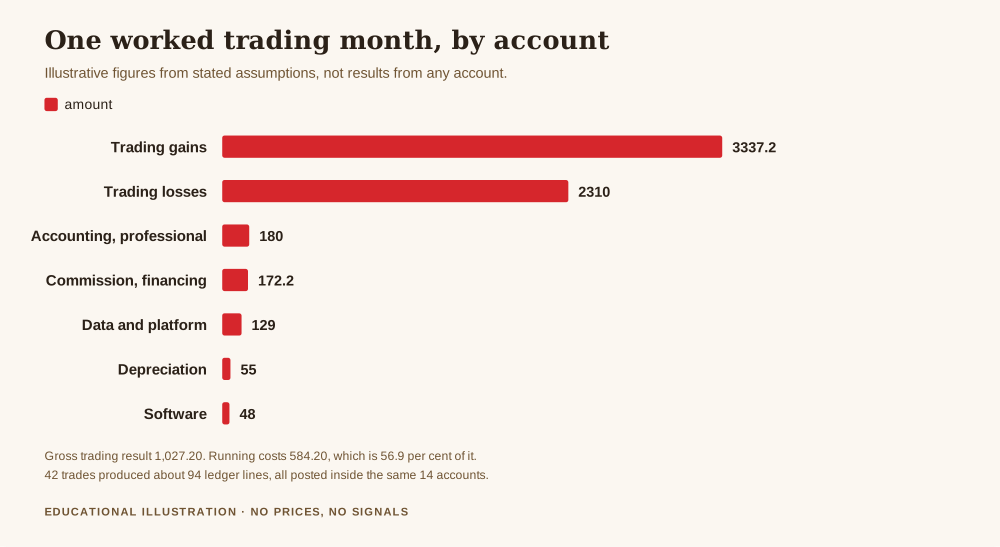
A worked month shows the relationship better than any definition. Take a business that closes 42 trades, pays commission and financing on each one, pays for data and software monthly, pays an accountant, depreciates a laptop, and takes some money out for the owner. That month produces roughly 94 debit and credit lines in the ledger, and all 94 of them land inside the same 14 accounts.
That ratio is the whole idea. The list stays still. The book grows. Next month adds another ninety or so lines and not one new account.
The worked month, line by line
Here are the assumptions, stated so you can disagree with them. The figures are invented to show the structure, not drawn from any real account, and they are not a claim about what a month should look like: 42 closed trades, 18 of them gains averaging 185.40 and 24 of them losses averaging 96.25, commission and financing of 4.10 per trade, data and platform fees of 129.00, software of 48.00, an accountant's bill of 180.00, depreciation of 55.00, and owner drawings of 800.00.
Posted to the ledger, the month reads:
- 4000 trading gains realised, 3,337.20
- 5000 trading losses realised, 2,310.00
- 6000 commission and financing, 172.20
- 6300 accounting and professional, 180.00
- 6100 data and platform fees, 129.00
- 6400 depreciation, 55.00
- 6200 software and subscriptions, 48.00
The gross trading result is 1,027.20. Running costs total 584.20. The net result for the month is 443.00, and the owner drawings of 800.00 are not an expense at all, they reduce equity, which is why they sit in the 3100 account and never touch the profit figure.
Now notice what the structure bought. Running costs consumed 56.9 per cent of the gross trading result this month. That sentence is only available because commission, data, software, professional fees and depreciation went into five separate accounts on the way in. Had they all gone into one bucket called expenses, the number would still exist in the ledger somewhere, scattered across ninety lines, and nobody would ever dig it out.
Why the list has to be decided before the book fills
This is the part that costs people a year. A chart of accounts is a set of questions you are committing to be able to answer. If you did not create account 6100 for data and platform fees, then at the end of the year you cannot answer what data cost, not because the money is missing but because it was never separated. You can go back and re-code twelve months of entries, and some people do, and it is miserable work.
So choose the list by working backwards from the questions. A trading business usually wants to answer four: what did the trading itself produce before costs, what did it cost to be in business at all, how much has the owner taken out, and how much of what is in the account is actually owed to someone else. The fourteen accounts above exist to answer precisely those, which is why tax set aside gets its own liability line rather than hiding inside the bank balance. That distinction is the one that quietly destroys otherwise sound businesses, and it is the same point made in the suspense account piece.
Keep the list short on purpose. A fourteen account structure that is used consistently is worth more than a sixty account structure that gets guessed at every month, because consistency is what makes two periods comparable.
What double entry is actually for
Every line in the general ledger has two sides, and the reason is not ceremony. Take one closed trade that gained 210.00 with 4.10 of commission. The broker account asset rises, so it is debited 205.90. Trading gains are credited 210.00. Commission and financing is debited 4.10. The two sides agree, and they agree for every transaction, which means that at any moment the sum of all debits in the book equals the sum of all credits.
That equality is a built in error detector. If the two sides do not agree, something was entered once instead of twice, or entered in the wrong direction, and you know before the figure reaches a tax return. A single column list of profits and losses has no such property. It will happily accept a typo and carry it forward forever.
It is also the mechanism by which the ledger produces the statements. Group the ledger accounts by type and the income and expense accounts give you a profit and loss, while the asset, liability and equity accounts give you a balance sheet. You do not build those reports separately. They fall out of the same book, which is why balance sheet figures and profit figures can never contradict each other if the ledger is sound.
How long any of this has to be kept
Record keeping obligations are the reason the ledger is not optional. The United States Internal Revenue Service puts it plainly for businesses: you keep records as long as they are needed to prove the income or deductions on a tax return, and the required period depends on the action, expense or event the record documents. For one category the agency gives a specific figure, stating that you should keep all records of employment taxes for at least four years.
Rules differ by country and by what kind of business you run, so the number that binds you may be different. The structural point does not change: the obligation is to produce evidence on request, years later, and a general ledger backed by broker statements is evidence. A spreadsheet of remembered figures is not.
There is a wider reason to take the books seriously, and it is not about tax. Figures from the United States Bureau of Labor Statistics on establishment survival show roughly half of new establishments still operating in their fifth year, with five year survival rates between about 49.8 and 56.3 per cent depending on the year the business started. Most of those closures are not caused by bad bookkeeping. But a business that cannot tell you what it costs to run is a business making decisions blind, and that is a choice rather than bad luck.
Setting one up this week
You do not need accounting software to start, though it helps once the volume grows. You need the list, then the discipline.
Write the account list first, on one page, with a number and a name and a type for each. Keep it to the smallest set that answers your four questions. Then open the ledger, whatever form it takes, and agree with yourself that nothing gets recorded into an account that is not on the list. The moment you allow an entry that does not fit, the structure has started to rot.
Record from source documents, not memory. The broker statement is the source for trades, the bank statement for everything else, and the two should be reconciled monthly. Separate the owner's money from the business's money in your head even if the law does not force you to, because drawings recorded as expenses will overstate your costs and understate what the business actually earns.
Then review it monthly against the questions it was built to answer, which is the habit covered in the metrics a trading business should track, and set up alongside the plan in the one page trading business plan.
Get the free REX one page trading business plan, with the account lines and monthly review questions this article describes. One email, no spam, unsubscribe anytime.
Get the free business plan →Frequently asked questions
What is chart of accounts vs general ledger, in one sentence each?
The chart of accounts is the list of every account your business may record into. The general ledger is the complete record of transactions posted into those accounts, each with a debit and a credit.
Can you have a general ledger without a chart of accounts?
Not coherently. Every ledger entry has to name an account, so a list exists whether or not you wrote it down. The difference between a designed chart of accounts and an accidental one is that the designed version was chosen to answer questions, and the accidental one grew from whatever you typed first.
How many accounts should a one person trading business have?
The worked example here uses fourteen, which is enough to separate trading results from running costs, to track tax set aside, and to keep owner drawings out of the profit figure. Add accounts when you have a question an existing account cannot answer, not because a template suggested one.
Is a trading journal the same as a general ledger?
No, and you want both. A trading journal records why you took a trade and what you observed, which is a decision record. The ledger records what the trade did to the money. They answer different questions and neither substitutes for the other.
Are owner drawings an expense?
No. Drawings reduce equity, they do not reduce profit. In the worked month above, 800.00 of drawings leaves the net result of 443.00 untouched. Recording drawings as an expense is one of the most common errors in a one person business, and it makes the business look less profitable than it is.
Does the ledger need special software?
No, though software reduces errors once trade volume is high, mainly by enforcing the double entry automatically. The structure matters more than the tool. A disciplined spreadsheet with a real chart of accounts beats expensive software used inconsistently.
Where this leaves you
The answer to what is chart of accounts vs general ledger is that one is the design and the other is the record, and the design has to come first because the ledger can only separate what the list told it to separate. Fourteen accounts and ninety odd entries a month is not an accounting department, it is an afternoon of setup and about twenty minutes a week, and it is the difference between knowing that running costs took 56.9 per cent of your gross trading result and merely feeling that costs seem high.
The record keeping requirement, including that records of employment taxes should be kept for at least four years, comes from the Internal Revenue Service recordkeeping guidance for businesses, and the establishment survival rates from the Bureau of Labor Statistics Business Employment Dynamics series. Every figure in the worked month was calculated here from the assumptions printed above, and the figures are illustrative, not results from any account.
About the author. Rex writes REX Trading Signal for people who want to run an account like a business rather than a hobby, which mostly means writing things down, keeping the costs visible, and making the boring decisions before the exciting ones. Everything here is education and personal experience, not financial advice, and no entry, stop or target discussed should be treated as a signal.