
Every set of books eventually meets a transaction it cannot explain. A credit lands in the broker account with no matching statement line, a transfer arrives a day before the record of it, a fee is charged twice and refunded once. The question what is a balance sheet suspense account has a one line answer: it is the holding account where an amount sits while you work out where it really belongs. The longer answer is why a trading business that does not have one quietly reports the wrong profit.
What is a balance sheet suspense account, in one paragraph
A suspense account is a temporary account on the balance sheet that holds an amount you have received or paid but cannot yet classify. It exists because double entry bookkeeping has a rule you cannot break: every entry needs two sides. If money moved and you do not know why, you still have to record that it moved. The suspense account is the second side of that entry, and it is honest in a way that a guess is not. It says, in the books, this happened and I do not yet know what it was.
The defining feature is that it is temporary. A suspense account is healthy only while it is clearing. A balance that sits there for a year is not a suspense account any more, it is an unanswered question wearing an accounting label.
The arithmetic of guessing instead
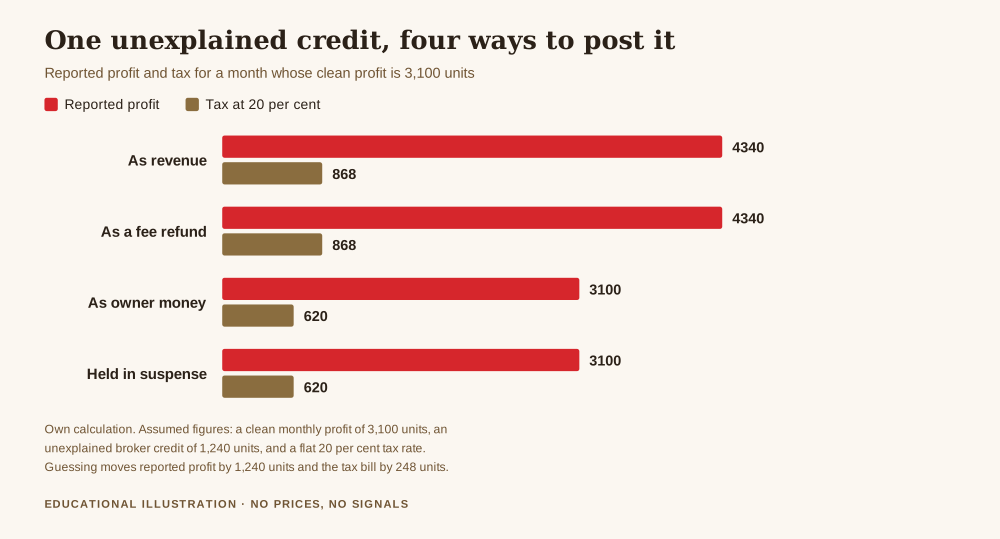
Here is why this is not a bookkeeping technicality. Take a month whose clean profit is 3,100 units, and an unexplained credit of 1,240 units arriving from the broker. These are assumed figures, chosen to keep the arithmetic readable.
If you post that credit as trading revenue, reported profit becomes 4,340. If you post it as a refund of fees, which reduces an expense, reported profit is also 4,340. If it was actually your own money, a transfer you made and forgot, it belongs in equity and profit stays at 3,100. And if you park it in suspense until you know, profit stays at 3,100 until the answer arrives.
At an assumed flat tax rate of 20 per cent, that is a tax bill of 868 against 620. Guessing wrong moves reported profit by 1,240 units and the tax by 248. The unexplained item is 40 per cent of the month's clean profit, which is the part that should make you sit up. One unidentified line can distort a small trading business's monthly result by nearly half, in either direction.
Both errors hurt. Overstating profit means paying tax on money that was never income, and reviewing a month that looked better than it was. Understating it means a misstatement waiting to be found later, when finding it is more expensive.
What goes into suspense in a trading business
The cases are predictable enough to list, and they repeat.
Broker credits with no description. Rebates, promotional credits, corrections, partial refunds of a fee charged in error. The statement says the money arrived and little else.
Transfers in flight. Money that has left the bank and not yet shown at the broker, or the reverse, across a month end. Nothing is wrong, the two records simply disagree about which day it is.
Swap and financing adjustments that do not match what you calculated, usually by a small amount, and usually because of a rate or a timing convention rather than an error.
Amounts where you know the number and not the category. A payment to a platform that might be a subscription, might be data, might be a one off. The money is certain, the classification is not.
The plug you were tempted to post. The reconciliation is out by 18 units and you are tired. That 18 belongs in suspense, not in a convenient expense line.
The entry, written out
Bookkeeping language makes this sound harder than it is, so here are the actual lines for the 1,240 unit credit.
On the day the money appears, the broker cash balance has gone up and you do not know why. Debit broker cash 1,240, credit suspense 1,240. The balance sheet balances, the cash figure matches the statement, and nothing has touched the profit and loss account, which is the whole point. Profit is unaffected by an event you do not understand.
Three weeks later the broker confirms it was a refund of a data fee charged twice in the prior quarter. Now you clear it: debit suspense 1,240, credit the data and platform expense line 1,240. The suspense balance returns to zero and the correction lands against the expense it belongs to. If instead the answer had been a rebate on volume traded, the credit side would be other trading income. If it had been your own transfer, the credit side would be owner capital.
Three different answers, three different final homes, one identical first entry. That is the argument for the suspense account in a sentence. You do not need to know the answer to record the event correctly, and the first entry never has to be reversed or explained away, because it never claimed anything that was not true.
If you keep books in a spreadsheet rather than in software, the mechanism is the same. One column for the suspense balance, one row per open item, and a rule that the column total must agree with the sum of the open rows every time you close a month.
How to run one without it becoming a dustbin
Four rules are enough.
One account, named plainly. Add a line to your chart of accounts called suspense, and do not create several. The point is a single place to look.
Every item dated and described. Not the amount alone. The date it arrived, where it arrived from, and the two or three explanations you think are plausible. The description is what makes the item solvable in three weeks, when you have forgotten it entirely.
An ageing rule. Nothing sits unexamined. In a worked example, a suspense account holding three items, an unidentified broker credit at 41 days, a transfer with no matching statement line at 12 days, and a fee charged twice with the refund not yet seen at 5 days, has a total of 58 days outstanding across three open questions. That total is the metric. If it grows month after month, the books are drifting.
A hard close at the review. The suspense balance is read aloud at the weekly review and again at the monthly one. Not glanced at. Read, with each item either explained, chased, or escalated to an email to the broker that day.
A suspense account you look at on a schedule is an instrument. A suspense account you look at once a year is a confession.
Real books carry an unexplained bucket too
It is worth knowing that this is not a hobbyist's problem. Apple Inc reported other current liabilities of 66,124,000,000 US dollars in its FY2026 Form 10-K for the period ended 26 September 2026, a figure you can pull directly from the SEC's structured data rather than taking anyone's word for it.
Be precise about what that does and does not show. An other liabilities line is an aggregation of items too small or too varied to present separately, all of which are identified and classified. It is not a suspense account. The point of the comparison is narrower: audited books at the largest scale still carry a catch all line, because real transaction flow never resolves perfectly into tidy categories. The difference is that a large company's catch all is understood and a neglected suspense account is not.
How long an unexplained item has to survive
There is a deadline on this work, and it is not set by you. The IRS states the general rule that you must keep records supporting an item of income or deduction until the period of limitations for that return runs out: three years in the ordinary case, six years if you do not report income that is more than 25 per cent of the gross income shown on your return, and unlimited where a return is fraudulent or not filed.
Three years is 1,095 days. That is how long you may need to explain the 1,240 unit credit sitting in your suspense account today, and it is a strong argument for solving it this month, while the broker's support team can still find the ticket and you can still remember the week. Tax rules vary by country and this is education rather than tax advice, so confirm your own position with a qualified accountant in your jurisdiction.
Notice how the rule and the reality meet. The unexplained item is the one most likely to be questioned, and the one you are least able to document later. Time works against exactly the entries you understand least.
Get the free REX one page trading business plan, with the monthly review lines that keep unexplained money visible instead of buried. One email, no spam, unsubscribe anytime.
Get the free business plan →Frequently asked questions
What is a balance sheet suspense account used for?
Holding an amount that has genuinely moved but cannot yet be classified, so the books stay balanced and the uncertainty stays visible. It is a temporary account, and it should clear to zero once each item is identified.
Is a suspense account an asset or a liability?
Either, depending on the direction of the item. Money received that you cannot yet classify sits as a liability, because you may owe it back or it may turn out to be somebody else's. An unexplained payment out sits as an asset until identified. Some bookkeepers run one account that can swing either way, which is acceptable as long as the sign is reviewed.
How long can something stay in suspense?
As a working rule, not past the next monthly review without a named reason and a chase. The outside limit is set by recordkeeping requirements, since the IRS period of limitations is three years in the ordinary case and six if unreported income exceeds 25 per cent of gross income shown.
What happens if I never clear the suspense account?
Your balance sheet stops reconciling to reality, every ratio built on it inherits the error, and the eventual correction lands in a later period where it misstates that month instead. If you compute a working capital ratio on books with a stale suspense balance, the answer is decorative.
Can I just post an unexplained credit as income to be safe?
It is a common instinct and it is not safe, it is simply a different error. Posting owner money as income overstates profit and can mean paying tax on capital you already owned. Classify when you know, hold in suspense when you do not.
Does any of this affect how I should trade?
Only indirectly, which is the honest answer. Clean books tell you what the business actually earned, and a review based on a real number is worth more than one based on a flattering one, but nothing here is a market instruction and no entry, stop or target discussed should be treated as a signal.
Where this leaves you
The useful version of what is a balance sheet suspense account is not a definition, it is a habit. Money moves, you record that it moved, and you refuse to invent a reason for it. One unexplained credit of 1,240 units in a 3,100 unit month is 40 per cent of the result, and the business that guesses has not avoided the uncertainty, it has only hidden it inside a number it will later rely on.
The foundation under this article is the one page trading business plan. Beside it, the matching exercise that feeds the suspense account is in how to reconcile your broker statement, the account structure it belongs to is in what a chart of accounts looks like, the monthly read of the result is in your monthly profit and loss review, and the author page is here.
The recordkeeping and limitation periods quoted here are set out in the IRS guide Publication 583, Starting a Business and Keeping Records, which also covers reconciling a business checkbook. The Apple figure is from the SEC's XBRL company concept data for other current liabilities, taken from the FY2026 Form 10-K.
About the author. Rex writes REX Trading Signal for people who would rather run an account than gamble with one. The working assumption here is that a trading account is a small business, and that the ordinary disciplines of a small business, knowing what you owe, keeping records that survive a bad month, and reviewing numbers on a schedule rather than on a feeling, do more for survival than any entry technique. Everything published here is education and not financial advice, and no entry, stop or target discussed should be treated as a signal.