
Most traders can tell you their account balance to the cent and nothing else about their financial position. That is a reasonable thing to know and a poor thing to run a business on, because the balance answers one narrow question, how much is at the broker right now, while ignoring what you owe, what you have put aside elsewhere, and how much of the whole thing is genuinely yours. What is a balance sheet statement of financial position is the question that fixes that gap, and the two names in it are not two documents. They are one document with an accountant's name and a plain English one.
What is a balance sheet statement of financial position, in the plainest terms
It is a snapshot, on one named date, of everything the business owns, everything it owes, and the difference between the two. The IRS puts it in a single sentence in its guide for new business owners: a balance sheet shows the assets, liabilities, and your equity in the business on a given date.
Statement of financial position is simply the more descriptive name for the same report, and the one many accounting frameworks now prefer, because that is literally what it reports: your position, financially, at a point in time. If a bookkeeper hands you a statement of financial position and you were expecting a balance sheet, nothing has changed except the heading.
The word balance is not decorative either. The report is built on an identity that has to hold every single time:
Assets = Liabilities + Equity
What you own equals what you owe plus what is actually yours. If it does not balance, something is missing or double counted, which is why the format has survived for centuries. It audits itself.
How it differs from the profit and loss statement
This is where people get tangled, so it is worth being precise. The profit and loss statement covers a period: what happened across November, across the quarter, across the year. The statement of financial position covers an instant: where things stood on 30 November, full stop.
One is a film, the other a photograph. A profitable month can end with a weaker position than it started, if the profit was withdrawn and a tax liability accrued against it. A flat month can end stronger, if debt was repaid. They answer different questions and you need both, which is why I keep the monthly review of the first one separate in the monthly profit and loss review.
A worked statement for a one person trading business
Abstract definitions do not stick, so here is the whole thing with numbers. Every figure below is an assumption I have chosen to show the mechanism, not a record of any real account.
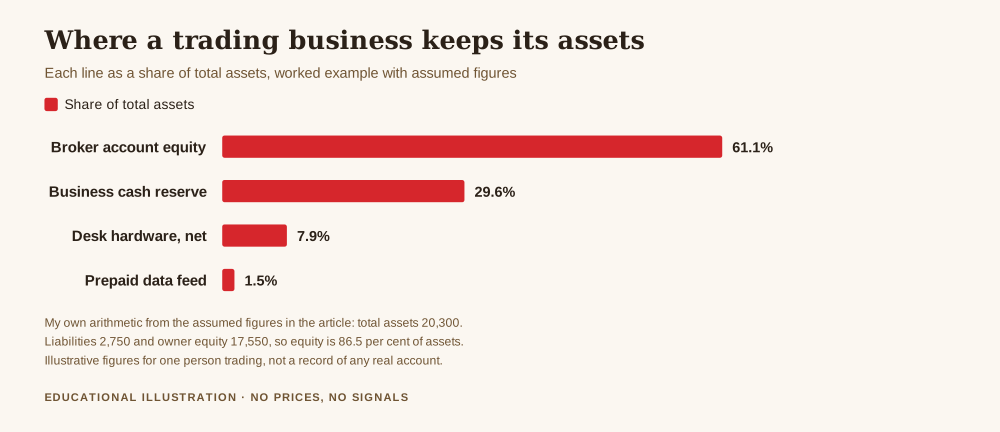
Current assets. Broker account equity, 12,400. Business cash reserve held separately, 6,000. A data subscription paid three months in advance, 300. Total current assets, 18,700.
Fixed assets. Desk hardware at a cost of 2,400, less accumulated depreciation of 800, giving net fixed assets of 1,600.
Total assets: 20,300.
Current liabilities. Income tax accrued but not yet paid, 2,150. Platform subscriptions owed, 180. Business card balance, 420. Total liabilities, 2,750.
Owner equity: 17,550.
Check the identity. Assets of 20,300 equal liabilities of 2,750 plus equity of 17,550, which is 20,300. It balances, so the statement is internally consistent.
Now notice what that prepaid data subscription is doing on the asset side. You have already paid the money, so it feels like a cost, but you have bought three months of something you have not yet used, and that unused portion is a resource the business still holds. That is the kind of line a balance sheet catches and a bank statement never will.
The three things this statement tells you that a balance cannot
First, how much of the business is actually yours. Equity of 17,550 against total assets of 20,300 is an equity ratio of 0.865, so 86.5 per cent of what the business holds is genuinely owned rather than owed. That one number reframes the whole operation.
Second, whether short term obligations are comfortably covered. Current assets of 18,700 against current liabilities of 2,750 is a current ratio of 6.80, meaning short term resources cover short term obligations nearly seven times over. The ratio itself is covered properly in the working capital ratio, but the point here is that you cannot compute it at all without the statement.
Third, and most uncomfortably, how concentrated the business is. Broker account equity of 12,400 is 61.1 per cent of total assets. Sixty one per cent of everything this business owns sits inside one account, at one counterparty, exposed to one market. Nothing in the profit and loss statement would have told you that, and it is exactly the exposure I wrote about in concentration risk in your trading business.
The tax line is the one that changes behaviour
Look again at the accrued income tax of 2,150. It is sitting in liabilities, which means it has already been subtracted from your equity, which means the statement is telling you something the broker platform never will.
The broker shows 12,400 and that number feels spendable. It is not. Against it sit 2,750 of obligations, so the genuinely uncommitted portion of that account is 9,650. The difference, almost 2,800, is money that already belongs to somebody else and happens to still be in your possession.
This is the single most common way a profitable trading year turns into a cash crisis. The money looked available because the only report anyone checked was the one that cannot show obligations. Keeping records that make this visible is not optional housekeeping either, since the IRS is explicit that supporting business books and records have to be kept, and a balance sheet is one of the statements it names.
How to build yours without it becoming a project
Do it monthly, on a fixed date, and keep it to one page. Start by listing what the business owns: every broker account at its current equity, business cash held elsewhere, anything prepaid, and equipment at cost less what you have written off so far. Then list what it owes: tax accrued on profit already made, subscriptions billed but unpaid, any card or loan balance, and anything owed to you personally if you have lent the business money.
Subtract the second list from the first. That is your equity, and the number you want to watch over time is not whether it is large but whether it is rising, because rising equity is the only honest definition of a trading business that is getting somewhere.
Two mistakes to avoid. Do not fold personal assets into it, because the moment the statement mixes the two it stops being able to answer any question about the business. And do not skip the accrued tax line because the bill has not arrived, since that omission is precisely what makes the statement comforting and useless. Where all of this gets written down and reviewed is the one page trading business plan.
Get the free REX one page trading business plan, including the reserve and obligation lines that keep a statement of financial position honest month after month. One email, no spam, unsubscribe anytime.
Get the free business plan →Frequently asked questions
What is a balance sheet statement of financial position, in one line?
A one date snapshot of what the business owns, what it owes, and the difference, which is your equity. Balance sheet and statement of financial position are two names for the same report.
Do I need one if I am a sole trader with one account?
Yes, and arguably more than a larger operation does, because a sole trader is the person most likely to mistake the broker balance for the business position. The statement takes fifteen minutes a month once the habit exists, and it is the only report that shows accrued tax sitting against money you can currently see.
Why does it have to balance?
Because equity is defined as assets minus liabilities, so the identity holds by construction. If your statement does not balance, something has been omitted, entered twice, or recorded on the wrong side, which makes the failure to balance a useful error check rather than an inconvenience.
Is a trading loss shown on the balance sheet?
Not directly, no. Losses appear on the profit and loss statement for the period. Their effect reaches the statement of financial position through reduced assets and therefore reduced equity, which is another way of saying the photograph shows the result while the film shows the event.
What counts as a liability for a trading business?
Anything the business is obliged to pay out: tax accrued on profits already earned, subscriptions and services billed but unpaid, card and loan balances, and money you have personally lent the business. The accrued tax line is the one most often left off, and the one that most often causes trouble.
How often should I prepare one?
Monthly is the right cadence for most trading businesses, on the same date each month so the comparisons mean something. The value is almost entirely in the series rather than in any single statement, because what you are watching for is the direction of equity over a year.
Where this leaves you
The useful answer to what is a balance sheet statement of financial position is that it is the only report that tells you how much of your trading business is actually yours. In the worked example that was 86.5 per cent, with short term cover of 6.80 times, and with 61.1 per cent of all assets concentrated in a single broker account. Three facts, none of which appear anywhere on a trading platform.
Run your account like a business and this becomes routine rather than daunting: one page, one date a month, the identity checked at the bottom. The traders who get into trouble with money they already owed are almost never the ones keeping this statement. They are the ones who had a number on a screen and believed it was theirs.
The statement that a balance sheet shows the assets, liabilities, and your equity in the business on a given date is from IRS Publication 583, Starting a Business and Keeping Records, which also names the income statement and balance sheet among the financial statements a business keeps, and the requirement to keep supporting business books and records is set out on the IRS recordkeeping page. Every currency figure in this article, namely the assets of 18,700, 1,600 and 20,300, the liabilities of 2,150, 180, 420 and 2,750, the equity of 17,550, the uncommitted 9,650, and the ratios of 0.865, 6.80, 61.1 per cent, 29.6 per cent, 7.9 per cent and 1.5 per cent, was calculated here in Python from the assumed figures stated in the text and is not a record of any real account. This article describes general bookkeeping practice and United States federal recordkeeping guidance only.
REX Trading Signal publishes the daily record with the quiet days and the losing days included, so you can judge a process rather than a highlight reel. The free business plan above is the one page version of the operating rules used here. Following along is free, the Kit is optional, and nothing here promises a profit.
About the author. Rex writes REX Trading Signal for people who want to run an account like a business rather than a hobby, because the operators who last are the ones who wrote the rules down before the market tested them. This is education and not financial, tax or legal advice, tax rules differ by country and change over time, your own circumstances decide what any of this means for you, and no entry, stop or target discussed should be treated as a signal.