
Every business has an input price it does not control. A haulier has diesel, a bakery has flour, and an account has volatility. When that price moves, the business either adjusts its order quantities or it discovers the problem in the accounts a quarter later. Trading in volatile markets is that adjustment, and almost nobody treats it as one.
What usually happens instead is a debate about whether the conditions are tradeable. People argue about whether it is too choppy, whether to stand aside, whether this is opportunity or danger. That is the wrong conversation, because it treats volatility as a weather report rather than as a number that belongs in the costing.
The right conversation is duller and much more useful. Your risk budget has not changed. The cost of buying a fixed amount of exposure has. Therefore your order quantity has to change, by an amount you can calculate rather than feel. This article is that calculation, and the three things it breaks if you skip it.
Trading in Volatile Markets Is a Pricing Problem, Not a Courage Problem
If you want evidence that volatility is an input price rather than a mood, look at how a regulator handles it.
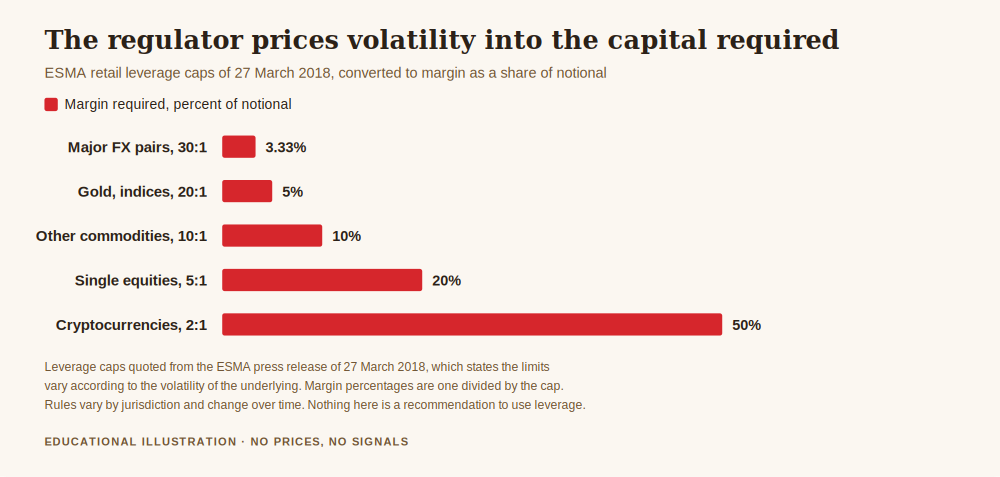
When ESMA introduced its retail measures on 27 March 2018, it set leverage limits which, in its own words, vary according to the volatility of the underlying. The tiers run from 30:1 for major currency pairs, to 20:1 for gold and major indices, 10:1 for other commodities, 5:1 for individual equities, and 2:1 for cryptocurrencies.
Convert those caps into the capital each one demands, which is simply one divided by the leverage, and the logic becomes explicit:
- Major currency pairs: 3.33 per cent of notional.
- Gold and major indices: 5.00 per cent.
- Commodities other than gold: 10.00 per cent.
- Individual equities: 20.00 per cent.
- Cryptocurrencies: 50.00 per cent.
Fifty per cent against 3.33 per cent is a factor of fifteen. For the same notional exposure, the regulator requires fifteen times the capital in the most volatile tier as in the least. It is not making a judgement about which market is more attractive. It is charging for variance, the way an insurer charges more to cover a building on a flood plain.
Your own business should do the same thing internally, and at a finer resolution than five tiers, because gold in a quiet August and gold around a policy decision are not the same input price either.
The Rule That Keeps the Risk Budget Fixed
Here is the adjustment, and it is one line.
Hold the risk budget constant at whatever percentage of equity you have decided to risk per trade. Let the stop distance be set by the market rather than by your preference, which in practice means it scales with whatever volatility measure you use, an average range over a recent window being the usual choice. Position size is then the risk budget divided by the stop distance, so size moves inversely with volatility:
- Volatility at half its normal level: position size 2.00 times baseline.
- Volatility normal: 1.00 times.
- Volatility at 1.5 times normal: 0.67 times.
- Volatility at twice normal: 0.50 times.
- Volatility at three times normal: 0.33 times.
Notional exposure moves with size, so it falls in exactly the same proportion. That is the whole rule. When the market doubles its daily range, you buy half as much of it, and your worst case in money is unchanged.
The reason this feels wrong is worth naming. A volatile market looks like a bigger opportunity, and halving your size in front of a bigger opportunity feels like timidity. But the opportunity and the risk both scaled up, and only one of them is capped by your equity. A business that doubles its order size because the market got exciting is not being bold, it is abandoning its purchasing discipline at exactly the moment prices moved against it.
What It Costs to Skip the Adjustment
Suppose you keep the same position size while volatility doubles. Your intended one per cent risk per trade has become two per cent, because the stop that used to sit outside the noise now sits inside it. Track what that does to capital through a losing run, using nothing more than one minus the risk, raised to the number of trades:
- After 5 straight losses: 95.10 per cent of capital at one per cent risk, 90.39 per cent at two per cent.
- After 10: 90.44 per cent against 81.71 per cent.
- After 20: 81.79 per cent against 66.76 per cent.
- After 30: 73.97 per cent against 54.55 per cent.
Now the part that does not get quoted often enough. Recovery is not symmetric with the loss, so doubling the risk does not double the damage, it more than doubles it. After ten straight losses, the one per cent account needs a 10.57 per cent gain to get back to level. The two per cent account needs 22.39 per cent. That is 2.1 times the work, not 2.0, and the gap widens the deeper the drawdown goes: at three per cent risk the repair job is 35.61 per cent.
Ten consecutive losses is not a disaster scenario. It is a normal feature of a method with a win rate anywhere near half, and any business plan that cannot absorb one is not a plan.
The Same Stop Is a Different Stop
There is a second effect, and it is the one that catches people who do adjust their size but leave their stop where it has always been.
A stop is only meaningful relative to how far the market normally travels. Assume for a moment that price wanders with no particular direction, that its moves are normally distributed, and that you are watching continuously. Under those assumptions the chance of touching a stop before the horizon ends follows the reflection principle, which gives twice the tail probability of the normal distribution at the stop's distance measured in standard deviations:
- Stop 3.0 standard deviations away: 0.3 per cent chance of being touched.
- 2.0 away: 4.6 per cent.
- 1.5 away: 13.4 per cent.
- 1.0 away: 31.7 per cent.
- 0.75 away: 45.3 per cent.
Keep the stop in the same place while volatility doubles and its distance measured in standard deviations halves. A stop that sat at 3.0 standard deviations now sits at 1.5, and the chance of being taken out rises from 0.3 per cent to 13.4 per cent, roughly a fiftyfold increase. A stop at 2.0 becomes a stop at 1.0, from 4.6 per cent to 31.7 per cent, about seven times.
Those assumptions are generous and they are stated so you can discount them properly. Real markets have fatter tails than a normal distribution and their moves are not independent, which means the real numbers are worse than these, not better. The direction of the error matters more than its size: this calculation understates the problem.
The practical consequence is that adjusting size without adjusting stop distance solves half the problem and creates a new one. You have protected the money at risk per trade while quietly tripling how often you pay it.
The Close Out Gets Closer as Notional Grows
Third effect, and it is the one that ends businesses rather than damaging them.
The ESMA measures also standardise a margin close out rule at 50 per cent of minimum required margin, on a per account basis. Positions get closed for you when equity falls to half the margin requirement. Work out how much adverse movement that allows, on an account of 10,000 holding a single gold position at the 20:1 cap, ignoring overnight financing:
- Notional 50,000: margin 2,500, which is 25 per cent of the account. You can absorb 8,750 of loss, which is a 17.50 per cent adverse move in the notional.
- Notional 100,000: margin 5,000, half the account. You can absorb 7,500, a 7.50 per cent move.
- Notional 150,000: margin 7,500, three quarters of the account. You can absorb 6,250, a 4.17 per cent move.
Tripling the position does not triple the risk of a forced close out. It cuts the survivable move from 17.5 per cent to 4.17 per cent, a bit over four times narrower, because the margin locked up is growing at the same time as the cushion is shrinking. Raise volatility on top of that and the account is operating inside a window that can close in a single session.
This is why the size rule and the exposure rule are the same rule seen from two directions, and why both belong in writing rather than in judgement.
Get the free REX one page trading business plan, the sheet where your risk limit, your volatility rule and your review schedule live on a single page instead of in your head. One email, no spam, unsubscribe anytime.
Get the free business plan →Frequently Asked Questions
What counts as a volatile market in practice?
Rather than a label, use a ratio: current average range over its own longer-run average. Above about 1.5 you are in different conditions and your sizing should already have responded. The specific measure matters far less than using the same one every time, because a rule you change during the event is not a rule.
Should I just stop trading when volatility spikes?
That is a legitimate business decision and it should be written in the plan in advance, with a trigger level attached. What does not work is deciding in the moment, because the moment is exactly when the decision is hardest to make well. Standing aside at a stated threshold is a policy; standing aside because today feels wrong is a mood.
Does trading in volatile markets change my win rate?
The arithmetic above suggests that holding stops fixed while volatility rises will lower it, since a stop measured in standard deviations has moved closer. Whether your method's edge survives the change is a separate question that only your own record over a large sample can answer.
Why not widen the stop and keep the size?
Because those two things are the same decision. Widening the stop while holding size constant increases the money at risk per trade by the same proportion you widened it. You can choose either variable, but the product of the two is your risk budget and it is not allowed to drift.
Does a smaller position mean smaller profits?
In a volatile market the move per unit is larger, so a smaller position is not automatically a smaller result. That is the point of sizing against volatility rather than against a fixed lot: it holds both sides of the distribution roughly constant in money terms instead of letting both inflate together.
Where did the numbers in this article come from?
The leverage tiers, the wording about volatility and the 50 per cent margin close out rule are quoted from the ESMA press release of 27 March 2018, linked above and checked live before publication. Margin percentages are one divided by the leverage cap. The capital survival figures are one minus the risk per trade, raised to the number of losses, and the recovery figures are one divided by that, minus one. The stop probabilities use the reflection principle for a driftless normal random walk, an assumption stated in the text and generous in a known direction. Nothing here is a forecast or a performance claim.
Where REX Fits
REX Trading Signal is free to follow. Daily XAU/USD analysis with the reasoning written down before the trade, losing days included, on Telegram. There is a free one page business plan for anyone who wants their limits and costs in one place, and an optional Kit for people who want the full system. Nothing here promises a profit, and nothing here is a signal service.
Input prices belong in the costing, not in the commentary. The one page trading business plan template is the pillar this article belongs under, position sizing for gold trading is where the size rule gets built, the trading 1 percent rule sets the risk budget these calculations hold fixed, and how your trading business survives a market shock covers the single event rather than the sustained regime. More about who writes this is on the about page.
About the author. Rex writes REX Trading Signal and treats an account as a business with books, limits and a review schedule rather than a series of opinions. He is unreasonably interested in the costs people leave off the plan, which is usually where the plan fails. Nothing in this article is a recommendation to trade, and no entry, stop or target discussed should be treated as a signal.
Disclaimer: This article is general educational content about position sizing, volatility and margin arithmetic in retail trading. It is not financial advice, not investment advice and not a recommendation to use any firm, product or risk level. Regulatory wording is quoted from the source linked in the text and may change, and rules vary by jurisdiction. Trading leveraged products carries a substantial risk of loss and most retail accounts lose money. Figures are illustrative calculations from stated assumptions, not predictions or performance claims.