
Trading choppy market conditions feels like a skill problem. You take a position, it goes your way for twenty minutes, it comes back, it stops you out, and then it goes where you thought it would go without you. Do that four times in a fortnight and the natural conclusion is that you are reading the market badly. I want to argue that on most of those days you were reading it fine, and that what actually happened is a cost problem wearing a skill problem's clothes.
A business that sells the same volume in a quiet month as a busy one, at the same fixed cost per transaction, does not have a sales problem. It has a margin problem, and the fix is on the cost side of the ledger rather than the effort side. That is exactly what a choppy market does to a trading account, and it is measurable.
What Trading Choppy Market Conditions Actually Costs
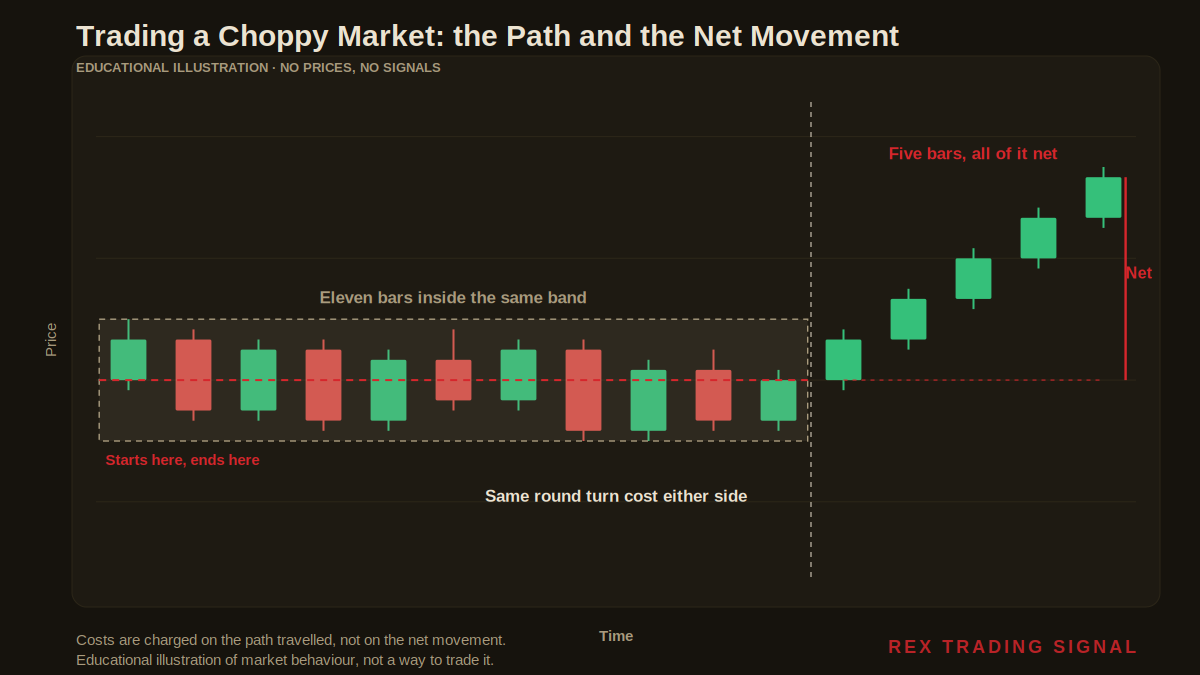
There is a clean way to put a number on how directionless a stretch of market has been, and it does not require an indicator package. Take the price at the start of a window and the price at the end, and measure the distance between them. That is the net movement. Then add up the absolute size of every step in between, ignoring direction. That is the path. Divide the first by the second and you get a ratio between zero and one, usually called an efficiency ratio.
A ratio of one means the market went from A to B in a straight line: every unit of movement was progress. A ratio near zero means it wandered a great distance and ended up roughly where it began. Your costs are charged on the path. Your profits come out of the net movement. When those two numbers diverge, the market is quietly repricing your business without changing anything on your fee schedule.
So I measured it. Using the World Gold Council's published series of the LBMA gold benchmark price, I took 380 observations running from 18 September 2023 to 18 September 2026, and computed the efficiency ratio over rolling windows of 20 observations, which is roughly two months of trading. That gives 361 overlapping windows. The results are not close:
- The lowest window came in at 0.000, a two month stretch that ended where it started.
- The tenth percentile was 0.035.
- The median window was 0.263.
- The ninetieth percentile was 0.573.
- The highest was 0.929.
Two things jump out. First, the median is 0.263, which means that in a typical two month window, roughly three quarters of the distance the market travelled produced no net movement at all. Second, 58 per cent of all windows scored below 0.30, and only 9 per cent scored above 0.60. Choppy is not the exception you wait out. On this measure, choppy is the normal state and trending is the exception.
One honest caveat on the measurement: the series I used samples roughly every second trading day, not every day and certainly not every hour. A finer sample would capture more of the path and fewer of the straight lines, which means the true efficiency ratios are lower than the ones above, not higher. The number understates the problem.
Putting the Cost Next to the Opportunity
Now the business arithmetic, with the assumptions written out so you can disagree with any of them.
Assume an account that turns over 20 round turns in a month. Assume each round turn costs 0.15 per cent of the notional traded, covering the spread and the commission. That makes the monthly transaction cost 3.0 per cent of notional, and it is a fixed cost in the sense that matters here: it does not care what the market did. Now assume the path the market travelled in that month was 10 per cent of notional, the same in every scenario. Only the efficiency ratio changes.
- In a tenth percentile window, efficiency 0.035, net movement is 0.35 per cent of notional. The 3.0 per cent of costs is 854 per cent of the entire net movement available.
- In a median window, efficiency 0.263, net movement is 2.63 per cent. Costs are 114 per cent of it.
- In a ninetieth percentile window, efficiency 0.573, net movement is 5.73 per cent. Costs are 52 per cent of it.
Read the median line again, because it is the one that describes most months. In a typical window, the cost of 20 round turns exceeds the entire net movement the market offered. Not your share of it, all of it. That is before a single losing trade, before slippage on a bad fill, before anything you would normally blame.
This is why the choppy fortnight feels like incompetence. The arithmetic was against the activity itself, and no amount of reading the chart better changes a fixed cost charged per transaction.
The Fix Is on the Cost Side, Not the Skill Side
Any other business owner looking at that table would reach the same conclusion within a minute, and it would not involve trying harder. If your cost per transaction is fixed and the revenue per transaction has collapsed, you do fewer transactions. That is not defeat, it is the ordinary response to a change in unit economics.
Halve the trade count in a low efficiency window, from 20 round turns to 10, and the monthly cost falls from 3.0 per cent of notional to 1.5 per cent. You have kept 1.5 per cent of notional that would otherwise have been spent buying access to movement that was not there. Nothing about your analysis had to improve. You simply stopped paying full price for a thin month.
The more interesting version of this is that it changes what a filter is for. Most people treat a market condition filter as a way to improve their win rate, and then judge it by whether it did. That is the wrong test. A filter is a cost control. Its job is to stop the business from buying inventory in a season when nothing sells, and you should judge it on total costs avoided rather than on whether the trades it blocked would have won. Some of them would have. That is not the point, any more than a shop that closes on a dead Tuesday is refuted by the one customer who turned up.
Choppy Is Not the Same as Quiet, and the Difference Matters
These two conditions get filed under the same heading and they are not the same business problem at all.
A quiet market has little movement in either sense. The path is short, the net movement is short, and the temptation is boredom. You know it is happening because nothing is going on, the screen barely changes, and the risk is that you invent a reason to trade just to feel employed. The cure is patience, and it is mostly a discipline problem.
A choppy market is the opposite in one crucial respect: there is plenty of movement. The path is long. Every candle looks like something is developing, because in the narrow sense something is. What is missing is not activity, it is direction. And that is far more expensive than boredom, because a quiet market does not tempt you into twenty round turns. A choppy one does. It produces a constant supply of setups that look exactly like the ones that work, right up until the point they turn around.
This is why the two conditions need different rules. Against a quiet market you are defending yourself from doing something for the sake of it. Against a choppy market you are defending yourself from doing the right thing at the wrong price, over and over, while the bill accumulates. The first is a psychology problem with a cost, the second is a cost problem with a psychological disguise, and treating the second as though patience alone will fix it is how a fortnight disappears.
There is a volatility trap hiding in here too. A choppy market often has high realised volatility, so any sizing rule that scales with volatility will quietly shrink your positions during exactly the stretch where your fixed costs per trade have become the dominant problem. Smaller positions, same number of round turns, same cost per round turn. The cost line does not shrink with your size the way the opportunity does.
Writing the Rule Before You Need It
The reason this does not get done is that the decision arrives at the worst possible moment. You notice the market is chopping after it has already taken three stops off you, which is exactly when stepping back feels like quitting while behind. So the rule has to exist before the week starts, in writing, in the operating plan.
What that looks like in practice is a threshold and a consequence, both decided in advance. The threshold is a measurement of how directionless recent trading has been, whether you compute the efficiency ratio yourself over a rolling window or use any equivalent measure of range against path. The consequence is a specific reduction in activity, not a vague intention to be more selective. Halve the trade count, or stand down entirely below some level, and write down which.
Then log it. When the month is over, the entry in the book should record the condition, the rule it triggered, the trades not taken and the costs not incurred. That last column is real money and it belongs on the same page as the profit and loss, for the same reason a business tracks what it did not spend. If you do not have a place to put that, the one page trading business plan template has a section for exactly this kind of operating rule, and the fixed and variable costs of a trading business article covers where transaction costs sit in the accounts.
Get the free REX one page trading business plan, including a place to write down the market condition rule that decides when your business trades less. One email, no spam, unsubscribe anytime.
Get the free business plan →Frequently Asked Questions
Is trading choppy market conditions always a bad idea?
No. It is a worse deal at the same cost per trade, which is a different statement. If your cost per round turn is genuinely small relative to the movement you are targeting, the arithmetic changes. The point is to price the condition rather than ignore it, and 58 per cent of the two month windows measured here scored below 0.30.
How do I know a market is choppy before it costs me?
You do not know in advance with any certainty, and anyone who says otherwise is selling something. What you can do is measure the recent past, which is what the efficiency ratio does, and accept that it is a lagging description. A rule based on a lagging measure still beats a decision made after three stop outs.
Should I just widen my stops in a choppy market?
That changes your risk per trade rather than your cost per trade, so it addresses a different problem. If you widen the stop without reducing size, you have increased the risk on every position in the least rewarding conditions. That is the wrong direction.
Does this mean I should switch to a longer timeframe?
It can, because fewer decisions means fewer round turns, and the arithmetic above rewards that directly. Just be honest that you are changing the business model rather than applying a temporary patch, and check that your costs and your available time actually suit it.
Where did the numbers in this article come from?
The efficiency ratios were computed from the World Gold Council's published LBMA benchmark price series, 380 observations from 18 September 2023 to 18 September 2026, sampled roughly every second trading day, over 361 rolling windows of 20 observations each. The cost figures assume 20 round turns a month at 0.15 per cent of notional each and a monthly path of 10 per cent of notional, all stated so you can substitute your own. No gold price level appears anywhere in this article, and none of it is a forecast.
Where REX Fits
REX Trading Signal is free to follow. The daily record goes up with the reasoning stated before the outcome is known, losing days included, because a business keeps the whole ledger. There is a free one page business plan for anyone who wants the operating structure in one place, and nothing here promises a profit or acts as a signal service. If this article is useful to you, read what a business owner does when the market goes quiet for the discipline side of the same problem, and trading in volatile markets for the opposite condition, where the pricing decision runs the other way.
Cost per transaction is fixed, net movement is not, and the gap between those two facts is where a quiet month goes.
About the author. Rex writes REX Trading. He came to this from running an actual business with actual inventory, where nobody would dream of buying stock at full price into a dead season and calling it discipline. Nothing in this article is a recommendation to trade, and no entry, stop or target discussed should be treated as a signal.