
A member messaged me in the middle of a bad fortnight and asked the question straight: should i take a break from trading, or is stopping just quitting with better manners? He had lost six in a row, he was sleeping badly, and he had started opening the platform before he had decided what he was looking for. It is a good question and it almost always gets answered with feelings. I want to answer it the way you would answer it about any other business you owned, which means with the operating manual and a calculator rather than with encouragement.
The short version is that most traders take breaks at exactly the wrong times and for exactly the wrong reasons, and the fix is to stop treating downtime as a response to pain and start treating it as scheduled maintenance. Everything numerical below is my own calculation from assumptions I state, apart from the aviation rules, which are quoted from the regulation itself.
Should i take a break from trading, or is the streak just arithmetic?
Start by ruling out the most common trigger, because it is usually not evidence of anything. A run of losses feels like information. Most of the time it is just what independent trades look like when you line enough of them up.
Take a business doing 200 trades a year at a 45 per cent win rate. The chance of seeing at least one run of six consecutive losses somewhere in that year is 93 per cent. The longest losing run you should expect, as a matter of ordinary arithmetic, is about eight. Not as a disaster, as the base case.
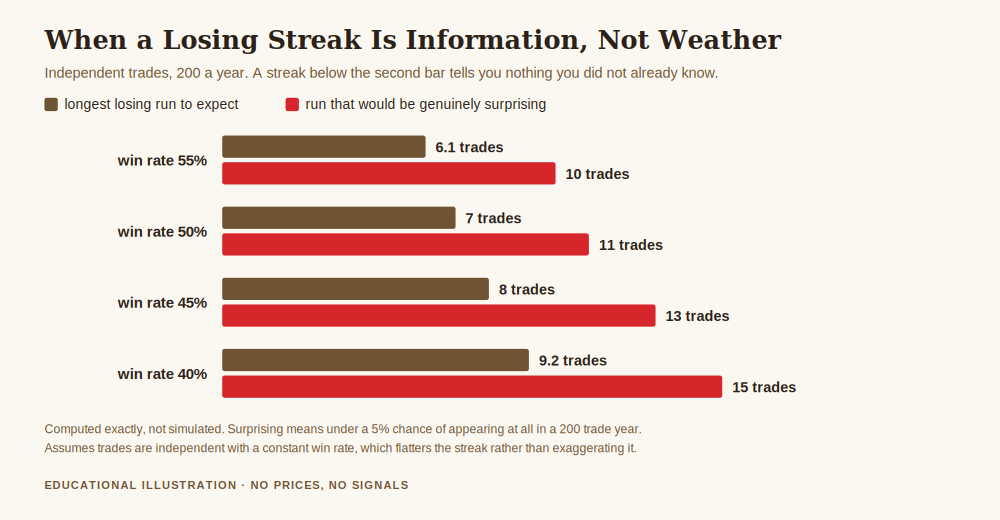
The right hand bar is the number worth writing into your operating rules. It is the shortest run whose chance of turning up at all in a 200 trade year is under 5 per cent. At a 45 per cent win rate that is thirteen. Below thirteen, a streak is weather. At or above it, something has probably changed in the process and the business has a real reason to stop and look.
Notice how far that sits from where people actually stop. Three losses in a row feels catastrophic and carries almost no information. I have taken breaks after three. They were not decisions, they were flinches.
One honest caveat about that calculation. It assumes trades are independent with a constant win rate, which is not quite true of anybody. But the assumption works against my argument rather than for it: real trading has streaky stretches that make long runs more common than the table says, not less. If a run is unremarkable under these assumptions, it is unremarkable.
What a regulated industry does about the same problem
Commercial aviation faces a version of this question with rather higher stakes, and it did not leave the answer to how the crew felt on the day. The rest requirements for US flightcrew are set in 14 CFR Part 117, and the shape of the rule is worth copying even if the numbers are not.
Four provisions matter here. A flightcrew member must be given at least 30 consecutive hours free from all duty in any 168 consecutive hours. Before any duty period there must be at least 10 consecutive hours of rest containing a minimum of 8 uninterrupted hours of sleep opportunity. Flight duty is capped at 60 hours in any 168 consecutive hours, and at 190 hours in any 672 consecutive hours.
Run those last two against each other and you find the interesting part. Sixty hours in a week is 35.7 per cent of the available hours. One hundred and ninety hours over four weeks is 28.3 per cent, which is about a fifth tighter. The rule assumes a week at the ceiling is survivable and a month at the ceiling is not, so it prices recovery into the longer window rather than the shorter one.
And the 30 hour block is not a ceiling at all, it is a floor that cannot be traded away. Nobody has to justify it, nobody has to be tired enough to earn it, and no amount of feeling fine makes it optional. That is what separates scheduled downtime from reactive downtime, and it is the single idea I would take from Part 117 into a trading business.
The cost of stopping, and the cost of not stopping
The reason people resist a break is opportunity cost, so price it. Two hundred trades over 46 trading weeks is about 4.35 trades a week. For an operator with a genuine edge of 0.10 R per trade, a week off costs 0.43 R of expected profit. Two weeks costs 0.87 R. Four weeks costs 1.74 R.
Those are small numbers, and the second column is what makes them look smaller still. Suppose being rattled does what being rattled does, and turns an edge of plus 0.10 R into minus 0.10 R while also doubling position size. Eight trades taken in that state cost 1.6 R. If the edge goes to minus 0.20 R instead, the same eight trades cost 3.2 R.
So two weeks of deliberate downtime costs under one R, and a week and a half of trading badly costs two to four times that, before you count the extra variance that double size drags in. The break is the cheap option and it is not close. The only case where the arithmetic reverses is the operator with a large, verified edge who is not actually impaired, and that operator was not asking the question.
Why the reactive break is the worst of both worlds
The obvious alternative to a calendar is a rule: stop after k losses in a row. It sounds disciplined. Run the numbers on it and it falls apart from both ends.
At a 45 per cent win rate over 200 trades, a stop after three rule fires about fifteen times a year. If each firing means a week off, that is roughly 65 trades of downtime a year, a third of your business, triggered by a pattern that carries almost no information. Go the other way and set the trigger at eight, and it fires 0.73 times a year, which means it is not really a rule, it is a thing you wrote down once.
There is a deeper problem than the frequency. A reactive break hands the scheduling decision to your worst moment. You stop when you feel terrible, which means you stop after the damage, and you come back when you feel better, which is a state with no relationship at all to whether the process has been fixed. A business that only services equipment after a breakdown is not running a maintenance policy, it is running a repair policy, and paying repair prices.
What a scheduled downtime policy looks like
Here is what I actually run, offered as a worked example rather than as instruction:
- A weekly floor. One period of at least 30 consecutive hours with the platform closed, the alerts off and no chart review. Mine runs from Friday's close. It is not earned and it is not skippable, exactly as in Part 117.
- A quarterly block. One full week off every quarter, put in the calendar at the start of the year, before anyone knows whether it will fall in a good month or a bad one. This is the one people negotiate with themselves about, which is precisely why it goes in early.
- An evidence trigger, set high. A losing run at or beyond the surprising threshold for my own win rate stops trading, not because it feels bad but because at that length something has probably changed. The stop is not a rest, it is a review: pull the last thirty trades and check whether the process was followed before deciding anything about the strategy.
- A state trigger that is not about results. Two nights of bad sleep, or catching myself opening the platform without a written plan for the session. This one fires on inputs rather than outcomes, which is the only way to catch impairment before it shows up in the P and L.
The last one is the one that took me longest to accept, because it means stopping on days when nothing has gone wrong yet. That is the entire point. Part 117 does not wait for an incident either.
Coming back, and what to check first
A break with no defined return is a slow exit, so write the return date down at the same time you write the stop. Then treat the first week back as a restart rather than a resumption: smallest size you consider meaningful, and a written plan per session, until you have a handful of trades where the process was followed regardless of outcome.
Before you take a single trade, do the review you were going to do anyway. Was the streak inside the expected range for your win rate, or past it? If it was inside, the process is probably fine and the break was maintenance. If it was past it, the break bought you the chance to find out what changed, and skipping the review wastes the whole thing.
If you are rebuilding the weekly rhythm after time off, the weekly review is the natural place to anchor it, and knowing when to stop for the day covers the shorter timeframe version of the same decision.
Get the free REX one page business plan, the sheet I use to run an account like a business, including where the scheduled downtime and the review triggers go. One email, no spam, unsubscribe anytime.
Get the free business plan →Frequently asked questions
How long should a break from trading be?
Long enough to be a real interruption and short enough to have a date on it. A weekly floor of 30 consecutive hours and a quarterly block of a week is the structure I use. What matters more than the length is that the end is defined in advance, because an open ended break is how people drift out of the business without deciding to.
Will I lose my edge if I stop for a week?
The arithmetic says a week off costs an operator with a 0.10 R edge about 0.43 R of expected profit. Whether execution quality decays over a week is a separate question and I have no data on it, which is why the return protocol above starts small and rebuilds rather than picking up where it left off.
Is a losing streak a good reason to stop?
Only past the point where it is surprising. At a 45 per cent win rate over 200 trades a run of six is 93 per cent likely to happen, so it tells you nothing. Thirteen would be genuinely unusual and is worth a full process review. The trouble with streak triggers generally is that they schedule your downtime for your worst moment.
Should I close open positions before taking a break?
That is a question about your own rules rather than one I can answer for you, but a break is not a break if a position is still running, because the position keeps the attention even when the platform is closed. Whatever you decide, decide it before the break rather than during it.
Where did the aviation figures come from?
From 14 CFR Part 117 directly, sections 117.23 and 117.25, read from the Electronic Code of Federal Regulations on 1 October 2026. They are quoted rather than paraphrased because the exact windows are what make the comparison useful.
What if I cannot afford to stop, because trading is my income?
Then the business has a cash reserve problem rather than a downtime problem, and the downtime problem is a symptom. A business that cannot pause without missing a payment is running with no buffer, which is its own risk and a larger one than a fortnight of missed trades.
Where REX fits
REX Trading Signal is a free journal about running a trading account as a business, with the books, the costs and the operating rules written down. Everything is free to read and free to follow on Telegram. The optional piece is the one page business plan above. There are no profit promises here, no results marketing, and nothing anyone can sell you that will make your account behave.
If you are formalising the operating side more generally, the one page business plan is where the downtime policy and the review triggers actually live.
About the author. Rex writes REX Trading Signal and treats an account as a business with books, costs and an operating manual. He took reactive breaks for two years before working out that scheduling them in advance cost less and worked better. Nothing here is financial advice, and no entry, stop or target discussed should be treated as a signal.