
A setup appears, you take it, price pulls back, and the pullback looks like a better price for the same idea, so you take it again. Then it pulls back a little further and you add a third. Each ticket was sized by the rules. Each one, on its own, risked exactly what the business allows. And yet multiple entries on the same trade are not three trades. They are one position that happens to have been opened in three instalments, and the risk rules that looked at each ticket separately never saw it.
This is a risk accounting article, not a strategy article. There is no entry here, no stop, no target and nothing to copy. What follows is the arithmetic of what stacking does to the size of a loss, to the probability of that loss, to a daily loss limit and to a drawdown, with every assumption written out so you can check it against your own records.
The question comes up in my inbox more than you would think. Roughly 16 messages there match the overtrading keywords, which is a keyword count and not a survey, but the same worry runs through them. One reader asked: "When there are two entry fields for trading, how many entries should I place in each one?" Another noticed the problem from the other side: "Not everyone has a large enough account to make many entries." A third had learned it the expensive way: "I was opening too many trades. I had to adjust the number of orders." They are all asking the same thing. How much risk is actually on the table?
What Multiple Entries on the Same Trade Actually Are
The test is simple. Ask where each entry would be proven wrong. If the answer is the same level for all of them, they are one idea, and one idea is one position however many order tickets it took to build.
That is the whole definition, and it matters because most risk rules are written per ticket. Risk 1 per cent per trade. Never more than 1 per cent on any single order. Those rules are sound, and they are also blind to stacking, because each of three entries does honestly risk 1 per cent on its own. It is only when you ask what happens at the shared invalidation that the real number appears, and the real number is the sum.
I watched this happen in this channel on a recent session. Two long setups on gold went out in the same session, and both reached their stops the same day. I stood down for the rest of the day rather than try to win it back. They were separate setups, but they were long the same instrument at the same time, so the market only had to do one thing to prove both of them wrong. On the books, that afternoon was one bad idea expressed twice.
The Arithmetic, With the Assumptions Written Out
The assumptions, all of them, because the conclusions are only worth what the assumptions are worth. An account of 10,000 dollars. A risk rule of 1 per cent per entry, so one R is 100 dollars. Three entries taken on the same idea, each sized at 1R, each sharing the same invalidation level. For the probability comparison, any single idea fails with a probability of 0.55, which is an assumption for illustration and not a claim about any real method.
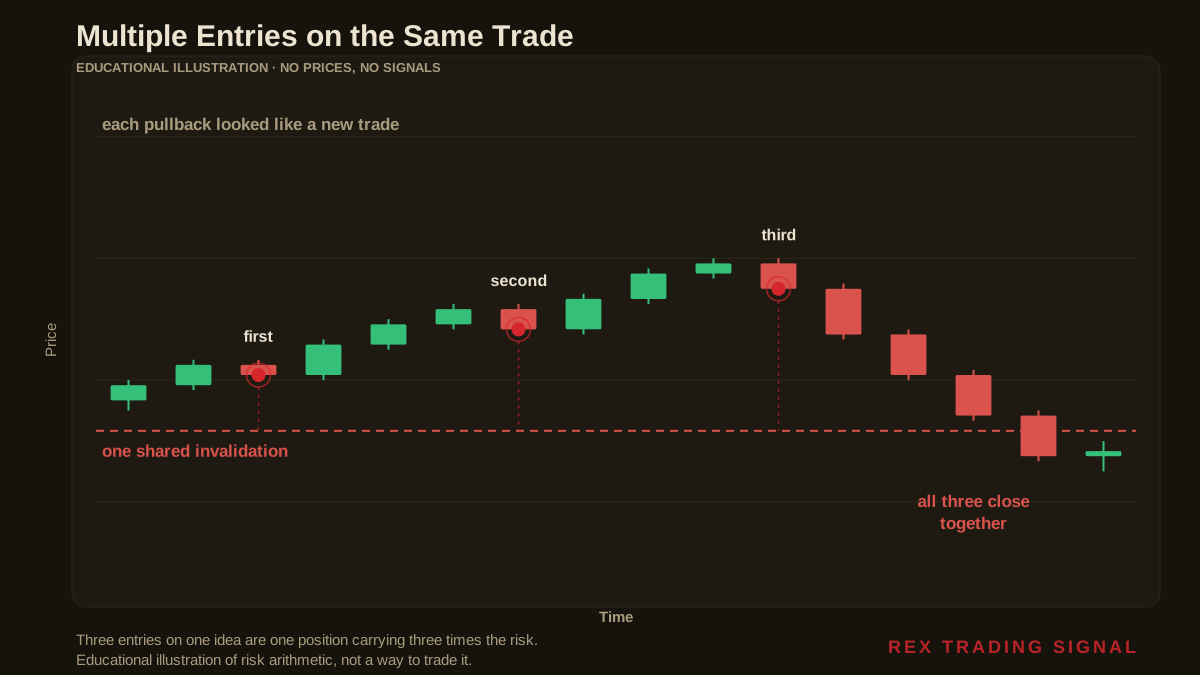
The first number is the size. Three entries of 1R each on one idea put 300 dollars, or 3 per cent of the account, behind a single point of failure. The per entry rule was obeyed three times and the per idea risk tripled.
The second number is the one that people miss, and it is the reason this deserves its own column on the books.
Why the Probability Changes, Not Just the Size
Take three ideas that are genuinely independent, meaning each can fail without the others failing. If each fails with a probability of 0.55, the chance that all three fail is 0.55 multiplied by itself three times, which is 0.1664, or 16.64 per cent. A 3R loss from three independent trades is possible but it is not the usual outcome.
Now take three entries on the same idea. They do not fail independently. They fail together, at the same line, at the same moment. So the chance that all three fail is simply the chance that the one idea fails, which is 0.55, or 55 per cent.
On those assumptions, losing 3R in one go is 3.31 times more likely when the risk is stacked on one idea than when it is spread across three independent ones. Same total risk. Same per entry rule. A completely different distribution of outcomes.
This is the oldest result in portfolio theory, and it is worth reading at the source. Harry Markowitz set it out in Portfolio Selection, The Journal of Finance, 1952, volume 7, pages 77 to 91. The point that carries over to a single trading account is that holdings which move together do not reduce risk by being numerous. Three entries on one idea are about as correlated as positions can be.
What It Does to a Daily Loss Limit
Suppose the business runs a daily loss limit of 3 per cent, which is an assumption for this example. A single entry at 1R uses a third of that limit, 33.3 per cent of it. Three stacked entries on one idea use all of it, 100 per cent, on one decision.
That changes what the limit is for. A daily loss limit exists so that a bad day ends before it becomes a bad month, and it works by forcing a pause after several separate things have gone wrong. When one stacked idea can consume the entire limit, the limit stops being a circuit breaker for a run of mistakes and becomes a description of a single trade. The business has quietly swapped a safety system for a bet size.
The practical fix is not a new limit. It is counting the risk per idea when you check the limit, so that three tickets on one invalidation register as one 3R decision and not as three small ones.
What It Does to a Drawdown
Run the same comparison across a bad stretch. Assume five ideas in a row fail, which happens to every method sooner or later. With 1 per cent at risk per idea, the account falls by 4.90 per cent, and getting back needs a gain of 5.15 per cent. With 3 per cent at risk per idea, because each idea was stacked three times, the account falls by 14.13 per cent, and getting back needs a gain of 16.45 per cent.
Five losing ideas is not a disaster scenario. It is an ordinary week for many methods. The difference between a 4.90 per cent drawdown and a 14.13 per cent drawdown is not a difference in the quality of the ideas. It is entirely a difference in how the business counted its risk.
One reader described the pattern that produces the second number very precisely: "After a losing trade, I would often try to make it back immediately. I was taking too many trades, using bigger lot sizes." Stacking entries is the polite version of the same thing. It feels like patience, buying a better price, but on the books it is a larger position on one opinion.
When Splitting an Entry Is Legitimate
None of this means a position must be opened in one ticket. Scaling into a position is a reasonable operating choice, and it can be done without any of the problems above.
The difference is where the budget is set. Decide the risk for the idea first, say 1R in total, and then divide that budget across the entries. Three entries of a third of an R each, sharing one invalidation, are still a 1R position. The idea gets the averaging you wanted and the business keeps the risk it agreed to.
What turns scaling into stacking is sizing each entry as if it were the first. That is the version where the per idea risk grows with every pullback. One reader described the moment it starts: "Didn't catch as many entries as I've spread out across the entry range." The temptation to add a full sized ticket is highest exactly then.
Putting It on the Books
The change to the records is one column. Next to every entry, write the invalidation level it shares, or a short label for the idea it belongs to. When you check exposure against the per trade rule, the daily limit or the weekly limit, add up every entry that shares a label and treat the total as one position.
Then add one line to the operating rules: risk is counted per idea, not per ticket. It reads as obvious once written down, and it is almost never written down, which is why the per ticket rules keep being obeyed while the account takes losses that are three times the size those rules were meant to allow.
What This Does Not Say
It does not say that adding to a position is always wrong. Splitting a fixed budget across entries is a legitimate way to build a position. The problem is only stacking full sized entries on one invalidation.
It does not say the 0.55 failure probability describes any real method. It is an assumption chosen to make the comparison visible. The ratio between stacked and independent outcomes changes with the probability you assume, but the direction of the result does not.
And it does not say how to find setups or where to place anything. Nothing here is a view on direction or a reason to take any trade.
Get the free REX one page trading business plan, the document where rules like counting risk per idea get written down once, instead of being renegotiated every time a pullback looks like a bargain. One email, no spam, unsubscribe anytime.
Get the free business plan →Frequently Asked Questions
Are multiple entries on the same trade one position or several?
One position, if they share an invalidation. The test is where each entry would be proven wrong. If the answer is the same level for all of them, the market only needs to do one thing to close every one, so the risk should be added together and counted as a single position.
Is it bad to add to a winning trade?
Not necessarily. The question is whether the total risk on the idea stays inside what the business allows. Adding to a position while keeping the combined risk to the original budget is a sizing choice. Adding full sized entries that each risk the maximum is stacking.
How much risk is three 1 per cent entries on one idea?
Three per cent, on one decision. On a 10,000 dollar account at 1 per cent per entry, that is 300 dollars behind a single invalidation level.
Does stacking change the odds or only the size of a loss?
Both. On the assumption that any single idea fails 55 per cent of the time, three independent ideas all fail together 16.64 per cent of the time, while three entries on one idea all fail together 55 per cent of the time. That makes a 3R loss 3.31 times more likely when stacked.
How should a daily loss limit treat stacked entries?
Count them as one idea. With a 3 per cent daily limit, a single 1R entry uses a third of it, while three stacked entries use all of it on one decision, which turns the limit from a circuit breaker into a bet size.
Where did the numbers in this article come from?
The 300 dollars, the 16.64 and 55 per cent probabilities, the 3.31 ratio, the 4.90 and 14.13 per cent drawdowns and the 5.15 and 16.45 per cent recovery figures are all computed in Python from the assumptions written out above, so you can reproduce or refute them. The portfolio theory reference is Markowitz, Portfolio Selection, The Journal of Finance, 1952, verified through Crossref.
Where REX Trading Signal Fits
REX Trading Signal is free to follow. The daily record goes up on Telegram with the reasoning written before the trade rather than explained after it, losing days included. There is a free one page business plan for anyone who wants the operating documents in one place, and an optional Kit. Nothing here promises a profit.
A rule about counting risk belongs in the document where your operating rules live, which is the one page trading business plan. Concentration risk in your trading business is the same idea at the level of the whole book rather than one trade, how to set a daily loss limit covers the circuit breaker that stacking quietly defeats, and risk of ruin in trading shows what a larger per idea risk does to the odds of surviving a bad run.
About the author. Rex writes REX Trading Signal. He runs the account as a business, which mostly means counting risk the way the market will count it, per idea and per invalidation, rather than the way the order tickets make it look. Nothing in this article is a recommendation to trade, and no entry, stop or target discussed should be treated as a signal.
Disclaimer: This article is general educational content about risk accounting and position sizing. It is not financial advice, not investment advice and not a recommendation to buy, sell or use any product, venue, broker or firm. Figures computed here rest on the stated assumptions, which are illustrative and not a description of any real method or result. Trading carries risk of loss. Only commit capital you can afford to lose.