
The question of how to place same order in multiple trading accounts nearly always arrives as a plumbing question. Somebody has three logins open, a personal account, a second one at a different broker, and a funded account from an evaluation firm, and they want to know which button or which tool fires the same trade into all three at once.
The plumbing has an answer, and it is the least interesting part. What matters is what happens to the business once the plumbing works, because there are two consequences that people discover afterwards rather than before. One is arithmetic and it is worse than it looks. The other is regulatory and it depends entirely on whose money is in those accounts.
I am going to take them in that order, because the arithmetic applies to everybody and the regulation applies to a subset. Both are the kind of thing a person running this as a business writes down before acting, not after.
How to Place Same Order in Multiple Trading Accounts, Mechanically
There are four ordinary ways, and they sit on a ladder from manual to automated.
By hand, one at a time. Open each terminal, place each order. It is slow, the fills differ because time has passed between them, and it does not scale past two or three accounts. It is also the only method that has no software dependency and no third party in the middle.
A multi terminal or trade copier. Most retail platforms have either a built in multi account manager or a market of third party copiers. One master account is designated, orders placed there are replicated into linked accounts according to a sizing rule, usually a fixed ratio or a proportion of equity.
A broker side account manager facility. Some brokers offer an allocation interface where a single order is placed and then divided across sub accounts under one login. The fills are cleaner because the order reaches the market once.
Bunched orders with post execution allocation. This is the institutional version, one order to the market, allocated afterwards. It is the cleanest execution of the four and it is the one with the strictest conditions attached, which we will come to.
Every one of these works. None of them changes the two things below, and that is the entire point of this article.
The Arithmetic Nobody Runs Before Connecting the Accounts
Here is the belief that makes replication feel prudent. More accounts feels like more positions, more positions feels like spreading risk, and spreading risk feels like the responsible thing to do. Every step of that chain is wrong when the orders are identical, and the size of the error is easy to compute.
Assume a single trade loses with probability 0.45. That number is an illustration, not a claim about anybody's results, and the conclusion holds for any value you choose.
If four trades were genuinely independent, the chance of all four losing at once is 0.45 to the fourth power, which is 4.10 percent. That is the number the intuition is quietly using. It is what four separate bets would feel like.
When all four accounts receive the same order, there is only one outcome being repeated four times. The chance of all four losing is not 0.45 to the fourth. It is 0.45, which is 45 percent. The same event, 10.97 times more likely than the intuition suggests.
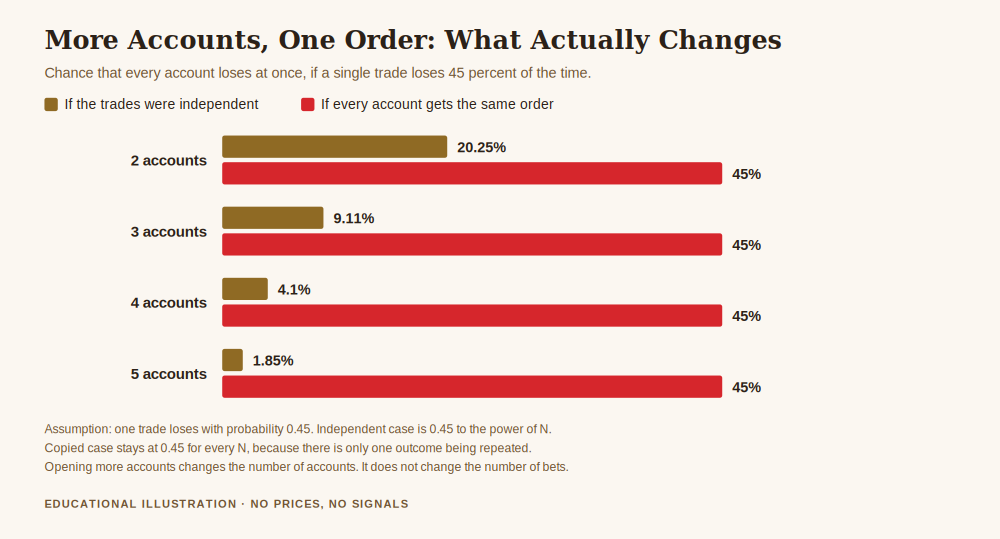
Notice the shape of the chart. The independent bar shrinks as accounts are added, which is what diversification looks like. The copied bar does not move at all. Adding a fifth, sixth or tenth account moves it by exactly nothing, because you have not added a bet. You have added a place where the same bet is recorded.
Now the part that surprises people in the other direction. Suppose each account risks 1 percent of its own equity, and the accounts hold equal amounts. When the trade loses, the total loss across all accounts is 1 percent of the combined equity, for any number of accounts. The risk rate does not get worse.
That sounds reassuring and it is actually the trap. Replication does not increase your risk percentage. It also does not decrease it, and decreasing it is what the person believed they were doing when they opened the extra accounts. They paid the operational cost of running four accounts and received no diversification whatsoever in return. In business terms, they bought something and got nothing.
Where the Copied Version Is Genuinely Worse
The percentage staying flat assumes the accounts are identical in every relevant way. They rarely are, and each difference makes the copy worse than the original rather than merely equal to it.
The fills are not the same. Sequential placement means later accounts trade later, at whatever the market is doing by then. On a fast move, the last account in the chain gets a materially different price, and it is always the same account that loses out.
The cost base is not the same. Four brokers means four spreads, four commission schedules and four swap tables. The same trade is a different trade after costs at each one, and the cheapest venue is subsidising your opinion of the strategy while the most expensive one quietly refutes it.
The rules are not the same. This is the sharpest edge when one of the accounts belongs to an evaluation firm. Those accounts carry their own daily loss limits and their own maximum drawdown terms, and a loss that is routine in your personal account can breach a threshold in the funded one. The copier does not know that. It sends the same order regardless.
The equity is not the same. Ratio based copying scales lot size mechanically. If one account is down 30 percent from a bad month, a fixed ratio keeps sending it the same relative exposure as the healthy accounts, so the weakest account carries proportionally the largest risk at the worst possible moment.
Get the free REX one page business plan, the sheet where the total risk ceiling across every account gets written down once, so no copier can quietly exceed it. One email, no spam, unsubscribe anytime.
Get the free business plan →The Line Where This Stops Being Your Own Business
Everything above assumes the accounts are yours. The moment one of them is not, the question changes from operations to registration, and people cross that line without noticing because the software makes it a checkbox.
In the United States, advising others on commodity interest trading is regulated activity. There is a de minimis exemption, and it has a number in it. Under 17 CFR 4.14(a)(10), which implements section 4m(1) of the Commodity Exchange Act, a person is exempt from registering as a commodity trading advisor if, during the preceding 12 months, they have not furnished commodity trading advice to more than 15 persons and they do not hold themselves out generally to the public as a commodity trading advisor.
Two conditions, and both have to hold. Fifteen is not a large number when a copier makes adding a follower a one click operation. And the second condition catches people who are well under fifteen but have a public channel advertising the service, because holding yourself out generally to the public voids the exemption on its own regardless of headcount.
The rule also defines who counts as a single person, and it is narrower than you would hope. A natural person, a minor child, and a relative or spouse sharing the same principal residence are grouped together. Your brother in another city is a separate person. So is your friend.
Then there is the execution side. Bunched orders, the cleanest way to place one order across many accounts, are governed by 17 CFR 1.35(b)(5). Post execution allocation is permitted, so account identifiers do not have to be recorded when the order is placed, but only if a list of conditions is met. The first one is the one that matters here: the person placing and directing the allocation must have been granted written investment discretion over the participating accounts, and must qualify as an eligible account manager, a registered commodity trading advisor, a registered investment adviser, or another listed category.
Written. Not a message agreeing to it, not an understanding between friends. And the person has to be in a category that mostly implies registration.
None of this is legal advice and I am not qualified to give any. The rules differ by jurisdiction, and the point is not to memorise these particular citations. The point is that the plumbing question has a regulatory answer attached to it, and the honest version of the question is not how to place the same order in several accounts. It is whose accounts are they, which is a question you can answer in ten seconds and should answer before you install anything.
What an Operator Actually Does
Strip the mechanics away and this reduces to four decisions that belong on paper before any software is connected.
Set one risk ceiling for the whole business, not one per account. If the group can lose 1 percent of combined equity on a correlated day, that is the number, and each account's size is derived from it. This is the single control that makes replication safe, and it is the one copiers do not provide because they cannot see across brokers.
Write down what each account is for. An account that exists to hold the same position as another account has no purpose. An account that exists because it is the only venue with an instrument you need, or because an evaluation firm requires it, has a purpose you can state in a sentence. If you cannot write the sentence, close the account.
Reconcile weekly across all accounts as one book. Per account statements will make a bad week look like four small problems. One combined ledger makes it look like what it is, which is one problem multiplied.
Decide the ownership question in writing. Every account is yours, or it is not. If any of them is not, stop and find out what your jurisdiction requires before a single order is copied, because that determination is not reversible after the fact.
The reason people ask how to place the same order in multiple trading accounts is almost always that they want more from a setup they already trust. That instinct is fine. It is just that the answer is not distribution. Copying one opinion into four places multiplies the paperwork, the cost base and the failure modes, and leaves the opinion exactly as good or as bad as it was in one account. The accounts were never the constraint.
Frequently Asked Questions
How to place same order in multiple trading accounts at once?
Either manually in each terminal, through a multi account manager or trade copier that replicates from a master account, through a broker side allocation facility, or as a bunched order allocated after execution. All four work mechanically. Which one you may use depends on whether the accounts are yours, and bunched orders in particular carry conditions under 17 CFR 1.35(b)(5).
Does trading the same setup in several accounts reduce risk?
No. Identical orders are perfectly correlated, so the chance of every account losing at once equals the chance of the single trade losing. With four accounts and a 45 percent loss probability, that is 45 percent rather than the 4.10 percent four independent trades would give. My calculation, assumptions stated in the text.
Is copy trading for friends or family legal?
It depends on your jurisdiction and on the specifics. In the United States, 17 CFR 4.14(a)(10) exempts a person who has advised no more than 15 persons in the preceding 12 months and does not hold themselves out generally to the public as a commodity trading advisor. Both conditions must hold. Other countries have their own regimes. Get advice from someone licensed where you live before you take on anyone else's account.
Why do the fills differ between my accounts?
Because sequential orders reach the market at different moments, and because each broker has its own liquidity, spread and execution policy. Even a copier that fires within milliseconds sends separate orders to separate venues. Expect dispersion and record it, because it is a real cost of running the setup.
What breaks first when one account is a funded evaluation account?
The rules mismatch. Evaluation accounts carry daily loss limits and maximum drawdown terms that your personal account does not have. A copier replicates the order, not the rulebook, so an ordinary loss elsewhere can breach a threshold there. Size that account against its own limits or leave it out of the replication entirely.
Where did the numbers in this article come from?
The 15 person threshold and the definition of a single person are the text of 17 CFR 4.14(a)(10). The written discretion requirement for post execution allocation of bunched orders is 17 CFR 1.35(b)(5)(i). The 4.10 percent, the 45 percent and the 10.97 times ratio are my own arithmetic under the assumptions stated above. No trading results, win rates or gold prices appear anywhere in this article.
Where REX Fits
REX Trading Signal is free to follow. Daily XAUUSD analysis with the reasoning written out, losing days included, plus an optional Kit for people who want the operating system of the business written down. There is no promise of profit here, because nobody can honestly make one.
A risk ceiling that spans every account is a document, not a setting in a copier. The one page trading business plan template is the pillar this sits under, and the combined ceiling belongs on it. How to manage multiple trading accounts covers the bookkeeping side of running several at once, concentration risk in your trading business is the same correlation problem seen from the position side rather than the account side, and how to build a trading system covers the thing that actually was the constraint.
About the author. Rex writes REX Trading Signal. He is interested in the unglamorous half of this business, the ledger, the controls and the review date, on the view that an account survives on its administration long before it survives on its ideas.
Disclaimer: This article is general educational content about the operational and regulatory consequences of replicating orders across accounts. It is not financial advice, not investment advice, not legal advice, not tax advice, and not a solicitation to trade. The 15 person de minimis threshold and the definition of a single person are quoted from 17 CFR 4.14(a)(10), and the written discretion requirement for bunched orders from 17 CFR 1.35(b)(5). These are United States rules and they are summarised, not reproduced in full; other jurisdictions regulate this activity differently and rules are amended, so check the current text and speak to a licensed professional where you live before acting on any of it. Every probability figure is my own arithmetic under the assumptions written out in the text, and an illustrative loss probability is not a claim about anyone's results. Trading gold, CFDs and leveraged products carries a high risk of losing money rapidly, and no entry, stop or target discussed should be treated as a signal.