
How to manage multiple trading accounts is a question that arrives disguised as an admin problem. People ask it expecting an answer about logins, platforms and spreadsheets. The real answer is that an operator with four accounts does not have four businesses, they have one business with four sets of books, and until they start reading it that way the extra accounts are adding cost without adding anything else.
I want to put numbers on that, because "diversification" is doing a lot of unexamined work in most people's reasoning. So I simulated the same capital run two ways, twenty thousand years each, and the gap between the two is the entire subject of this article.
Why Operators End Up With Several Accounts
Usually for one of four reasons, and they are not equally good.
Two prop firm evaluations running at once, because the fee is small and two chances feel better than one. A personal account beside a funded one. A second broker held as a redundancy, because a platform outage during an open position is a real operational risk. Or an account per strategy, so the record for each stays clean.
That last one is the only reason on the list that is genuinely about measurement, and it is the strongest. Separating a scalping record from a swing record so you can tell which one earns its keep is a legitimate piece of bookkeeping. The others are about capacity, redundancy, or hope, and only one of those three is a business reason.
How to Manage Multiple Trading Accounts: The Arithmetic Everybody Skips
Here is the sentence I hear most: "it is fine, I only risk 1 percent per account." That statement can be completely true and completely useless at the same time, and which one it is depends on a single question. Are the accounts taking the same trades?
If you copy one signal into four accounts, that is not four positions. It is one position in four wrappers. When it loses, all four lose together, and your risk on total capital is exactly what it would have been in one account. You have gained nothing and you are now reconciling four statements.
If the accounts genuinely trade independently, the arithmetic changes, and it changes in a specific way: independent exposures do not add in a straight line, they add along the diagonal, scaling with the square root of the number of accounts. Written out, with each account risking 1 percent of its own equity and total capital held constant:
- 2 accounts: mirrored risk stays 1.000 percent of total, independent falls to 0.707 percent
- 3 accounts: mirrored 1.000 percent, independent 0.577 percent
- 4 accounts: mirrored 1.000 percent, independent 0.500 percent, a 2.00 times difference
- 10 accounts: mirrored 1.000 percent, independent 0.316 percent, a 3.16 times difference
The mirrored column never moves. That is the point of it. Every bit of benefit available from running more than one account lives in the second column, and copying a signal collects none of it.
What That Looks Like Over a Year
The table above is a snapshot of one bad day. The thing an operator actually has to fund is the drawdown, so I simulated it properly. Same total capital in every case, split equally, 1 percent of each account's own equity risked per trade, a 40 percent win rate at a two to one payoff, an expectancy of plus 0.20 units of risk per trade, two trades per account per day, 252 days, twenty thousand simulated years per configuration.
Typical aggregate drawdown across the whole book over one year:
- mirrored, at any number of accounts: 15.76 percent, with one year in twenty reaching 25.62 percent
- genuinely split across 2 accounts: 9.38 percent, one year in twenty at 15.05 percent
- genuinely split across 4 accounts: 5.42 percent, one year in twenty at 8.51 percent
- genuinely split across 8 accounts: 3.02 percent, one year in twenty at 4.70 percent
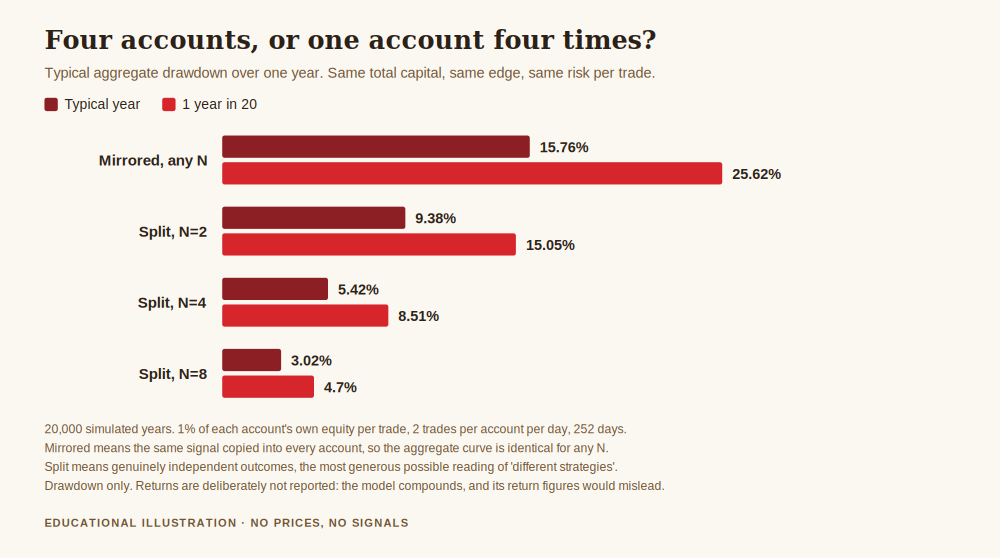
Read the first line again. Mirrored, at any number of accounts. One account or eight, if the trades are the same the aggregate curve is identical, so the drawdown is identical. Opening the eighth account changed the admin and nothing else.
Meanwhile the genuinely split book at four accounts carries a typical drawdown 2.91 times smaller on the same capital and the same edge. Worth noting that this is better than the square root rule from the previous section predicts. Drawdown shrinks faster than exposure does, because averaging independent paths smooths the shape of the equity curve as well as shrinking each step, and a drawdown is a property of the path. The square root rule is the conservative version of the benefit.
So the prize is real, and it is large. It is also conditional on something most multi account operators do not have: strategies whose losing days genuinely do not coincide. Two "different" strategies that are both long gold on the same morning are one strategy with two names, and the model above would score them as mirrored, not split.
The Part Where Per-Account Rules Bite
Now add the rules that come attached to funded accounts. In the same simulation I applied, to each account separately, a 5 percent daily loss limit and a hard stop at 20 percent below its own high water mark. Then I counted what happens inside one year:
- Mirrored: the chance at least one account is knocked out is about 19.5 percent, and it stays about 19.5 percent whether you run one account or eight. The chance you lose all of them is the same 19.5 percent, because they die together.
- Split, 2 accounts: at least one gone rises to 35.65 percent, all gone falls to 4.17 percent.
- Split, 4 accounts: at least one gone rises to 58.92 percent, all gone falls to 0.18 percent.
- Split, 8 accounts: at least one gone rises to 82.87 percent, all gone falls to almost zero.
This is the trade-off nobody states out loud, and it is a genuine one rather than a trick. Mirroring keeps the set intact or loses the set in one piece. Splitting makes it near certain that something gets knocked out in any given year, while making it very unlikely that everything does.
Which of those you want is a business decision, not a trading one. If losing one funded account means an evaluation fee and an afternoon of irritation, the split book is obviously right: you are trading a high chance of a small loss for a near zero chance of a catastrophic one. If losing one account means losing a client's confidence or a relationship you cannot rebuy, the calculus is different, and you should be running fewer sets of books rather than more.
What is not a business decision is drifting into eight accounts without deciding which regime you are in.
The Costs That Do Not Show Up on Any Statement
Three of them, and the first is measurable.
Idle margin. Every extra account needs its own margin, and capital pinned in account three to satisfy account three's requirements is capital doing nothing. Using the Federal Reserve H.15 three month constant maturity yield averaged over my sample period, 2.34 percent per year, holding a quarter of total capital idle costs 0.58 percent of total capital per year, and holding half costs 1.17 percent. Small, dull, and it comes off the top every single year.
Reconciliation. With one account, your P&L is a number you can read. With four, it is a number you have to assemble, and anything you have to assemble gets assembled late, or monthly, or never. This is the failure I see most: the operator can tell you exactly how each account is doing and cannot tell you how the business is doing, which means the only figure that matters is the one they never look at.
Attention. Four platforms open is four times the chance of the wrong ticket in the wrong window, and it is not a hypothetical error, it is an ordinary one on a busy morning.
What an Operator Actually Does About It
Five things, in order.
Set the risk limit on total capital, not per account. Per account limits are constraints imposed on you from outside. Your own limit is the one that governs the whole book, and it is the only one that describes your actual exposure. If your rule is 1 percent, it is 1 percent of everything you have at risk across every login, and the per account numbers have to fit inside it.
Keep one set of consolidated books. One sheet, updated on the same day each week, with every account as a row and the total as the line you actually read. If assembling it is painful, that is information: it means you have more accounts than you have systems.
Write down, honestly, whether your strategies are independent. Not whether they have different names. Whether they lose on different days. If you cannot point to periods where one was down and another was up, you are running a mirrored book and should price it as one.
Decide the regime deliberately. Mirrored for capacity, split for survivability, and never both by accident. Then size to the aggregate, whichever you chose.
Close the accounts that are not earning their keep. An account that exists because you opened it once is a cost centre. The test is simple: what question does this set of books answer that the others do not? No answer, no account.
Get the free REX one page business plan, the sheet where the risk limit for the whole book sits in one place instead of being scattered across four logins. One email, no spam, unsubscribe anytime.
Get the free business plan →Frequently Asked Questions
Is it better to have one big account or several small ones?
It depends entirely on whether the small ones would trade differently. If they would mirror each other, one account is strictly better: identical risk, a quarter of the admin, no idle margin. If they would run genuinely independent strategies, the split book carried a typical drawdown 2.91 times smaller at four accounts in my simulation, which is a serious advantage.
How to manage multiple trading accounts without losing track of total risk?
Put the limit on the total, then treat each account's allowance as a slice of it rather than a fresh budget. The error that causes real damage is arithmetic drift: four accounts each "allowed" 2 percent, which quietly becomes an 8 percent book on any morning the four agree with each other.
Does copy trading across accounts count as diversification?
No. It is the definition of the mirrored case. Copy trading multiplies your position count and your admin while leaving your risk profile untouched, and every figure in the mirrored row above applies to it exactly.
How many prop firm accounts should I run at once?
That is a capacity question, and the honest input is the one above: with independent trading, the chance of at least one account being knocked out inside a year was 58.92 percent at four accounts. Run a number where that outcome is an operating cost you have already budgeted for, not a surprise.
Should each account have its own strategy?
If you can genuinely run more than one, yes, because that is what turns extra accounts from overhead into diversification, and it keeps each record clean enough to judge. Most people cannot run two properly at once, and two half executed strategies are worse than one executed well.
Where did the drawdown figures come from?
I computed them, twenty thousand simulated years per configuration, with the assumptions stated in the text and repeated in the disclaimer. I have deliberately not published simulated returns from the same model: it compounds a fixed fractional bet, so its return figures would be large, arbitrary and easy to misread as a forecast. Drawdown is the quantity this article is about.
Where This Leaves You
The question is never how many accounts you have. It is whether they are the same account wearing different names.
If they are, consolidate, because you are paying four times the overhead for one position and holding margin idle to do it. If they are genuinely different, then you own something valuable, a book whose typical drawdown is a fraction of what any single account would produce on the same capital, and the job becomes protecting that independence rather than accidentally trading it away on the mornings when every strategy likes the same idea.
Either way the operating rule is the same one this whole business runs on. One set of books, one risk limit on the total, and every account required to justify the question it answers. Concentration risk in your trading business covers the same arithmetic applied to positions rather than logins, the key metrics every trading business should track is what belongs on the consolidated sheet, and the one page trading business plan template is where the total limit gets written down in the first place.
About the author. Rex writes REX Trading Signal, where a trading account is treated as a small business with costs, capacity limits and a set of books. He is more interested in the constraint that ends the quarter than in the trade that started it.
Disclaimer: This article is general educational content about the operational and risk arithmetic of running more than one trading account. It is not financial advice, not a recommendation of any broker, prop firm or account structure, and not a suggestion to open any particular position. Trading gold, CFDs and leveraged products carries a high risk of losing money rapidly. No entry, stop or target discussed should be treated as a signal. The drawdown and knockout figures are outputs of a Monte Carlo simulation I wrote, 20,000 simulated years per configuration, under the stated assumptions: total capital fixed and split equally between accounts, 1 percent of each account's own equity risked per trade, a 40 percent win rate at a two to one payoff, expectancy of plus 0.20 units of risk per trade, two trades per account per day, 252 trading days, trades independent within an account, no costs and no slippage. "Mirrored" assumes perfectly correlated outcomes across accounts and "split" assumes perfectly independent ones; real books sit between the two and are usually closer to mirrored. The per-account rules modelled are a 5 percent daily loss limit and a hard stop 20 percent below the high water mark, which are a common shape and not a quote from any named firm. These figures describe a model, not any real account, and they are not a target, a projection or a promise. Simulated returns are deliberately not reported. The idle margin figure uses the Federal Reserve H.15 three month constant maturity yield averaged over the 2,585 days with a published value between 4 January 2016 and 14 August 2026, cross referenced against the session calendar of the published LBMA gold benchmark. No gold price is quoted anywhere in this article and no trading results are represented. Past behaviour of a public benchmark is not a prediction.