
If you trade gold, you have probably seen binance gold futures pop up in your feed this year. Gold on a crypto exchange, settled in USDT, with leverage most gold brokers will not offer. Then this week the same exchange paused withdrawals after a record hack. So the question in my inbox is simple: trade gold there, or with a regulated gold broker? I will not pick for you. I run my trading account like a business, and a business checks the contract, the costs and who holds the money before it chooses a supplier. That is what this page does.
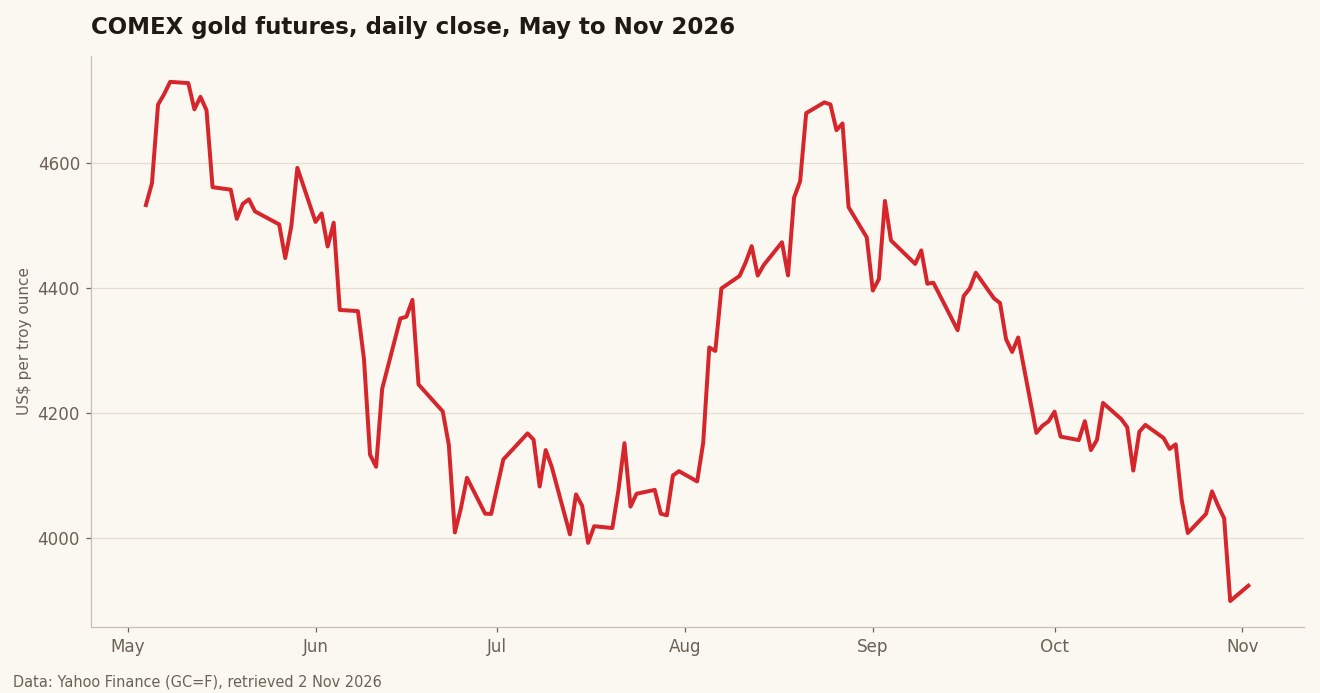
Source: Yahoo Finance daily closes (GC=F), retrieved 2 Nov 2026. Chart by REX Trading Signal.
What you are actually buying
Binance announced USDT-settled perpetual futures on gold and silver on 8 January 2026, as DL News reported at the launch. The gold contract is listed as XAUUSDT. According to reports at the time, it offers up to 50x leverage, a minimum size of 0.001 ounces, sits under a "TradFi" tab in the app, and is offered through an entity regulated in Abu Dhabi Global Market. Binance also lists two older gold-linked perpetuals: one on PAXG with up to 75x leverage, and one on Tether Gold (XAUT), whose monthly volume reached a record 6.4 billion dollars in March 2026, according to FXStreet.
Here is the part that matters for a business owner. A perpetual future is a contract, not a bar of gold. When you open a position, you do not own any metal and you do not own a token backed by metal. You hold a USDT-margined agreement with the exchange that pays you, or charges you, as the price moves. There is no expiry date, which is why it is called perpetual, and the exchange keeps the contract price close to the real gold price with a regular payment between buyers and sellers called funding.
A gold CFD at a normal broker is also a contract, not metal. The difference is who stands behind it and what your margin is made of. On Binance your margin is USDT sitting on a crypto exchange. At a regulated broker it is usually cash, held under that regulator's client money rules. That one difference carries most of the risk on this page.
Binance gold futures: the leverage maths first
Leverage is the first number a business should check, because it decides how fast a normal day can end the account. The arithmetic is plain: the loss on your margin equals the move against you times the leverage. Fees and funding come on top.
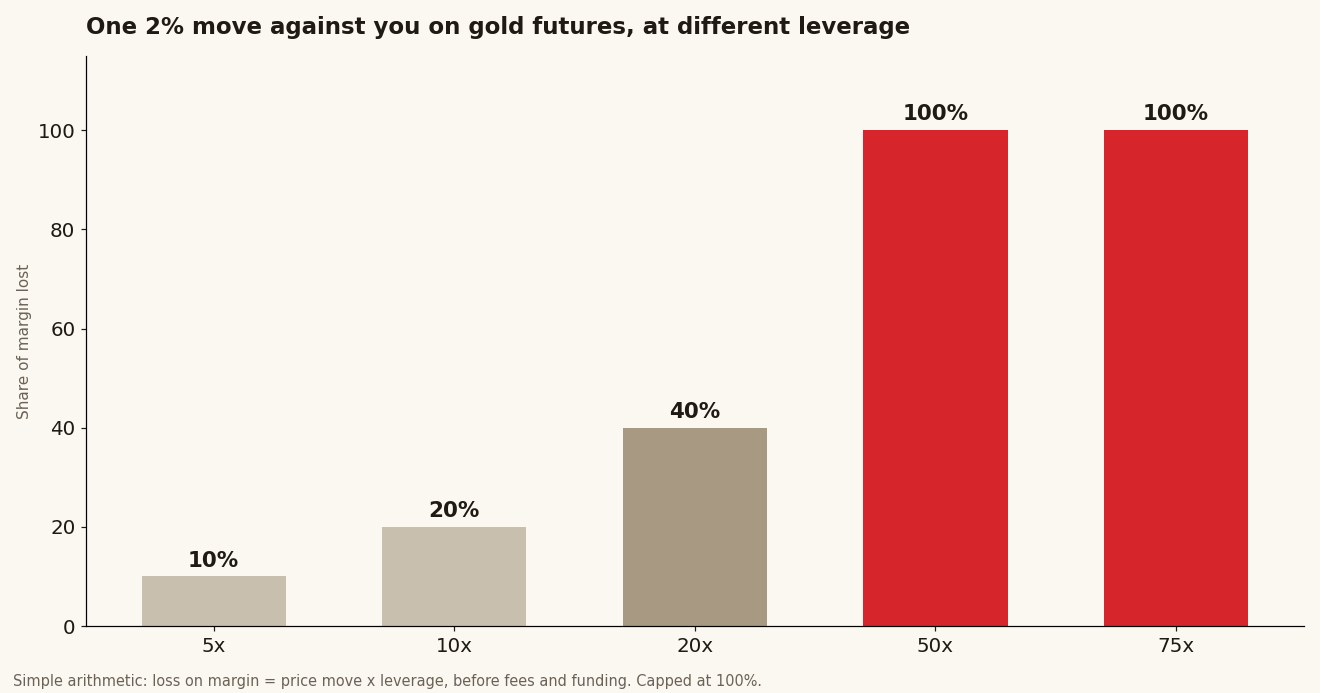
Source: REX Trading Signal calculation, loss on margin = adverse move x leverage, before fees and funding.
Take a 2% move against you. At 5x you lose 10% of your margin. At 10x you lose 20%. At 20x you lose 40%. At 50x, the maximum reported for XAUUSDT, you lose 100%, the whole margin. At 75x, the maximum on the PAXG contract, you do not even need 2%. A move of about 1.33% is enough to wipe the margin, and in practice the exchange closes you out before that point.
Is a 2% day rare in gold? I checked. Over the last six months, 126 trading days from May to November 2026, gold futures moved 2% or more in a single day on 20 of those days. That is about one day in six. They moved 1% or more on 55 days, close to half. The biggest single-day fall was 3.6% on 10 June and the biggest rise was 3.7% on 5 August. On 30 October, the same day Binance halted withdrawals, gold futures fell 3.3%.
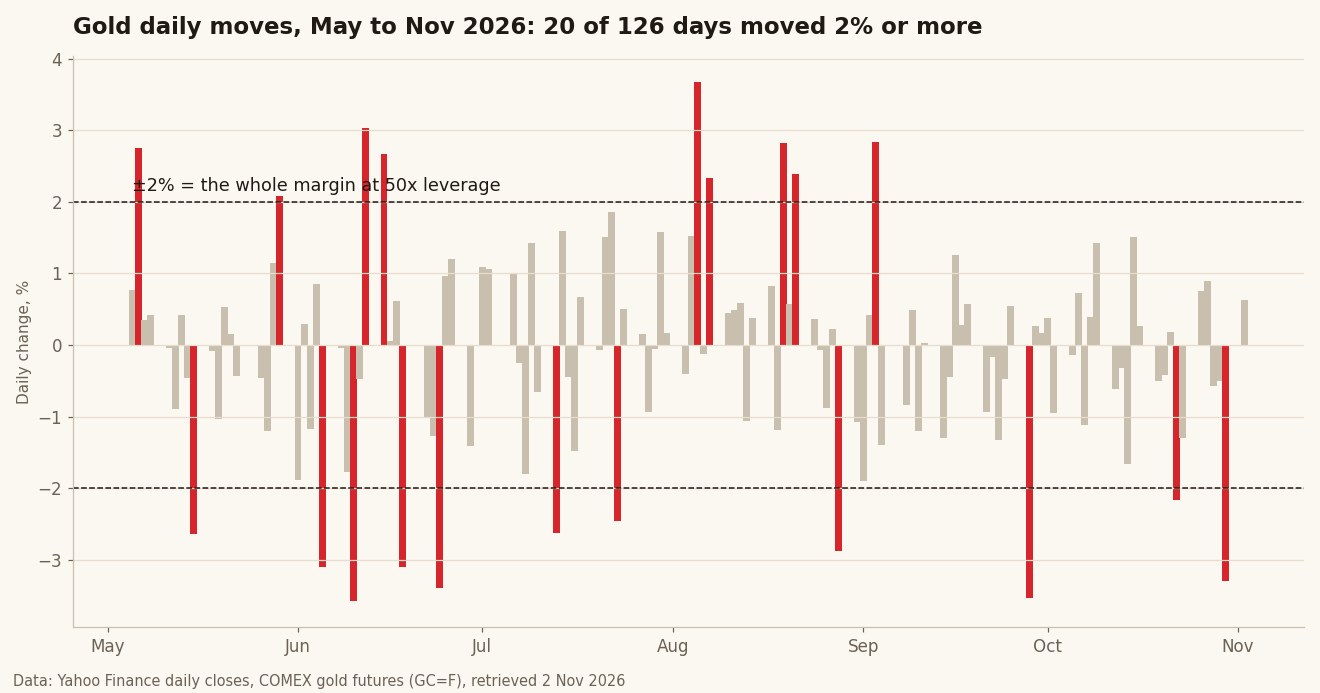
Source: Yahoo Finance daily closes (GC=F), May to November 2026, REX Trading Signal calculation.
Put those two facts together. At 50x, about one trading day in six would have been enough to take the whole margin on a single position held the wrong way. That is not a forecast, just the last six months counted. The fix is the same as at any broker: the leverage the exchange allows is a ceiling, not a setting. Size each position from your stop and your risk per trade, the way I explain in position sizing for gold trading, and the 50x button becomes a number you simply never press.
Funding and fees
A perpetual has a running cost. Every few hours, funding is paid between longs and shorts, usually by the crowded side. The rate changes, so I will not quote one. Read it on the contract page before you hold for days, the same way you would read the swap rate on a broker's gold CFD. Add trading fees on entry and exit, and put the total in your monthly costs.
The weekend freeze
Crypto trades all weekend. Gold does not. DL News noted that Binance's gold prices do not update outside traditional market hours, so the Saturday price is Friday's price, and weekend news arrives in one jump when gold reopens. A broker has the same gap. The risk is that a venue that never sleeps makes you forget the gold market does. Plan weekend exposure as if the gap is coming.
The risk that sits on top of the market
This week gave us a real example of the second layer of risk. Binance disclosed a security breach on Thursday 29 October 2026 and halted withdrawals early on Friday 30 October, Asia time. The reported loss was about 6.3 billion dollars, described as a record crypto theft. The FBI attributed the attack to North Korea's TraderTraitor group, the same group linked to the 1.5 billion dollar theft from Bybit in 2025.
To be fair to Binance, here is how it responded. Deposits were never suspended. Withdrawals resumed in phases on Sunday 1 November, starting with major coins plus USDT and USDC, according to Business Today. Other coins are still under repeated security audits with no timeline. Binance says it will absorb the loss rather than pass it to customers, and that about 95% of the stolen assets had been replenished by 1 November. It also says it found no evidence that private keys were exposed, and Yahoo Finance reports that withdrawal volumes are now stabilising.
That is a better response than many exchanges have managed. But look at it as a business owner. For roughly two days, you could not move your USDT off the exchange, during a week when gold had one of its biggest daily drops of the last six months. Your gold view could be right and you would still be stuck. Binance's own emergency fund, SAFU, set up in 2018, has typically been kept near 1 billion dollars, which is about 6.3 times smaller than this loss. The exchange covered it from its own balance sheet. Next time, at another venue, that may not be possible.
This is called counterparty risk, and it has nothing to do with charts. On any gold contract your result depends on two things: the gold price, and the exchange being able and willing to pay you. One reader wrote to me after a bad experience elsewhere: "One last thing this is legit right? I dont want to lose more." That is the right question, and it should be asked before the deposit, not after. If you want the account security side of this, I wrote about it in what happens if my brokerage account is hacked.
A neutral checklist: crypto exchange or regulated gold broker
I am not here to bash Binance or to sell you a broker. Both are suppliers. Score them with the same questions and let the answers decide. These are the five I use, and they come straight from how I choose any business partner, which I cover in choosing a broker like a business partner.
1. Licence: who regulates the exact entity you sign with?
Not the brand, the entity. Find the company name on your account agreement, then look it up on the regulator's own public register. A licence for one product or one country does not cover every product. Binance's gold contract is reported to be offered through an Abu Dhabi Global Market entity. Check what that covers for a client in your country.
2. Segregated funds: is your money kept apart from theirs?
Ask in writing whether client money is held separately from company money, where, and what happens to it if the firm fails. Ask whether there is a compensation scheme, and how much it covers. On a crypto exchange, your USDT margin sits in the exchange's custody, which is why a hack becomes your problem too.
3. Withdrawal track record: has it paid people out under stress?
Any firm pays out on a quiet Tuesday. The test is a bad week. Read what happened during past incidents, including this one. Then test it yourself: withdraw a small amount before you fund properly, and time how long it takes.
4. Leverage caps: what is the maximum, and who set it?
Some regulators set leverage limits for retail clients on gold. A venue offering 50x is not breaking a law, but it is not protecting you from yourself either. Your own cap should come from your risk per trade, whatever the venue allows.
5. Product and costs: what is the contract, and what does holding it cost?
Write down the product type, trading hours, fee per trade, overnight or funding cost, and the margin currency. Stablecoin margin also relies on that coin holding its value.
Run both options through those five questions on one sheet. Weaker answers do not mean you can never use a venue. They mean you put less money there, the same way a business never keeps all its cash with one supplier. I use the same thinking in prop firm vs broker.
How I would decide, as an owner
If I wanted gold exposure on a crypto exchange, I would treat it as a separate cost centre. A fixed amount of margin that I can afford to have frozen for a few days. Leverage chosen from my stop, not from the slider. Funding checked before every hold longer than a day. No position open into the weekend that I could not survive gapping 2% against me. And a written rule for what I do if withdrawals pause again.
The venue is not the edge. The rules are.
Get the free REX one page trading business plan, with your risk limit, your venue checklist and your cost lines on a single sheet, so the decision on this page is written down before you deposit. One email, no spam, unsubscribe anytime.
Get the free business plan →Frequently asked questions
Do I own gold when I trade gold futures on Binance?
No. You hold a USDT-margined perpetual contract with the exchange. It pays or charges you as gold moves, but there is no metal in your account. A broker's gold CFD is also a contract, so the real difference is who stands behind it.
How much leverage does the Binance gold contract offer?
The gold perpetual was reported at launch to offer up to 50x, and the PAXG perpetual up to 75x. At 50x, a 2% move against you equals your whole margin. Gold futures moved 2% or more on 20 of the last 126 trading days, so the maximum is a ceiling to stay far below.
Can I trade Binance gold on the weekend?
The app stays open, but the gold price does not update outside traditional market hours. Weekend news shows up as a jump when gold reopens.
Was my money at risk during the Binance hack?
Binance says it will absorb the roughly 6.3 billion dollar loss and not pass it to customers, and withdrawals for major coins plus USDT and USDC resumed in phases on 1 November. Even so, withdrawals were paused for about two days. That pause is the counterparty risk every trader takes on at any venue.
Is a regulated gold broker always safer?
Not automatically. A licence only helps if it covers the exact entity and product you use. Check the register, how client funds are held, the withdrawal record and leverage caps, then test a small withdrawal yourself.
Where REX Trading Signal fits
REX Trading Signal is free to follow. The daily record on Telegram includes losing days, because a record that only shows winners is not a record. If you want your risk limit, your venue checklist and your monthly costs on one page, there is a free one page trading business plan, and the thinking behind it is in the one page trading business plan template. There is also an optional Kit for the full operating method. Nothing here promises a profit or tells you to use or avoid any venue. The questions are here; the answers are your decision.
About the author. Rex writes REX Trading Signal and runs his trading account the way he runs a business: suppliers are checked before money moves, limits are set before the week starts, and every cost has a line. He shares what he does as a business owner so you can judge it yourself. Figures come from the linked sources or from his own stated calculations. This is not financial, legal or tax advice, and nothing here is a trade signal. Leveraged gold and crypto products can lose you more than you expect, so never trade money you cannot afford to lose.