
When my shop was struggling in its second year, I did what struggling owners do. I bought things. A better till system. A footfall counter. A loyalty app nobody used. Each one promised to tell me something about my business, and each one gave me another screen to look at instead of the room I was standing in.
What eventually turned it around was embarrassingly simple. I started standing at the front of the shop for twenty minutes a day and just watching. Where people paused. What they picked up and put down. Which shelf they walked past every time. None of that was in any of the systems I had paid for. It was all sitting in plain sight, in the behaviour of actual people, and I had been too busy reading dashboards to notice it.
I made exactly the same mistake when I started trading. My charts ended up carrying six indicators, all derived from the same price, all disagreeing with each other, all lagging behind the thing they were describing. I had built myself a room full of dashboards and stopped watching the shop floor.
That is what price action is, and why it matters. Everything below is education about how to read a market, not instructions and never a signal, and there are no prices or levels here on purpose.
What Price Action Actually Means
Price action means reading the record the market already keeps, the movement of price itself, rather than reading a calculation performed on that record.
The distinction matters. Almost every indicator on your platform is derived from price. It takes the same numbers you can already see, does arithmetic on them, and draws the result. That can be useful for smoothing or summarising, but it cannot add information that was not already there, and it always arrives slightly late, because a calculation cannot finish until the input exists.
You will hear the purist version called "naked" price action, meaning a chart with nothing on it at all. I do not think you have to be a purist about it. Plenty of good operators keep one reference line on the chart. The useful shift is not deleting every tool, it is changing what you are looking at first. Read the market's behaviour first, then use a tool to help you see it more clearly if it genuinely helps.
Why Reading Behaviour Works
Here is the part that convinced me, and it is a business argument rather than a technical one.
Markets move because people act, and people act on two things that have never been optimised away: the fear of losing money and the greed for more of it. Strategies get arbitraged out. Edges get crowded. Software gets faster. But the shape of a crowd that is frightened, or a crowd that is getting confident, has not fundamentally changed, because it is a property of humans and not of technology.
Price is the running record of that behaviour. It is not a prediction and it is not a promise. It is a receipt of what people were willing to do, and it is the only thing on your screen that is not a derivative of something else. That is why the psychology side of this business and the chart-reading side are not two separate subjects.
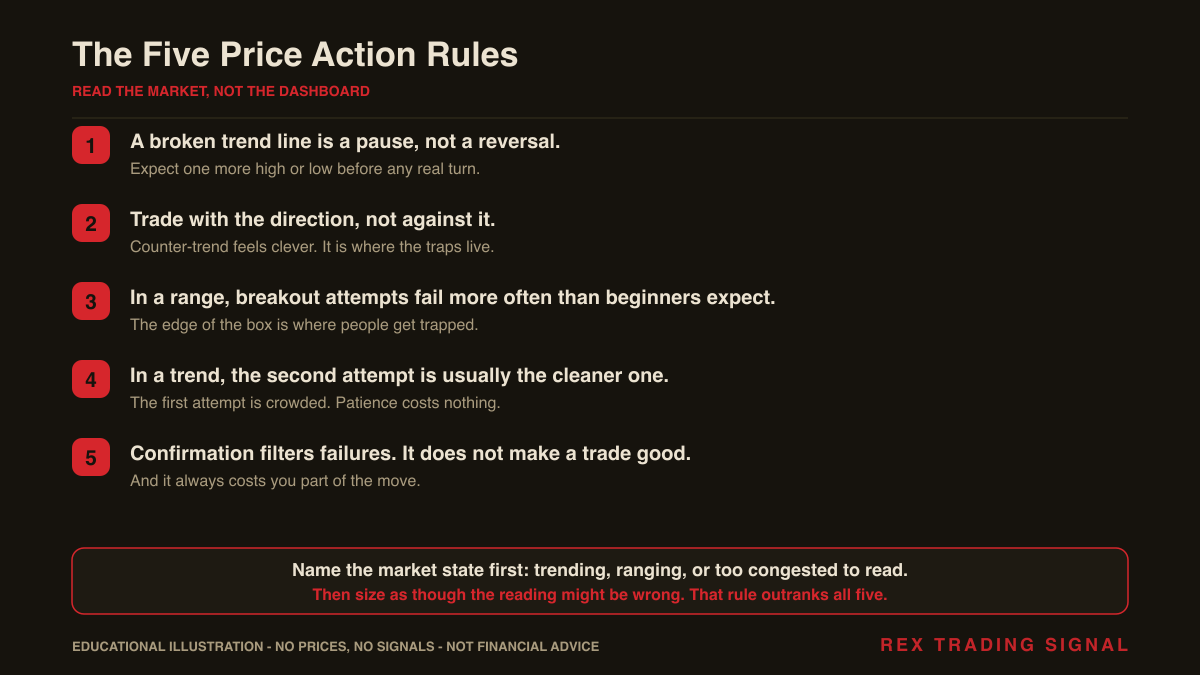
Rule One: After a Trend Line Breaks, Expect a Fresh Extreme Before a Real Reversal
A trend line breaking feels like an ending. Most of the time it is not. It is more often the market pausing than the market turning around.
The pattern experienced traders describe is this: when a trend line gives way, price frequently goes on to make one more new high in an uptrend, or one more new low in a downtrend, before any genuine reversal takes hold. The break was the first crack, not the collapse.
In business terms, this is the difference between a bad week and a failing business. One bad week is information. It is not a reason to shut the doors. Owners who liquidate on the first bad week do it constantly, and traders who call a reversal on the first broken line are making the same error with the same confidence.
The practical upshot is patience. A broken trend line is a reason to pay closer attention, not a reason to flip your whole view. If a trend is genuinely turning, it will keep giving you evidence. If it is not, the cost of waiting was nothing.
Rule Two: Counter-Trend Trades Are Where the Traps Live
This one is uncomfortable because it argues against the trade that feels smartest.
When a market has been climbing for a while, every pullback looks like the top. It looks like the moment you spotted the turn before everyone else. That feeling is precisely the problem, because in a market that is genuinely trending, most of those pullbacks are not tops. They are pauses, and betting against the direction means betting against the flow that is actually there.
I am not going to tell you counter-trend trading never works, because that would be false. Some very good traders do it deliberately, with tight risk and full awareness of what they are doing. What I will say is that it is the wrong place to be learning. The trap is not that it always loses. The trap is that it occasionally wins spectacularly, which teaches you the wrong lesson at exactly the wrong stage.
The operator's default is simpler and duller: work with the direction the market is showing you, not the direction you think it should show you next. It is the same instinct as stocking what customers are actually buying rather than what you personally think they ought to want. I wrote about this in reviewing the trend like a business owner.
Rule Three: In a Range, Most Breakout Attempts Fail
This rule reverses the first two, and that reversal is the whole point.
In a sideways market, price keeps arriving at the same upper and lower boundaries and keeps turning back. Each time it reaches an edge, it looks like it is about to break out and start a trend. Most of the time it does not. It pokes through, traps everyone who acted on the break, and returns into the range.
You will see a percentage attached to this claim. Depending on who is talking, breakouts are said to fail seventy, eighty or ninety percent of the time. I would treat that number with real caution. Nobody has audited it, the figure depends entirely on how you define a range and a breakout, and it changes with market and timeframe. Quoting a precise statistic gives false confidence.
What survives the scepticism is the direction of the claim, and it is worth knowing: in a genuinely sideways market, breakout attempts fail considerably more often than beginners expect. That is enough to change how you behave without pretending to a precision nobody has.
So the same event, price pushing through a level, means opposite things depending on the state of the market. Which leads directly to the most useful thing on this page.
The Diagnosis That Comes Before Any Rule
Every rule above is conditional on the state of the market, so the first job is naming that state honestly.
Trending. Price is making progress in one direction. Work with it. Fighting it is the expensive option.
Ranging. Price is oscillating between boundaries. The edges matter, and the moves through them are where people get trapped.
Congested. Price is choppy, overlapping, going nowhere with no clean structure. There is no playbook for this, and pretending there is one is how accounts get chewed up in small pieces. This is the state where a business owner finds something else to do.
Most bad trades I have taken were not bad techniques. They were correct techniques applied to the wrong state. Fading an edge is reasonable in a range and expensive in a trend. Following momentum is reasonable in a trend and expensive in chop. The technique was never the problem. The diagnosis was.
Rule Four: The Second Attempt Is Usually the Cleaner One
This is the rule I would keep if I had to throw the other four away.
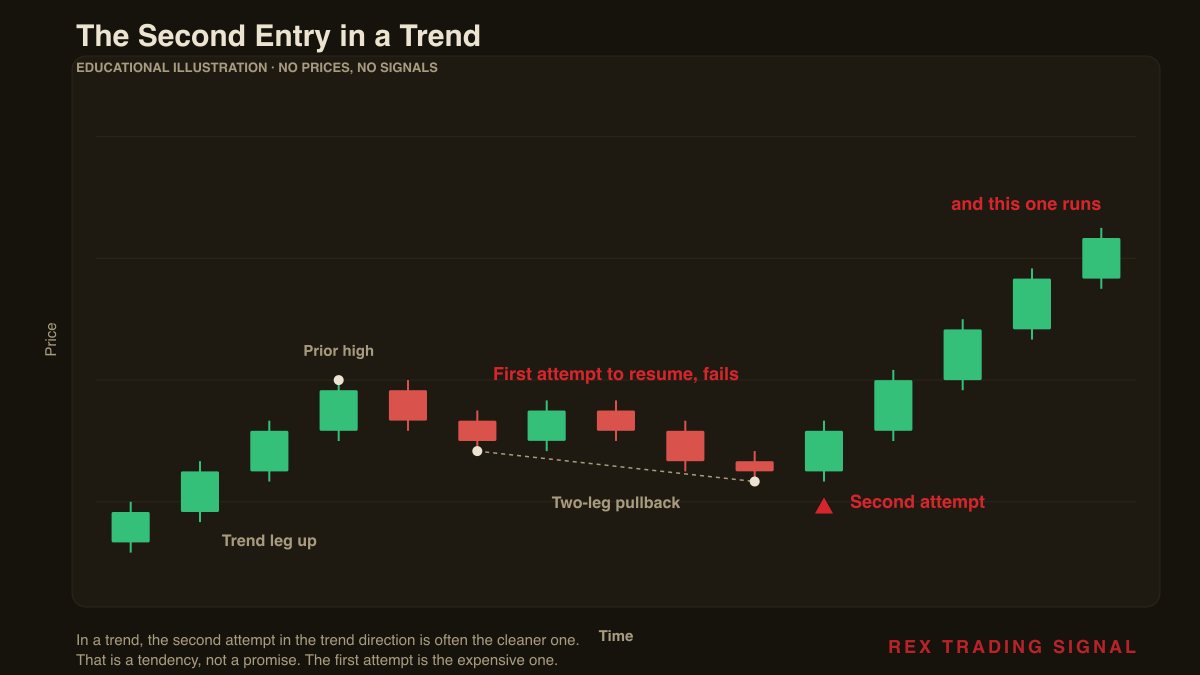
In a trend, price pulls back, then tries to resume. Very often that first attempt stalls and rolls over, price makes a second pullback leg, and the second attempt is the one that actually goes. Traders call this a second entry, and the pullback that produces it a two-leg pullback.
Why the first attempt struggles is not mysterious. It is crowded. It is the obvious moment, the one everybody watching sees at the same time, and obvious moments attract the impatient. The second attempt happens after the impatient have already been shaken out, which is a quieter and generally better-behaved place to be.
Any business owner recognises this. You do not sign with the first supplier who quotes you. The first quote is the one designed to be taken quickly by someone who has not looked around. Waiting for the second costs you nothing but patience, and patience is the cheapest thing on your shelf.
Note the word "usually" doing the heavy lifting. Sometimes the first attempt runs away and you miss it entirely. That is the trade-off you accept for skipping the crowded one, and it is a trade-off, not a free lunch. If missing moves upsets you more than losing money does, that is worth knowing about yourself before you build a method around waiting.
Rule Five: Confirmation Means Something Specific, and It Is Not Validation
The last rule is about what traders mean when they say they wait for confirmation.
The idea is that instead of acting while a candle is still forming and still capable of becoming anything, you wait for it to finish and then require price to actually continue in the direction it suggested. Traders call a candle used this way a signal bar. Requiring follow-through beyond it is the confirmation.
What this genuinely does is filter. It removes the trades where a candle looked convincing and then simply did not go anywhere, and there are a lot of those. What it does not do is make a trade good. Confirmation confirms that price moved a little further. It does not confirm that price will keep moving, and it never converts a poor idea into a sound one.
There is also a real cost, and it should be said plainly: waiting for confirmation means you are never getting in at the best available price. You are paying part of the move in exchange for filtering out some of the failures. Whether that trade-off suits you is a question for your own tested plan, not something anyone can answer on your behalf.
None of these five rules tells you what will happen. They describe what tends to happen. A tendency you can plan around is worth more than a certainty someone sold you.
The Rule That Outranks All Five
Here is the part that does not fit neatly on a slide, so it usually gets left off.
You could read every one of these five rules correctly and still lose your account. All five could be perfectly applied on a trade that goes against you, because tendencies are not certainties and nothing on a chart owes you an outcome. Reading the market better changes how often you are right. It does not change the fact that being wrong is a permanent feature of the job.
Which means the thing that actually keeps a trading business alive is not on this list at all. It is how much you risk on each position. A trader with mediocre chart reading and disciplined sizing survives long enough to improve. A trader with excellent chart reading and no sizing discipline gets removed from the game by the one trade where the reading was right and the market did not care.
So read the five rules as what they are: a way to understand the room you are standing in. Then put them underneath your risk rules, not on top of them, and write the whole thing down on one page so the live version of you does not get to renegotiate it.
A Word on Risk (Read This Before You Trade)
Let me be straight with you.
Trading gold and other leveraged products carries substantial risk, and most retail traders lose money. Everything above describes general tendencies that traders observe in price behaviour. None of it is a prediction, a system, or a set of instructions to follow. Nothing here is financial advice, and no entry, stop or target discussed should be treated as a signal. The percentages people quote about failed breakouts are not audited figures and should not be treated as reliable statistics. Any rule described here can and will fail on individual trades, which is exactly why position sizing outranks all of it.
Get the free REX one page business plan, the sheet that turns rules like these into a written process with a risk ceiling and a review date. One email, no spam, unsubscribe anytime.
Get the free business plan →Frequently Asked Questions
What is price action trading in simple terms? It is reading the movement of price itself to understand what buyers and sellers are doing, rather than relying on calculations performed on that price. The chart is treated as a record of behaviour instead of a surface for indicators.
Is price action better than using indicators? It is not better in some absolute sense, it is more direct. Indicators are derived from price, so they cannot contain information price does not already carry, and they arrive slightly late by construction. Many good traders keep one or two references on the chart. The shift that matters is reading behaviour first.
Do I have to trade with a completely blank chart? No. That is the purist version, and purism is not the point. A single reference line is fine if it genuinely helps you see structure. What causes trouble is a chart so crowded that you are reading six lagging opinions about the same data instead of the data.
Do ninety percent of breakouts really fail? That figure gets repeated a lot and I would not rely on it. It depends entirely on how you define a range and a breakout, it varies by market and timeframe, and nobody has audited it. What is worth taking seriously is the direction of the claim: in a sideways market, breakout attempts fail more often than most beginners expect.
Why is the second attempt supposed to be better than the first? Because the first attempt is the crowded, obvious one, and it tends to attract impatient money that gets shaken out when it stalls. The second attempt happens after that flush. It is a tendency rather than a rule, and sometimes the first attempt simply runs without you.
How long does it take to learn to read price action? Longer than any course suggests, and it never really finishes. The part you can learn quickly is naming the market state honestly, whether you are looking at a trend, a range, or unreadable chop. That single skill prevents more damage than any entry technique, because most bad trades are the right method used in the wrong conditions.
About Rex
I'm Rex. I ran a real shop for five years before I placed my first trade, and the lesson that carried over was not about markets, it was about attention. I spent my second year buying systems that told me about my business and my third year actually watching it, and only one of those years worked. When I started trading I stacked six indicators on a chart and repeated the mistake exactly.
Today I run the REX Trading Signal channel, around 11,900 people, on three rules I don't break: every signal carries a stop loss; I post my losing trades, not just the winners; and I never promise profit, no "guaranteed," no "fixed," no "risk-free." A trader who can honestly name what the market is doing right now, and who sizes as though the reading might be wrong, lasts longer than one who has memorised every pattern in the book.