

Most people looking for a part time trading strategy are really asking a scheduling question and being handed a market answer. They want to know what to trade around a job, and they get told about a timeframe, an indicator, a session. None of that addresses the actual constraint, which is that you have a fixed and fairly small number of hours, and no strategy survives contact with a calendar it does not fit.
Any business owner starts at the other end. You do not choose the product first and then discover you cannot staff it. You establish your capacity, then design an operation that runs inside it. That is the order I want to work in here. Before anything else, the standing rule: no entry, stop or target discussed should be treated as a signal.
Capacity is the input, not the leftover
Write down the hours you can genuinely give this in an ordinary week. Not a good week, not the week you took time off. A normal one, with the job, the commute and whatever else your life contains.
Whatever that number is, it is now a hard constraint on the design, in the same way a workshop with two benches constrains what a joinery firm can take on. The mistake almost everyone makes is to treat available hours as something to be squeezed later, after the strategy is chosen. Run that way round and you get an operation that works in theory and is quietly abandoned in the third busy month.
So the question is not what strategy is best. It is what strategy your capacity can run at full quality, every week, for a year.
What the market actually asks of you
Here is where the arithmetic helps, because the market's demands are measurable.
I took the LBMA Gold Price, the London benchmark used across the industry for settlement, and measured ten complete years, 1 January 2016 to 31 December 2025. That is 2,506 published benchmark days, an average of 250.6 benchmark days per year. Two assumptions stated plainly: a "day" is one benchmark publication, so weekends and holidays are excluded, and all movement is measured benchmark to benchmark, which ignores intraday swings.
Now treat each horizon as an operating model with a decision count.
- Run a daily operation and the market presents you with about 250.6 decision points a year. Average absolute movement per decision: 0.661 percent.
- Run a monthly operation, meaning roughly twenty benchmark days per cycle, and it presents you with about 12.5 decision points a year. Average absolute movement per decision: 3.251 percent.
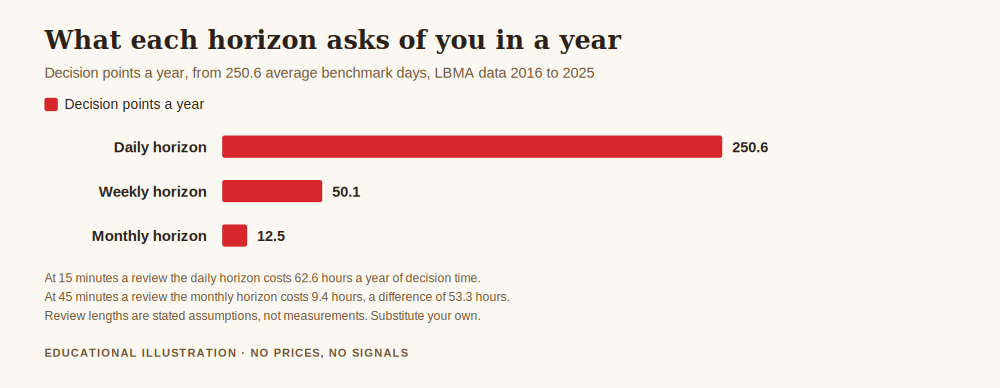
Twenty times fewer decisions, and each one carries 4.92 times more movement. That is not a rounding difference, it is a different business. The monthly operator is running a small number of larger units of work. The daily operator is running a high volume, low margin operation, and high volume low margin businesses are the hardest kind to run part time, in trading exactly as anywhere else.
A part time trading strategy, priced in hours
Put your own labour into the sum, because it is the input you are shortest of.
Suppose a daily review takes fifteen minutes done properly: check the level, check the context, decide, record it. At 250.6 decision points that is 62.6 hours a year. Suppose a monthly review takes forty five minutes, three times as long, because there is more to weigh. At 12.5 decision points that is 9.4 hours a year.
The difference is 53.3 hours a year, and the longer horizon still captures nearly five times the movement per decision. Those are my assumptions about review length, and you should substitute your own honest figures, but the shape of the result will not change, because the decision count differs by a factor of twenty while the time per decision differs by a factor of three.
This is the part that reframes the whole question. A part time trading strategy is not a compressed version of a full time one. Compression is what produces the familiar failure: the working trader who tries to run a daily operation in fifteen minutes of stolen attention, misses the context, and ends up with the costs of an active approach and the quality of a neglected one. The way out is not to move faster. It is to run a model with fewer, larger decisions.
If you have been trying to make the daily version fit around a job, how to day trade with a full time job deals with that specific case, and weekly trading vs day trading prices the dealing costs of each.
The eight days you cannot move
One more constraint belongs in the plan, and it is the one part time traders are most often ambushed by.
Some dates are known a year ahead. The Federal Reserve publishes its schedule in advance, and for 2026 there are eight scheduled FOMC meetings, in January, March, April, June, July, September, October and December. Gold is sensitive to interest rate expectations, so those announcements are among the most reliably eventful moments in the year.
Eight days out of roughly 250 is about three percent of the calendar, and you know all eight now. A business plans around its known busy periods rather than being surprised by them annually. Decide in advance what your operation does on those dates, whether that is stand aside, reduce size, or simply not open anything new the day before. Write the decision down once, while nothing is happening, and it will hold. There are more of these fixed events than the Fed calendar alone, and how to build a pre market routine for your trading business covers catching them systematically.
Building the thing
The operating version, in the order I would actually do it.
Fix the review slot before choosing anything else. A specific time on specific days that exists in your real week, not an aspiration to "check in the evenings". If the only reliable slot you have is Sunday afternoon, then you are designing a weekly operation, and that is a decision made rather than a compromise discovered.
Choose the horizon that fits the slot, then never fight it. If you review weekly, your positions must be able to survive a week without you. That rules out anything needing management inside the day, and it rules it out on capacity grounds rather than because it is a worse approach.
Make every position survivable while you are unavailable. This is the constraint that distinguishes a part time operation from a full time one, and it is not about being brave. A resting stop is not a preference here, it is the only thing standing between your account and a market that moves while you are in a meeting. Sizing is the other half, and position sizing for gold trading is the mechanism.
Write the fixed dates into the calendar now. The eight FOMC dates, plus whatever else your instrument reacts to. Three percent of the year, known in advance, is not something to rediscover each time.
Review on a slower cycle than you trade. If you trade weekly, review the business quarterly. Judging a twelve decision year after two decisions is not analysis, it is noise with a spreadsheet. How to run a weekly review for your trading business sets out what belongs in that session.
Cost the operation. Fewer positions means fewer spreads paid, but holding longer means financing charges on overnight positions. Both are real, both are knowable from your own broker, and the comparison is worth doing once properly. Fixed and variable costs of a trading business works through the categories.
What you give up, stated honestly
I am not going to present the longer horizon as free.
Twelve decisions a year is a very slow feedback loop. It takes a long time to accumulate enough repetitions to learn anything reliable, and it takes patience most people underestimate. A daily operator gets twenty times the reps, and if they are recorded properly that is a genuine advantage in learning speed.
You also carry overnight and weekend exposure, which means a gap can reach you while you sleep. That is a real risk and the answer to it is size, not vigilance, because vigilance is exactly what a part time operator does not have.
And the wider base rate applies whatever horizon you pick. Most retail accounts lose money, this business is difficult, and choosing a schedule that fits your life removes one common cause of failure rather than the general difficulty. The point of matching capacity is not that it makes trading work. It is that running an operation you cannot staff guarantees it will not.
Get the free REX one page business plan, the sheet where your review slot, your horizon and your risk ceiling live together on a single page. One email, no spam, unsubscribe anytime.
Get the free business plan →Frequently Asked Questions
What is the best part time trading strategy for someone with a full time job?
The one whose review cycle matches a slot that reliably exists in your week. For most employed people that is a weekly or monthly horizon rather than a daily one, because those are the models that tolerate you being unavailable for eight hours at a stretch. The specific method matters far less than whether the operating tempo is one you can sustain in a busy month.
How many hours a week does this actually take?
On my assumptions above, a monthly horizon comes to about 9.4 hours a year of decision time, and a daily horizon about 62.6 hours. Those cover the decisions themselves, not learning, record keeping or review, so treat them as a floor rather than a total. The useful exercise is to substitute your own honest review length and see what the model you are considering would cost you.
Is part time trading less profitable than full time?
That is not a question anyone can answer for you, and I would distrust a confident reply in either direction. What the arithmetic does say is that fewer decisions each carry more of the market's movement, so a part time operation is not automatically working with less raw material. It is working with fewer, larger units of it.
Can I start part time and go full time later?
You can, and it is the sensible sequence, but treat it as a business decision with evidence behind it rather than a graduation. The relevant evidence is a long record at a consistent horizon, not a good quarter. When should you go full time as a trader works through the conditions.
What do I do about the FOMC dates if I cannot watch them?
Decide once, in advance, and write it down. Standing aside around those eight dates is a perfectly respectable operating rule, and it is far better than an intention to be careful that you form on the day. The whole advantage of a known calendar is that the decision does not have to be made under pressure.
Does a slower horizon mean I need a bigger account?
Not necessarily, but it does change the arithmetic. Longer holds usually mean wider risk distances, which for a given percentage of capital at risk means smaller positions. That is the mechanism working correctly rather than a problem, though it does mean the minimum position sizes your broker allows can bite sooner on a small account. Check yours before you design around them.
Where this leaves the business
A part time trading strategy is not a lesser version of a real one. It is an operation designed around a real constraint, which is the most ordinary thing in business and the least common thing in retail trading.
The numbers are not subtle. Twenty times fewer decisions, nearly five times the movement in each, and fifty three hours a year returned to the rest of your life. What you buy with that is not an edge. It is the ability to run the same process in month nine that you ran in month one, which is the thing almost nobody manages and the thing everything else depends on.
Decide your capacity first. Let it choose the horizon. Then write the horizon, the review slot and the risk ceiling on the same page as the rest of the operation, which is what the one page trading business plan template is for.
REX Trading Signal is a free Telegram channel with daily XAUUSD analysis, the reasoning stated before the trade, losing days included. There is nothing to buy to follow along, an optional Kit if you want more structure, and no profit claims, because there honestly cannot be any.
About the author. Rex writes the REX Trading Signal journal. He treats a trading account as a small business with a balance sheet, an operating tempo and a set of constraints, on the view that most accounts fail for ordinary business reasons rather than exotic market ones.
Disclaimer: This article is general educational content about how trading operations and account arithmetic work. It is not financial advice and it is not a recommendation to buy or sell anything. Trading gold, CFDs and leveraged products carries a high risk of losing money rapidly. No entry, stop or target discussed should be treated as a signal. The review lengths used above are stated assumptions used to illustrate arithmetic, not claims about what your process will take. Market statistics are computed from the published LBMA Gold Price PM benchmark for 2016 to 2025, and external figures are linked so you can check them.