
Every few weeks somebody asks me, in one form or another, how much a day trader makes. It is a fair question and it deserves a straight answer, so here is mine: the question is shaped wrongly, and the way it is shaped is what costs people money. A salary is a number you are paid for showing up. Day trading income is a residual, what is left after the market, the spread, the commission and your own mistakes have taken their cut, and for most people that residual is negative.
This is an operations article, not a motivational one. I run an account as a business, which means I care about base rates the way a shop owner cares about the failure rate of shops on the same street. You do not open a restaurant without knowing that most restaurants close. You should not plan to replace a wage with a trading account without knowing what actually happened to the people who tried.
How much a day trader makes, according to the only evidence worth quoting
There is one study I keep coming back to, because it does the thing most trading content refuses to do: it follows everybody, not just the survivors. Fernando Chague, Rodrigo De-Losso and Bruno Giovannetti looked at every individual who began to day trade between 2013 and 2015 in the Brazilian equity futures market, which the paper notes was the third largest in the world by volume. Not a sample of people who volunteered. Everybody who started.
Their findings, in their own summary: 97 per cent of all individuals who persisted for more than 300 days lost money. Only 1.1 per cent earned more than the Brazilian minimum wage. Only 0.5 per cent earned more than the initial salary of a bank teller. The paper's title is a question, Day Trading for a Living?, and its first sentence answers it by saying that it is virtually impossible for individuals to day trade for a living, contrary to what course providers claim.
Read those three numbers again as a business owner, not as a hopeful trader. Persistence did not rescue people. The 97 per cent figure is specifically about the ones who stuck at it for more than 300 days, which is the group every course tells you to join. Staying longer was not the variable that separated winners from losers.
What those percentages look like in a room full of people
Percentages are easy to nod at and hard to feel, so I converted them into a count. Take 10,000 people who start day trading, which is roughly the attendance of a mid sized conference.
At the 1.1 per cent rate, 110 of those 10,000 people clear minimum wage. That is one in 91. At the 0.5 per cent rate, 50 of them clear the starting salary of a bank teller. That is one in 200. And among those who persisted past 300 days, 970 out of every 1,000 lost money.
One in 200 is not a probability you build a household budget on. It is a probability you build a hobby on, with money you have already decided you can lose. That distinction is the whole article, and everything below is just the arithmetic that supports it.
The older evidence points the same way
This is not one odd result from one market. Brad Barber and Terrance Odean studied 66,465 households with accounts at a large discount broker between 1991 and 1996. The households that traded most earned an annual return of 11.4 per cent while the market returned 17.9 per cent. The average household earned 16.4 per cent and turned over 75 per cent of its portfolio every year. Their title says the rest: Trading Is Hazardous to Your Wealth.
The gap between the most active traders and the market is 6.5 percentage points a year. That number sounds survivable until you compound it. On a 10,000 starting balance over ten years, at those two rates, the market path ends near 51,896 and the most active path ends near 29,434. The shortfall is about 22,462, and the busiest traders finish with roughly 56.7 per cent of what they would have had by doing almost nothing. Those last figures are my own arithmetic on the two published rates, compounded annually, before tax and costs.
Note what the activity bought them. Not a disaster, not a blown account, just a slow and permanent haircut. That is the realistic bad outcome for a disciplined person. The blown account is the realistic bad outcome for an undisciplined one, and I have written about that separately in why most traders blow their accounts.
The arithmetic nobody does before they hand in their notice
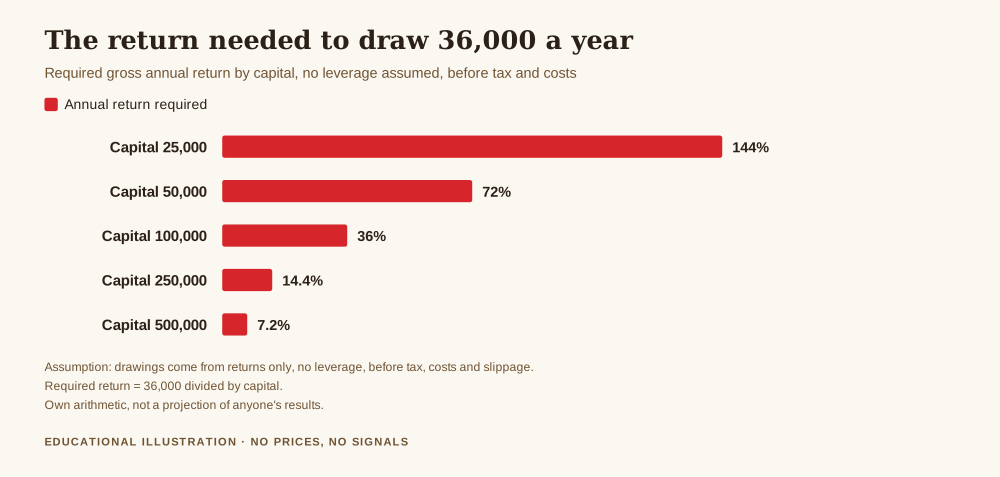
Here is the calculation I wish someone had put in front of me early. Decide what you need to draw per year, then ask what return on your actual capital that requires. The assumption is deliberately simple: you draw from returns only, you use no leverage in the estimate, and the figure is before tax, costs and slippage.
Suppose you need 36,000 a year, which is 3,000 a month. On 25,000 of capital you need 144 per cent a year. On 50,000 you need 72 per cent. On 100,000 you need 36 per cent. On 250,000 you need 14.4 per cent. On 500,000 you need 7.2 per cent.
Look at where that list becomes sane. The top two lines are fantasy for any sustained period. The bottom line, 7.2 per cent on half a million, is a demanding but recognisable investment return. The uncomfortable conclusion is that day trading for a living is mostly a capital problem wearing the costume of a skill problem. People with small accounts are not failing because they lack a better entry technique. They are failing because the withdrawal they need is an impossible fraction of the capital they have.
This is why the first page of my own plan is a capital and cost page rather than a strategy page, and why the template lives in the one page trading business plan.
What my inbox sounds like on this subject
I keep a rough count of what people write to me about. Roughly 286 messages in my inbox touch on trading alongside a job, and that is a keyword count across my own Telegram history rather than a survey, so treat it as a description of my readers and nothing more. The pattern in them is consistent, and it is not about technique.
One reader wrote: "I am a physician and don't have time for trading all the time." Another: "I don't really understand the market yet. I'm just learning alongside my job. Do you have any tips on what I can look at or read?" A third: "I'm still yet to feel confident about scalping while at work. I end up missing signals or getting too distracted to properly manage positions."
And the two that stay with me, because they are about money that is already committed: "It was also instructive for me to see the risk my three months' salary is exposed to in the stock market." And: "I am waiting for my coming month salary, with which I will make my capital."
Those last two are the ones I would gently argue with. Funding a trading account out of next month's salary converts a wage, which is reliable, into a residual, which is not. The base rates above say that trade is a bad one for about 199 people out of 200.
Why the honest number is so hard to find online
Three reasons, and all three are structural rather than conspiratorial.
Survivorship. The people who stopped do not post. A forum, a group or a feed shows you the residue of everyone who is still interested in talking about it, which is a biased sample by construction. The Brazilian study is valuable precisely because it observed everyone who started, including the ones who went quiet.
Selection in what gets measured. "How much do profitable day traders make" is a different question from "how much a day trader makes", and the first one is the one most content quietly answers. Conditioning on success and then reporting the average is how you get numbers that describe nobody.
Incentives. Somebody is selling a course. The study's own framing notes that its conclusion runs contrary to what course providers claim, and course providers are the largest producers of content on this exact search term.
What I actually do with these numbers
I do not use them as a reason to stop. I use them as a reason to size the activity correctly, which is a different decision.
First, the account is never the household budget. The business has its own capital and its own ceiling, and a bad quarter changes the business's plans rather than the family's.
Second, the wage stays. The base rates say the expected value of swapping a salary for a trading residual is poor, so the job funds the life and the account is allowed to be slow. Most of my readers are in this position anyway, whether they planned it or not.
Third, I measure in costs and process, not in income projections. I know my fixed and variable costs, I know my drawdown ceiling, and I review suppliers once a year. None of that requires a forecast of how much I will make, which is useful, because nobody can produce one honestly.
Fourth, I treat any month that beats the base rate as luck until proven otherwise. The study's 1.1 per cent did exist. Some of them were skilled. On a single good month there is no way to tell which group you are in, and the arithmetic of acting as though you are in the 1.1 per cent is brutal if you are wrong.
What this article is not saying
It is not saying trading cannot work. It is saying that the distribution is extremely thin at the top, that persistence did not fix it in the data, and that anyone planning around the thin tail should say out loud that this is what they are doing.
It is not a forecast of your results. The 97, 1.1 and 0.5 per cent figures describe one market over one window, equity futures in Brazil for people starting between 2013 and 2015. The Barber and Odean figures describe United States equity accounts in the 1990s. Neither is a prediction about gold, about you, or about now.
It is not advice about your job. I do not know your capital, your costs or your obligations, and the capital table above is arithmetic on stated assumptions, not a recommendation about anyone's employment.
Get the free REX one page trading business plan, the operating rules on a single sheet, including the capital and cost page this article argues should come before any income target. One email, no spam, unsubscribe anytime.
Get the free business plan →Frequently asked questions
How much a day trader makes, in one line?
In the largest study that followed everyone who started rather than only the survivors, 97 per cent of those who persisted beyond 300 days lost money, 1.1 per cent beat minimum wage and 0.5 per cent beat a bank teller's starting salary. Treat a living wage as the rare outcome, not the expected one.
Is there a realistic monthly income figure?
Not one that means anything, because income is a residual rather than a rate. The useful version of the question is the capital one: a 36,000 annual draw needs 144 per cent a year on 25,000 of capital and 7.2 per cent on 500,000. The required return, not the skill, is usually what makes the plan impossible.
Does getting better at trading fix the base rate?
Skill clearly exists, since a small group did clear those bars. But persistence alone did not fix it: the 97 per cent loss figure applies specifically to the people who kept going for more than 300 days, which is the group most often held up as the committed ones.
Do these studies apply to gold and forex?
Not directly. One covers Brazilian equity futures for people starting between 2013 and 2015, the other covers United States equity accounts in the 1990s. I quote them because they are the cleanest whole population evidence available, not because they measured XAU/USD. Any market with leverage, spread and frequent decisions has the same structure.
Should I fund an account from my salary?
That is your decision and I cannot know your circumstances. What the numbers say is that you are converting something reliable into something that was negative for the large majority of people who tried it, so it belongs in the category of money you have already decided you can lose.
Where did these numbers come from?
The 97, 1.1 and 0.5 per cent figures are from Chague, De-Losso and Giovannetti, Day Trading for a Living?, DOI 10.2139/ssrn.3423101, record verified at Crossref. The 66,465 households, 11.4, 17.9, 16.4 and 75 per cent figures are from Barber and Odean, Trading Is Hazardous to Your Wealth, The Journal of Finance, 2000, DOI 10.1111/0022-1082.00226, record verified at Crossref. Related work by the same authors on day trader skill appears in The cross-section of speculator skill: Evidence from day trading, Journal of Financial Markets, 2014, DOI 10.1016/j.finmar.2013.05.006. The counts out of 10,000, the one in 91 and one in 200 ratios, the 6.5 point gap, the ten year compounding to 51,896 and 29,434, and the capital table are my own arithmetic on those published rates, with the assumptions stated in the text. All records were read on 31 October 2026.
Where REX Trading Signal Fits
REX Trading Signal is free to follow. The daily record goes up on Telegram with the losing days included. There is a free one page business plan for anyone who wants the operating rules in one document, including the capital and cost page, and an optional Kit for people who want the full system. Nothing here promises a profit and nothing here is a signal service. The decision this article feeds into is covered in when you should go full time as a trader, and the failure mode it is trying to prevent is in why most traders blow their accounts.
About the author. Rex writes REX Trading Signal. He runs the account as a business, which mostly means knowing the base rate of the activity before setting a target inside it, and he would rather quote a study that followed everybody than a screenshot that followed one good week. Nothing in this article is a recommendation to trade, it is not financial or career advice, and no entry, stop or target discussed should be treated as a signal.