
Type forex scam or legit into a search bar and you are already in a weaker position than you think. Not because the question is stupid. Because of when it gets asked. It almost always arrives after somebody has seen a platform, met a person, or watched a balance grow, and by then the mind is looking for permission rather than evidence.
A business owner does not work that way with a supplier. Nobody signs a contract and then googles whether the counterparty exists. The check comes first, it is written down, and it is the same check every time regardless of how the counterparty made them feel.
This article treats the question as a procedure with a cost and a payoff, both of which can be measured. The figures are all published by United States federal agencies and the European regulator, and every calculation on top of them is my own arithmetic, stated as such.
Forex Scam or Legit: Why That Framing Loses Money
The phrase contains a hidden assumption, which is that there are two outcomes. There are three, and only one of them is good.
The venue is fraudulent, and you lose the deposit. The venue is legitimate and regulated, and you still lose the deposit, slowly, by trading. Or the venue is legitimate and you are among the minority who do not lose. Two of those three end the same way for your capital, and the check most people mean by "scam or legit" only addresses the first one.
That is not an argument for skipping the check. It is an argument for understanding what the check buys, so you do not walk away from it feeling safe about a risk it never touched. Both failure modes have published numbers attached, and they are worth putting side by side.
The Loudest Fraud Category Is Not the One That Empties Accounts
The FBI's Internet Crime Complaint Center publishes an annual count of what United States victims report. Its 2024 annual report logged 859,532 complaints and 16.6 billion dollars of reported losses, a 33 percent increase on the year before. Of those complaints, 256,256 reported an actual loss, which is 29.81 percent, and the average reported loss was 19,372 dollars.
Now split it by category, because the split is where the lesson is.
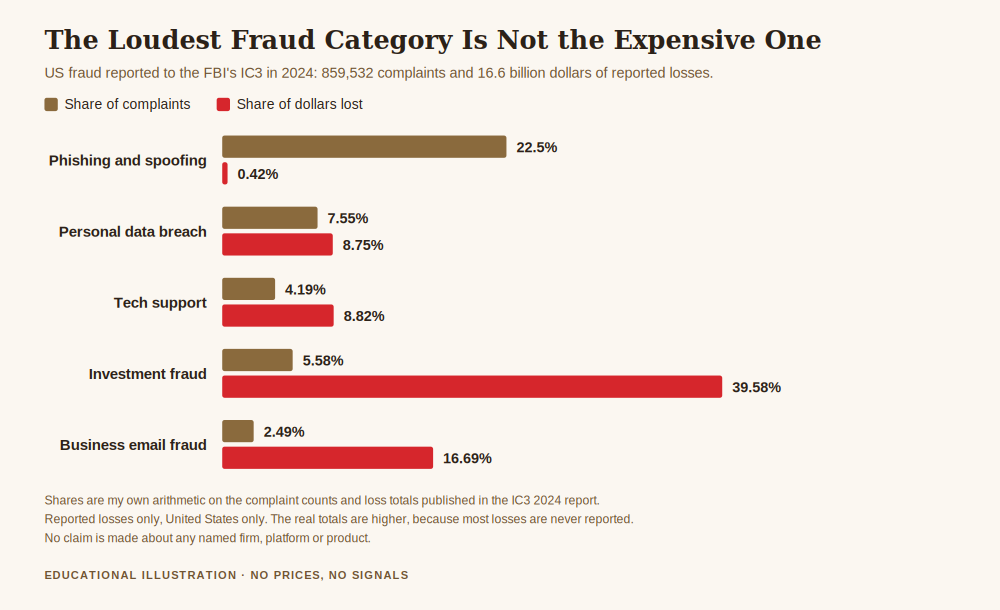
Phishing and spoofing generated 193,407 complaints, 22.50 percent of every complaint filed, and accounted for 70 million dollars, which is 0.42 percent of the money. Average loss per complaint: 362 dollars.
Investment fraud generated 47,919 complaints, 5.58 percent of the total, and accounted for 6,570,639,864 dollars, which is 39.58 percent of every dollar lost. Average loss per complaint: 137,120 dollars. That is 7.08 times the all crime average, and 379 times the average phishing loss.
Read that as an operator and it tells you where to spend your attention. The category everybody recognises, the clumsy email, the fake delivery notice, is the noisiest and the cheapest. The category that empties accounts is the one that arrives dressed as a business: a platform, a dashboard, an account manager, a statement. Those two facts are the same fact seen from two angles. The expensive fraud is expensive precisely because it does not look like fraud.
Seventy Six Percent of Confirmed Victims Did Not Know
Buried in the same report is the single most useful number I have seen on this subject, and it has nothing to do with how much was lost.
In January 2024 the FBI ran Operation Level Up, which used complaint data to identify people who were, at that moment, being defrauded through cryptocurrency investment platforms, and then contacted them to tell them. It notified 4,323 victims. Of those, 76 percent were unaware they were being scammed. The FBI puts the estimated savings to those victims at 285,639,989 dollars, about 66,074 dollars each.
Sit with that. These are not people who ignored warnings. These are confirmed victims, identified by federal investigators, and three quarters of them had to be told. Their own assessment of the platform, formed with full access to it, was wrong.
The operational conclusion is uncomfortable and clean: your confidence about a venue carries no information. It is not evidence, it is not a signal, and it does not scale with how carefully you looked at the website. This is exactly why a business runs a documented check on a counterparty instead of relying on the judgement of whoever happened to take the call. Not because that person is careless, but because the failure mode of human judgement here is silent.
The Second Failure Mode, Which Verification Does Not Touch
Suppose the check comes back clean. The firm is real, registered, and does what it says. What happens next is governed by an entirely different number.
When the European Securities and Markets Authority set its product intervention measures on 27 March 2018, it recorded that 74 to 89 percent of retail accounts typically lose money, with average losses per client running from 1,600 to 29,000 euros. Those were accounts at regulated firms inside the European perimeter. The verification question had already been answered for every one of them.
Put the two failure modes into one arithmetic. Assume, and this is an assumption of mine rather than a published figure, that one venue in twenty reached through an unsolicited approach is fraudulent. Out of 100 accounts opened that way, 5 end in fraud. Of the 95 that do not, ESMA's range says 70.3 to 84.6 lose money anyway. Total accounts ending down: 75.3 to 89.5 out of 100.
Run the check perfectly and you remove the 5. You are left with 74 to 89. The due diligence eliminated one failure mode entirely and moved the headline number by five points, because the other failure mode was always the larger one.
So the check is worth running, and it is nowhere near sufficient. Anyone who tells you that choosing a regulated broker is the safety step has sold you the smaller half.
The Check Itself, in the Order an Operator Would Run It
Here is the procedure. It takes about half an hour, it is the same every time, and none of it depends on how the firm presents itself.
Start at the regulator, not at the firm. Open the regulator's own register and search for the entity there. Do not follow a licence number or a link the firm supplied, because a cloned registration is a standard tactic and the number will check out against a real company that is not the one you are talking to. In the United States, futures and forex intermediaries appear in the National Futures Association's BASIC register, and the CFTC maintains a check before you invest page that includes its list of unregistered foreign entities. In the United Kingdom, the FCA register does the same job. Search by name, then confirm the website address on the register matches the one you are on, character for character.
Then check what happens to your money. A regulated firm holds client funds separately from its own and can tell you where. Ask which bank, under what arrangement, and what happens to your balance if the firm fails. A firm that answers this in one sentence, with a name in it, is a different proposition from one that answers with reassurance.
Then check the exit before you use the entrance. Read the withdrawal terms before the deposit terms. How long, to which account, at what cost, and under what conditions can it be refused. Then make the deposit route and the withdrawal route the same, in your own name. Money that arrives from a third party frequently cannot leave at all.
Then look at what the firm is rewarding. A bonus that converts into a withdrawal restriction, an account manager whose contact increases when you try to withdraw, pressure to add funds to unlock a level: these are not marketing, they are the business model showing through. The IC3 report describes the pattern for what it calls pig butchering exactly this way, a relationship first, then a platform where the balance grows and the withdrawal does not work.
Then write down what you found. A date, the register entry, the answers you got. Not for the firm's benefit. For the version of you in four months who is deciding whether to add to a losing position, and who will otherwise reconstruct the decision from memory and mood.
Get the free REX one page business plan, the sheet where the counterparty check, the cost base and the review date get written down while you are calm, so a decision made in enthusiasm has something to answer to. One email, no spam, unsubscribe anytime.
Get the free business plan →What the Half Hour Is Actually Worth
An operator would want the payoff written down, so here it is, with the assumption visible.
The average investment fraud complaint in the 2024 data reported a loss of 137,120 dollars. If the check takes half an hour and removes that outcome entirely, then on the one occasion in some number of accounts where the venue was fraudulent, that half hour returned 137,120 dollars. Even if only one account in a hundred you would ever open turned out to be fraudulent, the expected value of the half hour is 1,371 dollars, and it is the same half hour whether the account is small or large.
That last part is what makes it a policy rather than a judgement call. The cost of the check is fixed. The loss it prevents scales with the deposit. So the correct rule is not "check when the amount is large enough to be worth it", it is "check every time", because the only account where you would be tempted to skip it is the small first one, which is exactly the account a fraudulent venue uses to earn the larger second one.
Frequently Asked Questions
Is forex trading a scam?
The activity is not. Individual venues can be, and separately, most retail accounts lose money at venues that are entirely legitimate. ESMA recorded 74 to 89 percent of retail accounts losing money at regulated European firms. Treat "is it a scam" and "is it likely to work for me" as two different questions with two different answers.
How do I know if a forex broker is legit?
Find the entity on the regulator's own public register, not through anything the firm gave you, and confirm the website on the register matches the site you are using. Then confirm client money segregation, read the withdrawal terms before depositing, and fund only from an account in your own name.
The platform shows my balance growing. Is that proof it is real?
No, and this is the specific failure the FBI's Operation Level Up data speaks to. A displayed balance is a number the venue controls. Of 4,323 confirmed victims the FBI notified, 76 percent did not know they were being defrauded, and most of them were looking at a growing balance while it was happening. The test that matters is a completed withdrawal, not a screen.
Someone approached me on social media about a gold trading platform. What now?
Run the register check before any other step, and treat an unsolicited approach as the highest risk category rather than a normal one. The IC3 data puts investment fraud at 39.58 percent of all reported dollar losses in 2024, the largest single category by a wide margin, and the relationship first pattern is exactly what it describes.
Does a licence mean my money is safe?
It means a specific set of obligations applies, including segregation of client funds and, in some jurisdictions, negative balance protection and compensation arrangements. It does not mean the firm cannot fail and it says nothing about whether your trading will work. It removes one failure mode out of two.
Where did the numbers in this article come from?
The complaint counts, loss totals, category losses and the Operation Level Up figures are published by the FBI's Internet Crime Complaint Center in its 2024 annual report, linked above. The percentage shares, the average losses per complaint, the 7.08 and 379 multiples and the 100 account illustration are my own arithmetic on those published figures, using the assumptions stated in the text. The 74 to 89 percent retail loss range is ESMA's own. No gold price appears in this article, and no firm, platform or person is accused of anything here.
Where REX Fits
REX Trading Signal is free to follow. Daily XAUUSD setups with a stop loss, a reason and a rule, posted live on Telegram, wins and losses alike, plus an optional Kit for people who want the operating side written down. Nobody here promises a profit, because nobody honestly can.
Choosing who holds your money is a procurement decision, and procurement decisions belong in writing. The one page trading business plan template is the pillar this sits under, and the counterparty check belongs on it. Choosing a broker like a business partner takes the same decision further into the commercial terms, how to protect your account from hackers covers the risk that starts after the account is open and legitimate, and what happens if my brokerage account is hacked covers what recovery actually involves.
About the author. Rex writes REX Trading Signal. He is interested in the unglamorous half of this business, the costs, the controls and the review dates, on the view that the interesting half takes care of itself once the dull half is written down.
Disclaimer: This article is general educational content about counterparty due diligence. It is not financial advice, not legal advice, not a recommendation of any broker, platform or product, and not a solicitation to trade. No firm, platform or individual is accused of wrongdoing anywhere in this article, and no register or regulator named here endorses this article or its author. The complaint counts, loss totals, category figures and Operation Level Up results are published by the FBI's Internet Crime Complaint Center in its 2024 annual report and cover reported losses in the United States only, which makes them a floor rather than a total. The percentage shares, per complaint averages, multiples and the 100 account illustration are my own arithmetic on those published figures under the assumptions written out in the text; the one in twenty fraud rate is an assumption chosen to illustrate a method and is not a measurement of anything. The 74 to 89 percent retail loss range and the 1,600 to 29,000 euro average loss range are quoted from ESMA's product intervention measures of 27 March 2018 and describe retail CFD accounts in EU jurisdictions during that period. Registration requirements and investor protections differ by jurisdiction and change without notice, so confirm what applies to you with your own regulator. No gold price appears in this article. Trading gold, CFDs and leveraged products carries a high risk of losing money rapidly, and no entry, stop or target discussed should be treated as a signal. Readers should consider their own circumstances and speak to a licensed professional in their jurisdiction.